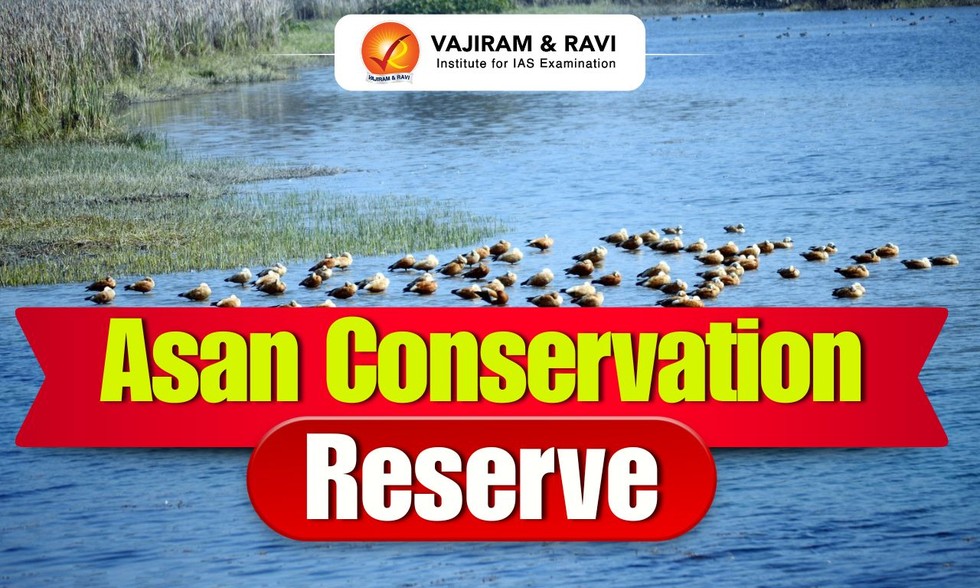
About Asan Conservation Reserve:
- It is located in the Dehradun district of Uttarakhand.
- It is situated at the confluence of the Asan and Yamuna Rivers.
- The Asan River, unlike other rivers which flow north to south, flows in a west to east direction.
- The reserve comprises the Asan Barrage and the wetland formed by damming the Asan River in 1967.
- The barrage created a freshwater reservoir with habitats ideal for migratory and resident birds.
- It was declared a Conservation Reserve in 2005 under Section 36A of the Wildlife (Protection) Act, 1972.
- It was declared a Ramsar site in 2020. It is the first Ramsar site in Uttarakhand.
- It is also listed as an Important Bird Area (BNHS and BirdLife International) and is popular for sightings of native and migratory birds.
- This biodiverse wetland lies strategically along the Central Asian Flyway, serving as a critical habitat for numerous migratory and resident species.
- It is home to 330 species of birds, including critically endangered-white-rumped vulture, Baer’s pochard; endangered-Egyptian vulture, steppe eagle, black-bellied tern; and vulnerable-marbled teal, common pochard, Indian spotted eagle, etc.
- The wetland is especially known for hosting large flocks of ruddy shelduck during winter.
- Among the fish, the endangered golden mahseer (Tor putitora) is particularly significant, as the wetland functions as an important feeding, migration, and spawning site.