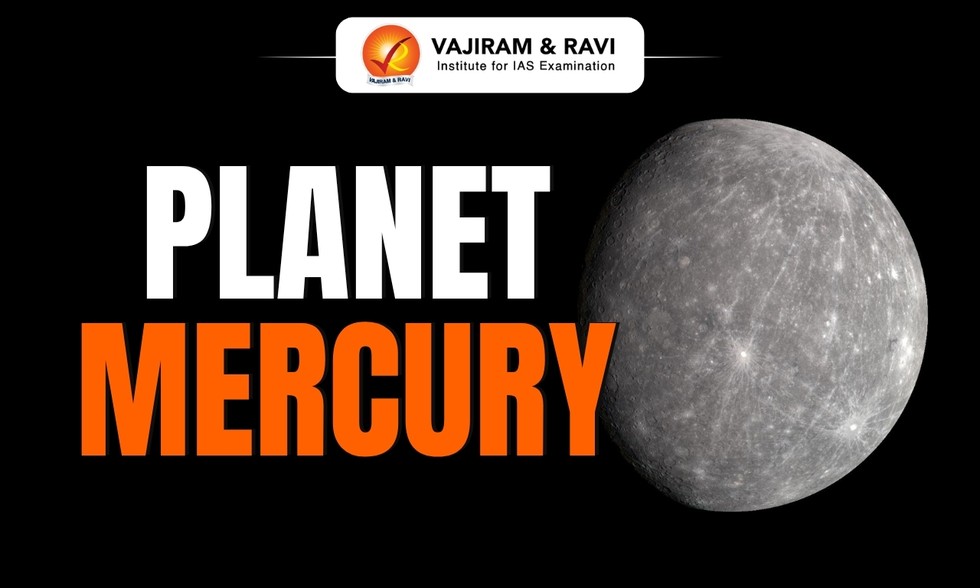
Mercury may have shrunk more than scientists previously estimated, with the planet’s diameter potentially reducing by as much as 23 km, a recent study has revealed.
About Planet Mercury:
It is the smallest planet in our solar system and the nearest to the Sun.
It is one of the four terrestrial (rocky) planets, along with Venus, Earth, and Mars.
As the closest planet to the Sun, it experiences extreme temperature variations at its surface, from about +450ºC (day) down to –180ºC (night).
However, Mercury is not the hottest planet; Venus has the highest average surface temperature because of its thick atmosphere and strong greenhouse effect.
It has permanently shadowed regions at its poles that never see sunlight and thus enables ice to exist on its floor.
Mercury’s ancient, cratered surface shows signs of past volcanic and tectonic activity and is heavily weathered by the harsh space environment.
The planet has huge impact basins, including the Caloris Basin, one of the largest impact features in the solar system.
Mercury has a large iron-rich core, which occupies a substantial portion of the planet's interior.
Its closeness to the Sun and its smallness make it the most elusive of the planets visible to the unaided eye.
NASA's MESSENGER spacecraft became the first spacecraft to orbit Mercury, entering orbit in 2011 and studying the planet until 2015.
The BepiColombo mission, a joint mission of the European Space Agency (ESA) and Japan Aerospace Exploration Agency (JAXA), is studying Mercury and is expected to enter orbit in 2026.
Dear Student,
You have still not entered your mailing address. Please enter the address where all the study materials will be sent to you. (If applicable).