
Lonar Lake
Lonar Lake has been recently included in the ‘Third 100 IUGS Geological Heritage Sites’, an international list recognising locations of outstanding scientific importance.
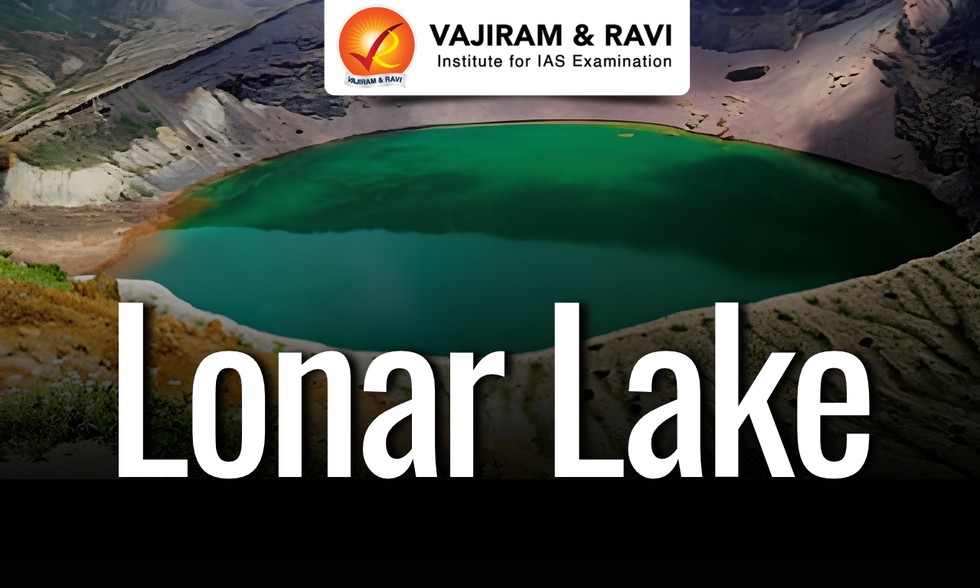
About Lonar Lake:
- Lonar Lake (also known as Lonar Crater) is situated in the Buldhana district of Maharashtra.
- It is less than 6 km in diameter and sits in a nearly circular bowl.
- It sits inside the Deccan Plateau—a massive plain of volcanic basalt rock leftover from eruptions some 65 million years ago.
- Its location in this basalt field suggested to some geologists that it was a volcanic crater.
- Scientists in the 1970s, however, confirmed the presence of maskelynite—a naturally occurring glass that is only formed by extremely high-velocity impacts.
- It is believed to have been created around 52,000 years ago when a high-velocity meteorite struck the basaltic Deccan Plateau.
- This impact led to the formation of a nearly circular depression, which gradually transformed into a saline and alkaline lake.
- It is the only known impact crater lake in basaltic rock in the world.
- It is the only known saline crater lake in the world. Its water is seven times saltier than seawater due to the presence of basalt rock.
- The basin is surrounded by steep slopes. It has several springs around the lake that supply water to the lake.
- It has several vents around the lake that release gases such as methane, carbon dioxide, hydrogen sulphide, etc.
- One of the most striking aspects is its color, which changes from green to pink depending on the season and the water conditions.
- This is caused by the presence of microorganisms that thrive in the saline and alkaline environment of the lake.
- Apart from its scientific importance, Lonar also has a rich historical and cultural heritage.
- The region has been mentioned in ancient scriptures, such as the Skanda Purana and the Ain-i-Akbari.
- The area surrounding the crater is home to centuries-old temples built during the Chalukya and Hemadpanti eras, showcasing stunning architectural craftsmanship and religious significance.
- It was already recognized as a Ramsar Site and a National Geological Heritage Monumen
- With the latest recognition, Lonar Lake moved closer to becoming a UNESCO World Heritage Site.
Key Facts about IUGS Geological Heritage Sites:
- IUGS Geological Heritage Sites are recognised by the International Union of Geological Sciences (IUGS) for their outstanding scientific value as exceptional examples of geological features, processes and discoveries.
- With 74 active national members, IUGS is one of the World´s largest scientific organisations.
- It encourages international cooperation and participation in the Earth sciences in relation to human welfare.
- They represent some of the world’s most significant places for understanding the Earth and its history.
- Located across the globe, they offer a surprising journey through the most important geological sites of the Earth.
- The selection of the Third 100 builds on the success and global impact of the First 100, announced in Zumaia, Spain, in 2022, and the Second 100, announced during the 37th International Geological Congress (IGC 2024) in Busan, Republic of Korea.
- Third 100 Geological Heritage Sites was announced at a IUGS Geoheritage Event, Algarve, Portugal.
- They are distributed across 47 countries and include 11 sites in Africa, 22 in the Americas, 22 in the Asia-Pacific region, 6 in the Middle East, 34 in Europe, 2 in Antarctica, and 3 in the High Seas.
- This list of geographical wonders include the Fjords of Norway, the San Andreas Fault in the US, Chocolate Hills in the Philippines and Mount Fuji in Japan.
Source: Maharashtra's Lonar Lake included in ‘Third 100 IUGS Geological Heritage Sites’