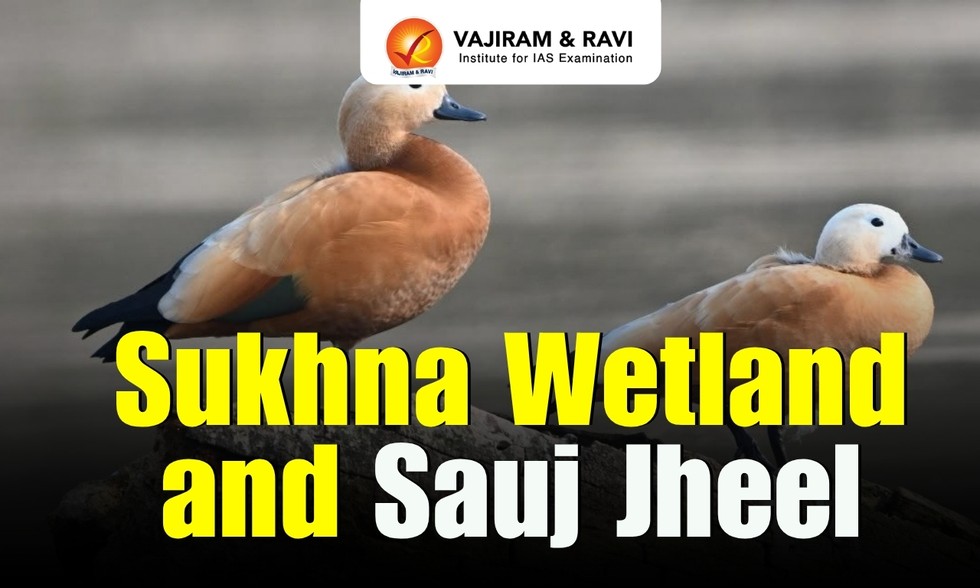
Recently, India has added Sukhna Wetland and Sauj Jheel to the List of Wetlands of International Importance, bringing its total number of “Ramsar Sites” to 103.
About Sukhna Wetland:
Location: It is located in Chandigarh and at the base of the Outer Himalayas.
It is a peri-urban reservoir that plays an important role in regulating sediment and water flows from the surrounding catchment.
It supports a range of habitats, from open water to littoral vegetation, scrub and forest, providing habitat for diverse species.
It is particularly important for resident waterbirds and others migrating along the Central Asian Flyway, providing feeding, breeding, roosting and wintering habitats.
Fauna: Notable species include the vulnerablecommon pochard (Aythya ferina) and the endangeredPallas’s fish eagle(Haliaeetus leucoryphus). The shallow littoral habitats also support reptiles such as the endangered black pond turtle (Geoclemys hamiltonii).
About Sauj Jheel:
Location: It is located in Uttar Pradesh.
It is a shallow lake surrounded by farmland in the floodplain of the Ganga River.
It forms part of a larger network of wetlands, contributing to ecological connectivity in the wider landscape, and is close to Saman Bird Sanctuary.
Vegetation: The lake supports diverse wetland-associated vegetation, including the sacred lotus (Nelumbo nucifera) and the wild sugarcane (Saccharum spontaneum).
Fauna: Notable waterbird species recorded at the Site include the vulnerable sarus crane (Grus antigone) and greater spotted eagle (Clanga clanga).
Dear Student,
You have still not entered your mailing address. Please enter the address where all the study materials will be sent to you. (If applicable).