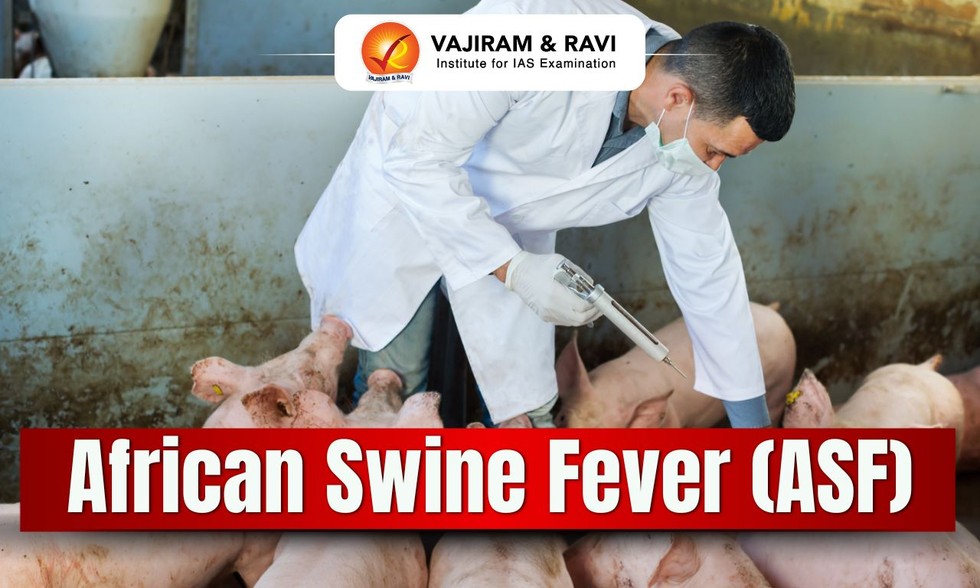
About African Swine Fever (ASF):
- It is a highly contagious viral disease affecting pigs and wild boar.
- It is caused by the African Swine Fever Virus (ASFV), a DNA virus from the Asfarviridae family.
- Characterised by high fever, haemorrhages, and mortality rates that may approach 100 percent, the disease has caused severe socio-economic losses to the global pig farming sector.
- The disease does not infect humans (not zoonotic) or other livestock species.
- Global Distribution:
- Originally found throughout sub-Saharan Africa, ASF is now prevalent in many countries in Europe, Asia, and Africa.
- India notified the first outbreak of the ASF virus in 2020 in the Northeastern States of Assam and Arunachal Pradesh.
- Since its first detection in India, ASF has spread to several States and Union Territories.
- Transmission:
- The virus is highly resistant in the environment, meaning that it can survive on clothes, boots, wheels, and other materials.
- It can also survive in various pork products, such as ham, sausages, or bacon.
- Therefore, human behaviours can play an important role in spreading this disease.
- Infection can occur through direct contact between infected pigs or boars but also, for example, through soft ticks in (sub)tropical regions or through contaminated materials or contaminated feed.
- Treatment: Currently, there is no treatment available against ASF, so prevention by adopting strict biosecurity measures, such as culling the animals, is the only way to prevent ASF.
- Prevention:
- A couple of commercially licensed ASF vaccines are available in Vietnam.
- ICAR–National Institute of High Security Animal Diseases (ICAR-NIHSAD), Bhopal, recently developed India's first indigenous MA-104_Cell_Line-Based Live Attenuated ASF vaccine for pigs.