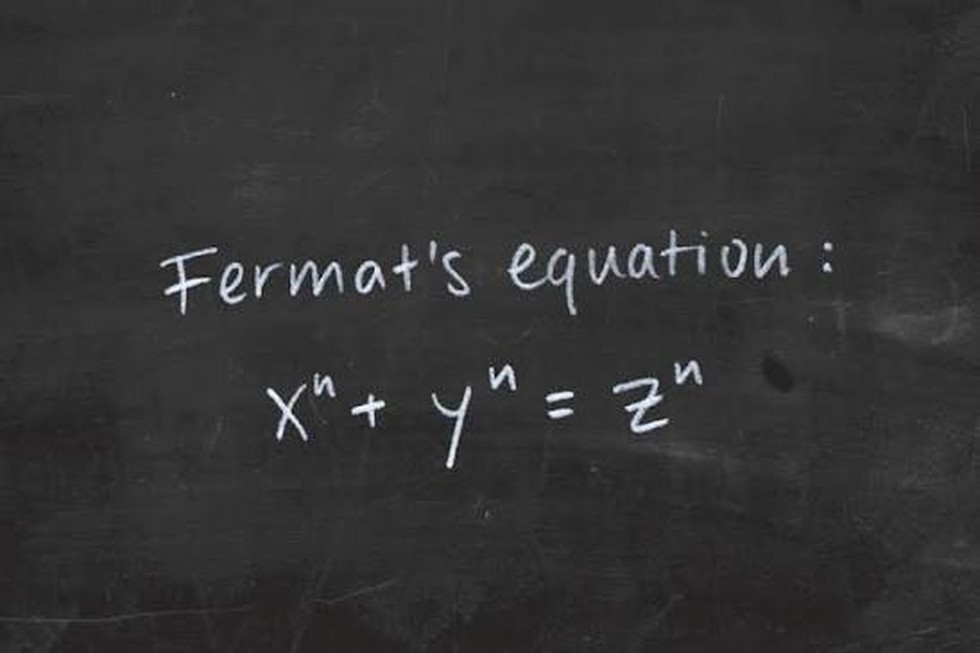
About Fermat’s Last Theorem:
- It is a famous mathematical statement proposed by Pierre de Fermat in 1637 claiming that the equation x^n + y^n = z^n has no integer solutions for n > 2.
- This conjecture was noted in the margin of Fermat's copy of "Arithmetica," an ancient Greek text on number theory, where he famously stated that he had a proof too large to fit in the margin.
- While solutions exist for n = 1 and n = 2 (known as linear and Pythagorean equations, respectively), the case for (n > 2) remained unsolved for over 350 years, making it one of the most significant unsolved problems in mathematics.
- The eventual proof was provided by mathematician Andrew Wiles in 1995, utilizing concepts from the modularity theorem for elliptic curves.
- Wiles's work built on earlier contributions from mathematicians like Gerhard Frey and Ken Ribet, who connected concepts related to elliptic curves and Fermat's conjecture.
- The theorem has not only resolved a long-standing mystery in mathematics but has also spurred advancements in areas such as algebraic number theory and the study of Diophantine equations.