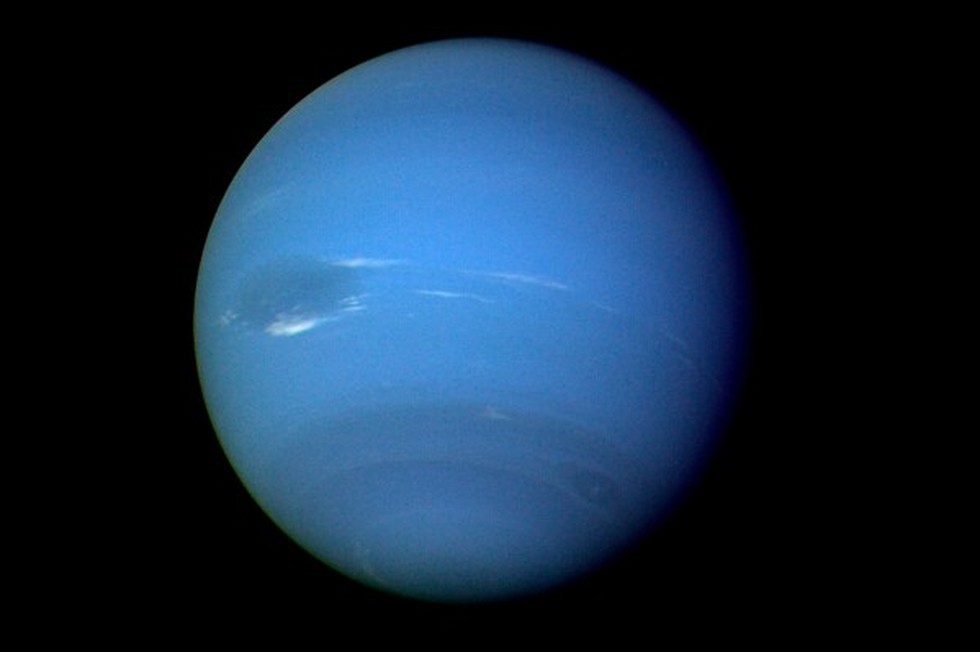
New observations from the James Webb Space Telescope suggest that Nereid may not have originated from the Kuiper Belt, as its crystalline water ice and unique spectral signature differ from known Kuiper Belt objects.
About Nereid:
It is the third-largest moon of Neptune.
It was discovered by Dutch astronomer Gerard Kuiper, who named the moon after the sea nymphs in Greek mythology.
It is unique because it has one of the most eccentric orbits of any moon in our solar system.
It is so far from Neptune that it requires 360 Earth days to make one orbit.
Like so many other moons in the outer solar system, Nereid was long suspected of migrating to Neptune's neighborhood from the Kuiper Belt.
But using the Webb telescope, scientists determined that Nereid’s composition was inconsistent with Kuiper Belt objects — it had too much ice.
That suggests it was part of Neptune's system all along.
What is the Kuiper Belt?
It is a large, doughnut-shaped cold region of icy bodies located in the outer reaches of our solar system beyond the orbit of Neptune.
It's sometimes called the "third zone" of the solar system.
It is similar to the main asteroid belt, found between Mars and Jupiter, in that its objects are composed of material leftover from the formation of the solar system around 4.6 billion years ago.
However, it is far larger than the main asteroid belt, up to 20 times as wide and 20 to 100 times its mass.
Like the asteroid belt, it has also been shaped by a giant planet, although it's more of a thick disk (like a donut) than a thin belt.
The icy bodies in the Kuiper Belt are called "Kuiper Belt Objects", or KBOs for short. Pluto is the best-known KBO.
In addition to rock and water ice, objects in the Kuiper Belt also contain a variety of other frozen compounds like ammonia and methane.
Dear Student,
You have still not entered your mailing address. Please enter the address where all the study materials will be sent to you. (If applicable).