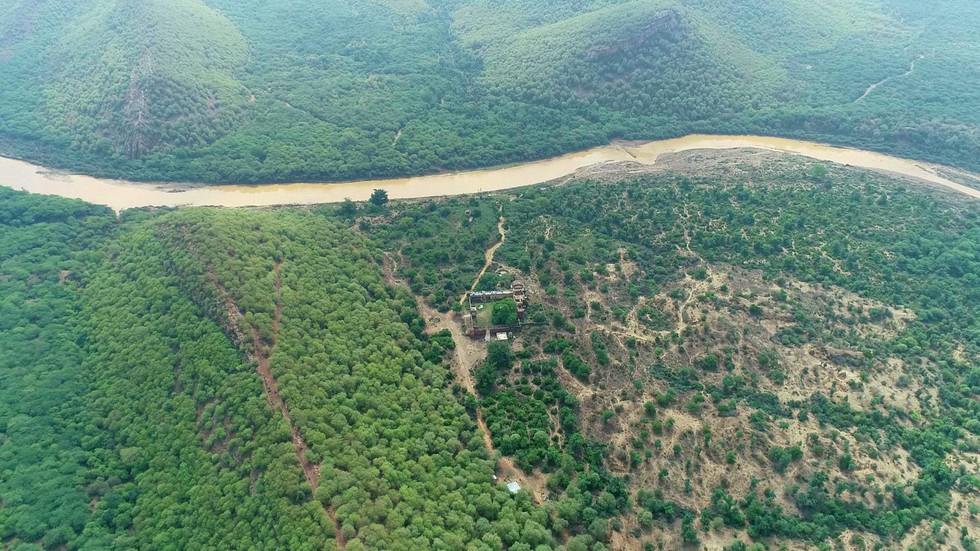
About Ramgarh Vishdhari Tiger Reserve (RVTR):
- It is located in Rajasthan’s Bundi district.
- Spread over 1,501.89 sq.km., the reserve has a 481.90 sq.km. core area and a 1,019.98 sq.km. buffer zone.
- It is strategically positioned to serve as a crucial corridor between the Ranthambore Tiger Reserve to the northeast and the Mukundara Hills Tiger Reserve to the south.
- It was notified as a tiger reserve on May 16, 2022.
- The Mez River, a tributary of the Chambal River, meanders through the reserve.
- The reserve’s topography is characterized by the rugged terrains of the Aravalli and Vindhyan mountain ranges, interspersed with valleys and plateaus.
- Vegetation: Dry Deciduous Forest
- Flora:
- The habitat is dominated by Dhok (Anogeissus pendula) trees.
- Other important flora includes Khair, Ronj, Amaltas, Gurjan, Saler, etc.
- Fauna:
- The area is dominated by leopards and sloth bears.
- Other important fauna include the Jungle cat, Golden jackal, Hyaena, Crested Porcupine, Indian Hedgehog, Rhesus macaque, hanuman langur, etc.
Key Facts about Pench Tiger Reserve (PTR):
- It is located in the southern reaches of the Satpura hills in the Seoni and Chhindwara districts in Madhya Pradesh and shares the southern boundary with Maharashtra.
- It is named after the Pench River, meandering through the reserve from north to south.
- It comprises the Indira Priyadarshini Pench National Park, the Pench Mowgli Sanctuary, and a buffer.
- The area of the PTR and the surrounding area is the real story area of Rudyard Kipling’s famous “The Jungle Book”.
- Vegetation: The undulating topography supports a mosaic of vegetation ranging from a moist sheltered valley to an open, dry deciduous forest.
- Flora:
- The reserve boasts a diverse range of flora, including teak, saag, mahua, and various grasses and shrubs.
- Teak forests are found in about one quarter of the area.
- Fauna:
- The area is especially famous for large herds of Chital, Sambar, Nilgai, Gaur (Indian Bison), and wild boar.
- The key predator is the tiger, followed by the leopard, wild dogs, and wolf.
- There are over 325 species of resident and migratory birds, including the Malabar Pied Hornbill, Indian Pitta, Osprey, Grey Headed Fishing Eagle, White Eyed Buzzard, etc.