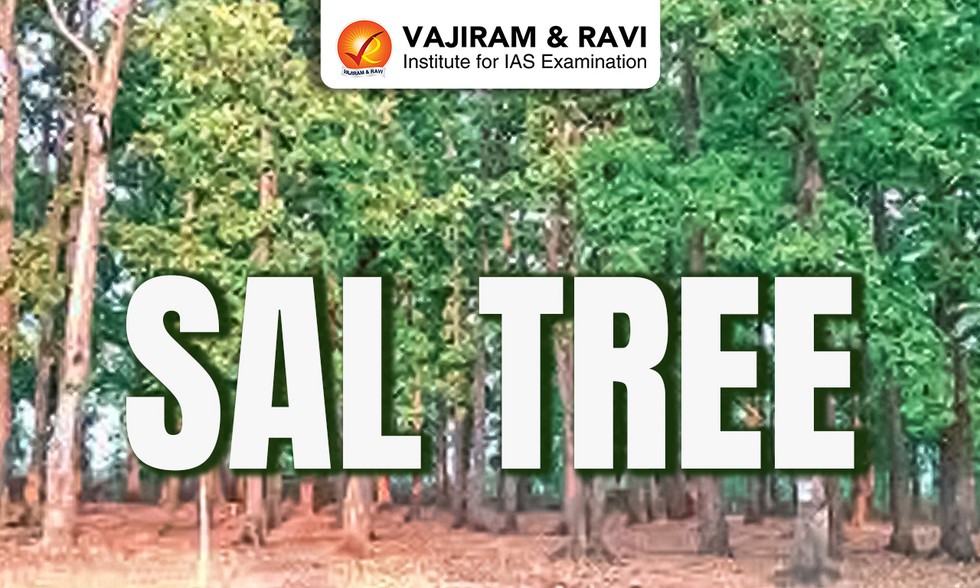
About Sal Tree:
- It is one of the oldest and strongest trees found in India.
- It's called the ‘Sentinel of the Forests’ because it can live for dozens of years and has the ability to withstand environmental changes.
- Distribution: It is also found naturally in Uttarakhand, Terai region of Uttar Pradesh, Jharkhand, Odisha, Madhya Pradesh, Chhattisgarh and West Bengal.
- Required climatic Conditions for Sal Tree:
- Temperature: It can tolerate temperatures as high as 40-45°Celcius in summers and as low as 5°Celcius in winters.
- Soil: It can be grown in the plains, provided there is light loamy soil with good drainage and the area receives approximately 1000 mm - 3000 mm of annual rainfall.
- Climate: It requires a warm and humid climate and can thrive at altitudes up to 1500 metres above the sea level.
- This tree can live up to 100 years and doesn't require frequent watering or care.
- It's especially suitable for hilly areas.
How can Sal Trees control Pollution?
- Dust and Particle Trapping: Its leaves are thick and waxy that can trap dust, carbon and fine particles in the air on their surface.
- Air Purification: It has a higher chlorophyll content which gives it the strength to withstand harmful gases such as carbon monoxide and sulphur dioxide present in vehicle exhaust.
- Natural Filter: It also has a very dense canopy that acts as a natural filter while trapping pollutants in the air.