Context:
- India recently hosted the 18th BRICS Summit in New Delhi, in September 2026. It was a success.
- Now, PM Narendra Modi plans to visit Canada and Brussels in December. India expects to sign formal Free Trade Agreements (FTAs) during these visits. This shows India is steadily building its global economic presence.
- This article highlights the challenges facing India’s inbound investment framework, examining why rising FDI commitments do not always translate into actual capital deployment.
The Headline Numbers
- India’s investment trajectory has genuinely improved:
- RBI data: Gross inward FDI reached a record $94.8 billion in FY26.
- UNCTAD’s World Investment Report 2026: India ranks 11th among the world’s top FDI destinations, following a 44% rise in inflows.
The Global Lag, Reflected in India
- Despite the headline growth, UNCTAD’s report reveals that globally, international project finance remains roughly a quarter below its 2021 peak — a trend India mirrors.
- Case in point — greenfield data centre investments (a focal sector across economic partnerships):
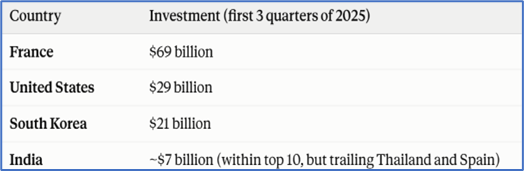
- This raises the central question: what creates the lag between committed investment and its actual deployment in greenfield projects?
The Real Negotiation Is Internal
- Investors believe incremental reform can ease this lag. Crucially, the remaining negotiations are often internal — between the Centre and States, between DPIIT and line Ministries, or between central rules and State notifications needed to enforce policy.
- Resolving these bottlenecks would benefit domestic enterprises as much as foreign investors.
Judicial Bottlenecks
- Commercial dispute resolution has improved but remains strained:
- India’s courts had nearly 48 million pending cases as of April 2026, including about six million in High Courts.
- Reforms like the Commercial Courts Act, 2015 and the Mediation Act, 2023 have helped. As a result, when companies write contracts now, they increasingly choose institutional arbitration as their standard method for resolving disputes.
- Smaller enterprises, however, still rely heavily on courts — making better staffing of commercial benches and mediation centres essential to reducing resolution times.
The Labour Codes: A Case Study in Fragmentation
- Parliament’s consolidation of 29 central labour laws into four codes was a legislative milestone, with Central Rules notified in May 2026.
- But since labour sits on the Concurrent List, implementation depends on State notifications.
- Gujarat moved swiftly, notifying rules under all four codes.
- Other industrial states are still finalising theirs.
- For enterprises designing national HR frameworks, this creates a messy transitional phase of varied state timelines.
Progress on Tax Certainty
- The Taxation Laws (Amendment) Act, 2021 effectively ended the ghost of retrospective tax disputes, withdrawing outstanding demands against entities like Vodafone and Cairn Energy.
- The relaunched Vivad se Vishwas scheme has helped reduce the broader direct-tax litigation backlog.
Compliance Recalibration: The QCO Example
- Mandatory BIS certification under Quality Control Orders (QCOs) was designed to protect consumers, but the framework expanded extensively.
- The Gauba Committee found QCOs had grown from fewer than 70 to nearly 790, covering raw materials and intermediate goods.
- For imported components, compliance costs rose to ₹20 lakh, with six- to eight-month certification timelines disrupting domestic MSME supply chains.
- Government response: QCOs were withdrawn on critical intermediate goods, including PVC, aluminium and zinc, providing relief to manufacturers.
Trade Pacts and Investor Protection Gaps
- India’s modern trade agreements now introduce binding investment targets:
- The EFTA agreement sets a historic $100-billion target, but investor-protection mechanisms remain a work in progress.
- The India-EFTA TEPA lacks an independent bilateral investment dispute mechanism.
- Switzerland is separately negotiating a bilateral investment treaty, which could inform future negotiations with the EU and UK.
Approval Speed: Still Uneven
- DPIIT is the nodal agency, but not the final decision-maker on approvals.
- A revised SOP issued in May 2026 sets a 12-week deadline, but compliance remains uneven.
- Positive example: Large-scale projects like Tata Electronics’ semiconductor facility in Dholera, Gujarat, show how effective administrative coordination can accelerate capital deployment.
Reform Lessons from Past Successes
- External Benchmark — Singapore’s CECA: Has facilitated over $195 billion in cumulative FDI since 2000, including $19.8 billion last year. Its non-discrimination and investor-protection frameworks offer a useful blueprint for India’s treaty negotiations.
- Domestic Benchmark — the mobile-phone industry: Demonstrates the potential of coordinated policy:
- Production grew 33-fold since FY15 — from ₹180 billion to ₹6.27 trillion.
- Exports reached ₹2.59 trillion.
- India is now the world’s second-largest mobile-phone manufacturer by volume, meeting 99.2% of domestic demand through local production.
Conclusion
- India’s rise to the 11th-largest FDI destination and the world’s second-largest mobile-phone manufacturer shows real resolve in tackling internal bottlenecks.
- But the mobile-phone success and the stalled labour-code rollout sit side by side as proof that coordination, not capital, is now India’s binding constraint.
- The next phase of reform will be won or lost less in trade negotiating rooms abroad and more in the everyday friction between Central rules and State notifications at home.

