
Gold Prices in 2026 - Reasons for the Fall and Future Outlook
Why in the News?
- Gold prices in the Delhi market declined by approximately 25% between February 28 and November 20, 2026, prompting concerns among investors and prospective buyers about the reasons behind the correction and the possibility of further declines.
What’s in Today’s Article?
- Gold Prices (Recent Trends, Sources of Gold Demand, Reasons for Fall in Gold Prices, Future Outlook, etc.)
Recent Trend in Gold Prices
- Gold prices in India have witnessed a sharp correction in 2026 after an exceptional rise over the preceding four years.
- According to Google Finance data, the price of 24-carat gold in Delhi declined from 1,70,305 per 10 grams on February 28, 2026, to Rs. 1,26,875 on November 20, 2026.
- However, the decline needs to be viewed against the preceding rally:
- February 26, 2022: Rs. 51,715 per 10 grams.
- February 24, 2024: Rs. 64,185 per 10 grams.
- February 28, 2026: Rs. 1,70,305 per 10 grams.
- November 20, 2026: Rs. 1,26,875 per 10 grams.
- Gold prices had increased by approximately 165% in the two years preceding February 2026 and 230% over four years.
- Even after the recent correction, prices remained approximately 145% higher than in February 2022 and 98% higher than in February 2024.
- This indicates that the 2026 decline represents a correction following an extraordinary price rally rather than a complete reversal of the earlier gains.
Major Sources of Global Gold Demand
- According to the World Gold Council, global net annual demand for gold averages approximately 3,200 tonnes, driven by four major sources:
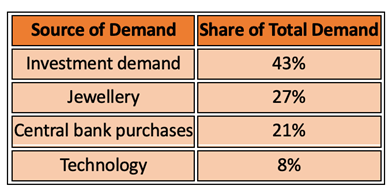
- Gold is distinct from conventional financial investments because it does not generate regular income through interest or dividends.
- Its primary investment value lies in its ability to act as a store of value and protect purchasing power during periods of inflation and economic uncertainty.
- For instance, inflation reduces the purchasing power of money over time. Gold has historically helped investors preserve value because its price has generally risen during periods of sustained inflation and uncertainty.
- World Gold Council data since 1971 indicates that gold prices have outperformed both US and global consumer price indices over the long term.
Reasons for Fall in Gold Prices in 2026
- Higher Interest Rates Reduce Gold's Attractiveness
- Gold does not generate interest or regular income. Consequently, when interest rates rise, investors have greater incentives to shift towards interest-bearing financial instruments such as government bonds.
- This creates an inverse relationship between interest rates and the attractiveness of gold as an investment.
- Higher interest rates can therefore reduce investment demand for gold and put downward pressure on its prices.
- Changing Inflation Expectations
- Gold is traditionally considered a hedge against inflation. When investors expect inflation to remain elevated, demand for gold generally increases as they seek to protect their purchasing power.
- However, expectations of tighter monetary policy and higher interest rates have strengthened the belief that inflation could be brought under control.
- This change in inflation expectations has further weakened demand for gold.
- The trend is not limited to the US Federal Reserve. Other major central banks, including the Bank of Japan and the European Central Bank, have also moved towards higher interest rates.
Factors That Drove the Earlier Gold Price Rally
- The sharp rise in gold prices before February 2026 was supported by four major factors.
- Rising Government Borrowing: Heavy borrowing by governments of major economies increased concerns about fiscal sustainability and future inflation. These concerns strengthened gold's appeal as a store of value.
- Persistent Inflation: Both headline inflation and core inflation remained above target levels in several major economies. Core inflation excludes the effects of volatile food and fuel prices, helping assess underlying price pressures.
- Geopolitical Uncertainty: Wars, international tensions and geopolitical instability increased demand for gold as a safe-haven asset. During periods of uncertainty, investors often shift towards gold to protect their wealth.
- Central Bank Purchases: Central banks have remained net buyers of gold since the 2008 global financial crisis. Their purchases have provided sustained support to global gold demand and prices.
Future Outlook for Gold Prices
- The future direction of gold prices will depend on the interaction between monetary policy and the broader economic and geopolitical environment.
- Rising interest rates are likely to exert downward pressure on gold prices by increasing the attractiveness of alternative investments.
- However, several factors could continue supporting gold demand:
- Government borrowing: Continued high levels of public debt and borrowing could sustain concerns about inflation and financial stability.
- Geopolitical uncertainty: International conflicts and geopolitical tensions may continue to support safe-haven demand.
- Central bank purchases: Central banks may resume or increase gold purchases as prices moderate, maintaining a source of structural demand.
- Inflation trends: Any renewed increase in inflation could strengthen gold's appeal as a hedge against declining purchasing power.
- Therefore, the possibility of further price declines cannot be ruled out. However, the continuation of central bank purchases, geopolitical uncertainty and concerns over government borrowing could limit the extent of the correction.