Why in news?
The Supreme Court began hearing a long-pending reference on the scope of legislative privileges — the special powers and immunities enjoyed by Parliament and state legislatures to protect their functioning.
The central question: can these privileges, under Articles 105 and 194 of the Constitution, be invoked against citizens and journalists, and can they override fundamental rights like freedom of speech under Article 19?
A seven-judge Constitution Bench, headed by Chief Justice of India Surya Kant, is hearing the matter.
What’s in Today’s Article?
- The Legal Framework at Stake
- How the Case Began: Tamil Nadu, 2003?
- Why a Reference Was Needed: Two Conflicting Precedents?
- The Evolving Judicial Trend
- What the Petitioners Argue?
The Legal Framework at Stake
- Article 194(3): Grants state legislatures certain privileges and immunities to protect their functioning (Article 105 does the same for Parliament).
- Article 19(1)(a): Guarantees freedom of speech and expression, including press freedom.
- The case turns on how these two rights interact. The petitioners argue privilege exists "to protect the functioning of the House, not to shield it from scrutiny."
- Liberty angle: Petitioners also invoke Article 14 (equality) and Article 21 (right to life), arguing that when legislatures order arrest or imprisonment for alleged "breach of privilege," this affects personal liberty.
- Any such action must satisfy constitutional guarantees of fairness, due process, and protection against arbitrariness.
How the Case Began: Tamil Nadu, 2003
- In 2003, The Hindu newspaper reported on sharp exchanges between the then Tamil Nadu CM J Jayalalithaa and the Opposition in the Assembly.
- The then Speaker K Kalimuthu objected, calling the reports "contrary to truth" and referring them to a Privileges Committee.
- The controversy escalated after The Hindu published an editorial titled Rising Intolerance.
- It criticised crude use of state power against various sections including political opponents and the independent media as showing "contempt for the democratic spirit."
- The editorial stated that legislative privilege exists to protect its free and independent functioning and not to protect the reputation of the government or of individual members.
- The outcome: The Tamil Nadu Assembly held journalists guilty of gross contempt and breach of privilege, sentencing them to 15 days' imprisonment and issuing arrest warrants. Police teams were deployed across Tamil Nadu, Karnataka and Delhi to execute them.
- The journalists approached the Supreme Court, which immediately stayed the warrants and referred the matter to a Constitution Bench, noting "substantial questions of law as to the interpretation of Articles 194(3) and 19(1)(a)" were involved.
Why a Reference Was Needed: Two Conflicting Precedents
- Pandit M.S.M. Sharma v. Sri Krishna Sinha (1959) — the "Searchlight case"
- A 4:1 majority held that Assembly privileges under Article 194(3) included the power to prohibit publication.
- Since Article 19(1)(a) is a general provision and Article 194(3) a special provision, the Court held free speech must yield to legislative privilege.
- It stated that even if the petitioner were deprived of personal liberty through Privileges Committee proceedings, this would be "in accordance with procedure established by law" — no breach of Article 21.
- Special Reference No. 1 of 1964 — Keshav Singh's Case
- Here, the UP Assembly jailed a citizen, Keshav Singh, for distributing pamphlets accusing an MLA of corruption.
- When the Allahabad High Court granted interim bail, the Assembly ordered the two judges, the lawyer, and Keshav Singh himself be brought before the House in custody. The President referred the dispute to the Supreme Court.
- A seven-judge bench held:
- Constitutional courts could examine the legality of detention ordered in privilege proceedings.
- Legislatures could not proceed against judges and lawyers for performing their duties.
- These two rulings created the doctrinal conflict the current seven-judge bench must now resolve.
The Evolving Judicial Trend
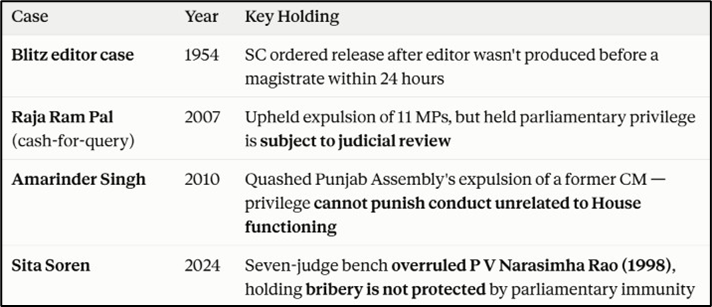
- This trajectory shows the Court steadily narrowing the scope of unchecked legislative privilege over the decades.
What the Petitioners Argue?
- The Assembly's action violated free speech, personal liberty, and natural justice.
- Honest and courageous reporting by the press is the bedrock of parliamentary democracy," and journalists cannot function in an atmosphere of fear and terror.
- Legislative privileges are subject to Article 21; allowing a legislature to deprive someone of liberty by mere passing of a resolution would be "an anathema to the Constitution.
- Privilege protects the House's functioning, not the government — there is no concept of any parliamentary privilege being applicable to a Chief Minister... or to a government, and privilege is not intended to protect the fame and reputation of the ruling party.
Conclusion
Two decades after a Tamil Nadu editorial landed journalists in jail, the question it raised finally returns to a seven-judge Bench: does legislative privilege exist to protect debate, or to protect legislators from criticism?
The Court's own trajectory — from Searchlight's deference to Keshav Singh's limits, through Raja Ram Pal's judicial review to Sita Soren's rejection of bribery immunity — suggests privilege is no longer presumed absolute.
How this case resolves that tension will shape not just press freedom, but the basic boundary between legislative self-protection and constitutional accountability.

