Why in news?
The latest report of the 16th Finance Commission, tabled in Parliament on February 1, highlights renewed support and strengthened financial backing for urban local governments.
What’s in Today’s Article?
- 16th Finance Commission: Overview and Key Recommendations
- 16th Finance Commission Boosts Urban Local Governments
- Rising Urbanisation and the Need for Greater Urban Funding
- 16th FC’s Financial Cushion
16th Finance Commission: Overview and Key Recommendations
- The 16th Finance Commission, chaired by Dr. Arvind Panagariya, submitted its report for the period 2026–27 to 2030–31, tabled in Parliament on February 1, 2026.
- The Commission has recommended that 41% of the divisible pool of central taxes be devolved to states — the same share as recommended by the 15th Finance Commission.
- The divisible pool excludes the cost of tax collection and revenues from cesses and surcharges.
- Criteria for Devolution Among States
- To distribute central taxes among states, the Commission uses a formula assigning weightage to specific parameters.
- Income Distance: Reduced from 45% to 42.5%
- Population (2011): Increased from 15% to 17.5%
- Demographic Performance: Reduced from 12.5% to 10%
- Area: Reduced from 15% to 10%
- Forest Cover: Retained at 10%
- Tax and Fiscal Effort: Removed (earlier 2.5%)
- Contribution to GDP: Newly introduced at 10%
16th Finance Commission Boosts Urban Local Governments
- The Finance Commission (FC) is a constitutional body that recommends how tax revenues should be shared between the Centre and states.
- Reconstituted every five years, it also provides grants to local governments.
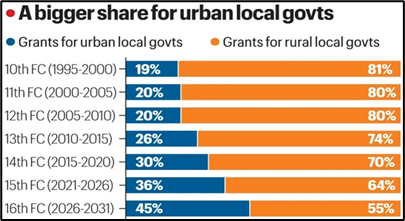
- Since the 10th FC — after the introduction of urban local bodies and panchayats as the third tier — such grants have been a regular feature.
- The 16th Finance Commission has significantly raised the share of grants for urban local governments to 45%, up from 36% under the 15th FC and 26% under the 13th FC.
- In absolute terms, it has recommended ₹3.56 lakh crore for urban local bodies — more than double the 15th FC’s ₹1.55 lakh crore and nearly 15 times the allocation of the 13th FC (post-2011 Census).
- These allocations determine the financial capacity of the lowest tier of government to address local infrastructure, service delivery, and grassroots governance challenges as India’s urban population continues to grow.
- Uneven Distribution Across States
- Grants are distributed according to the 16th FC’s population-based formula, resulting in varied outcomes for states.
- Kerala’s allocation increased by over 400%.
- Maharashtra saw a rise of over 300%.
- Odisha’s allocation grew by only 13%.
- Bihar experienced an 8% reduction.
Rising Urbanisation and the Need for Greater Urban Funding
- The 16th Finance Commission’s higher allocation to urban local bodies acknowledges India’s projected urbanisation level of 41% by 2031.
- With each decade, a larger share of India’s population is moving to cities, increasing the demand for stronger urban governance.
- Data Gaps and Policy Challenges
- The 2011 Census recorded 31% of Indians living in urban areas — lower than countries like China (45%), Indonesia (54%) and Brazil (87%).
- However, other estimates vary widely. A 2015 World Bank report suggested that 54% lived in cities and another 24% in urban clusters, pointing to significant discrepancies. Rapid migration trends further complicate accurate measurement.
- Inconsistent data hampers effective policy planning and resource allocation. Urban local bodies are particularly affected due to uncertain funding projections.
16th FC’s Financial Cushion
- The increased 45% share for urban bodies is seen as a buffer against future demographic revisions.
- If Census 2027 data shows higher urbanization — say 48% — the enhanced allocation would prevent urban governments from being financially underprepared, unlike earlier cycles when allocations were lower (36% or 26%).
- The 16th Finance Commission’s recommendations reflect India’s accelerating urban transition, though variations in state-level allocations highlight ongoing complexities in balancing demographic trends and fiscal federalism.

