Why in the News?
- The Union Cabinet has approved a major revision to the Agnipath scheme, offering 75% of Agniveers an additional two-year engagement and an opportunity to join the Armed Forces as regular soldiers, subject to eligibility and selection criteria.
What’s in Today’s Article?
- Agnipath Scheme (Original Framework, Major Changes, Enhanced Benefits, Govt’s Rationale, Implications, etc.)
Understanding the Agnipath Scheme
- The Agnipath scheme was introduced in 2022 as a recruitment reform for the Indian Army, Navy and Air Force. It aims to maintain a younger, fitter and technologically equipped military workforce.
- Under the original framework:
- Personnel were recruited as Agniveers for an initial period of four years.
- Up to 25% of each batch could be retained in the regular cadre based on merit and organisational requirements.
- The remaining 75% were released after completing four years of service and received a contributory Seva Nidhi package.
- The scheme represented a departure from the earlier system of regular military recruitment by introducing a fixed-term engagement model.
Major Changes in the Revised Agnipath Framework
- The Union Cabinet has approved an additional two-year engagement period for Agniveers who are not selected for regular enrolment after their initial four-year tenure.
- The revised arrangement introduces a two-stage pathway:
- First Stage: Selection After Four Years
- The top 25% of Agniveers will continue to be selected on merit for absorption into the regular cadre.
- Selection will be based on performance evaluations and the requirements of the respective services.
- Second Stage: Additional Two-Year Engagement
- The remaining 75% of Agniveers will be offered an additional two-year engagement.
- At the end of six years of service, they will be eligible for consideration for enrolment as regular soldiers.
- Regular enrolment will depend on their willingness and fulfilment of objective military selection criteria.
- The revised arrangement therefore provides all Agniveers with an opportunity to pursue regular military service, although enrolment is not guaranteed.
Enhanced Remuneration and Seva Nidhi Benefits
- The additional engagement period will provide improved financial benefits to Agniveers.
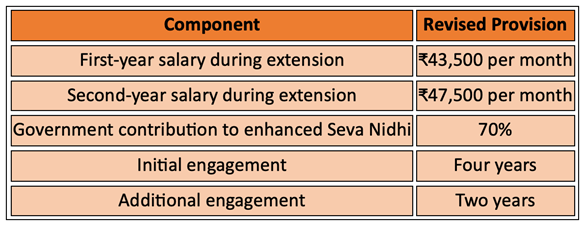
Image Caption: Financial Benefits to Agniveers
- Under the original arrangement, the Seva Nidhi package involved equal contributions from the Agniveer and the government.
- Under the revised framework, the government's contribution will increase to 70% for those completing the additional engagement period and choosing to exit.
- The revised arrangement also provides seniority benefits, further improving the service conditions of Agniveers.
Selection Criteria for Regular Enrolment
- The opportunity to join the regular cadre after the additional two-year engagement will depend on objective performance and service requirements.
- The selection process will consider:
- Adaptability: Ability to adjust to military responsibilities and changing operational requirements.
- Discipline: Maintenance of military discipline and professional conduct.
- Performance: Overall performance during the extended service period.
- Vigilance record: Absence of vigilance-related cases.
- Organisational requirements: The manpower requirements and operational needs of the respective services.
- The Chief of Defence Staff, General N.S. Raja Subramani, stated that a centralised database had been maintained across all three services to track Agniveers' performance, with annual reviews forming part of the assessment process.
Government's Rationale Behind the Reform
- The decision follows a four-year assessment of the Agnipath scheme by the three services, incorporating performance reviews, operational requirements and organisational feedback.
- According to the government, Agniveers have demonstrated strong performance in:
- Physical fitness and military preparedness
- Motivation, morale and competitive spirit
- Technological proficiency and adaptability
- Skills and educational qualifications
- The assessment also highlighted wider geographical representation in recruitment, a more standardised and transparent selection process, and the opening of various branches of the Armed Forces to women.
- The revised framework seeks to balance two objectives: maintaining a youthful military profile and retaining experienced personnel who have already undergone military training.
Implications for the Armed Forces
- The additional engagement period is expected to have several implications for military manpower management.
- Retention of Experienced Personnel
- The earlier four-year exit provision limited the period for which trained Agniveers could serve before leaving the Armed Forces.
- The additional two years will allow the services to retain trained personnel for a longer period.
- Maintaining a Younger Military Profile
- The government has clarified that the Agnipath scheme will continue in its existing form, with the initial four-year engagement unchanged.
- The revised arrangement is intended to provide greater flexibility without abandoning the objective of maintaining a younger military workforce.
- Competitive Performance and Merit-Based Selection
- The additional opportunity to enter regular service is expected to encourage Agniveers to maintain high standards of discipline, fitness and performance throughout their engagement.
- Career Continuity
- The extension provides an additional period of military employment and a further opportunity for regular enrolment. Those who eventually exit will also receive an enhanced Seva Nidhi package.