Why in news?
India and Canada have signed an agreement for the long-term supply of uranium to fuel India’s nuclear reactors. Under the deal, Canadian company Cameco will supply about 22 million pounds (around 10,000 tonnes) of uranium to India between 2027 and 2035. The contract is valued at about 2.6 billion Canadian dollars.
This is India’s second major uranium supply agreement within a month. Earlier, India finalised a similar deal with Kazakhstan’s state-owned company Kazatomprom, though details of that contract have not been disclosed.
These agreements are significant for India’s plans to greatly expand nuclear power generation and increase nuclear energy capacity more than tenfold by 2047.
What’s in Today’s Article?
- India’s Dependence on Imported Uranium
- Domestic Uranium Resources and Production
- Expanding and Diversifying India’s Uranium Supply
- India’s Three-Stage Nuclear Programme
India’s Dependence on Imported Uranium
- Although India has uranium deposits, the quality of its ore is relatively low. The uranium concentration in Indian mines ranges between 0.02 and 0.45 per cent.
- This is far lower than the global average of 1–2 per cent.
- In comparison, some mines in Canada contain uranium concentrations as high as 15 per cent.
- Because of the lower ore quality, extracting uranium in India is more expensive than importing it.
- Growing Reliance on Imports
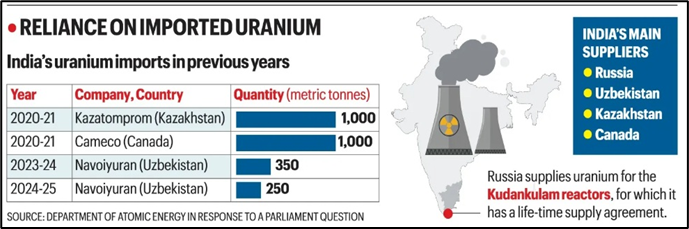
- Due to these limitations, more than 70 per cent of India’s uranium needs are currently met through imports.
- However, domestic production still plays an important role.
- It supports India’s nuclear weapons programme and provides a buffer in case global supply chains are disrupted.
- Expansion of Domestic Production
- India is increasing domestic uranium production to support the planned expansion of nuclear energy.
- The government aims to raise nuclear power capacity from about 9 GW today to 100 GW by 2047.
- Despite this expansion, domestic production is expected to meet only around 30 per cent of the fuel requirements of nuclear power plants in the future.
- Rising Uranium Demand
- India currently consumes about 1,500–2,000 tonnes of uranium each year. In 2025, the country’s requirement was about 1,884 tonnes.
- With the expansion of nuclear power, annual uranium demand could rise to about 5,400 tonnes.
- Even then, only around 30 per cent of this demand is likely to be met through domestic production.
Domestic Uranium Resources and Production
- India’s uranium production is mainly concentrated in Jharkhand and Andhra Pradesh, where seven mines are currently operational.
- Uranium deposits are also found in states such as Meghalaya, Rajasthan, and Telangana.
- India’s total uranium resources are estimated at about 4.3 lakh tonnes of uranium ore.
- More than 80,000 tonnes are located in mines allocated to the Uranium Corporation of India Limited (UCIL), and about 40 per cent of these reserves have already been extracted.
- Explorations are ongoing in nearly 15 states to identify new deposits.
Expanding and Diversifying India’s Uranium Supply
- New uranium supply agreements, including the recent deal with the Canadian company Cameco, aim to diversify India’s import sources and meet rising nuclear fuel demand.
- The agreement with Canada also reflects improving bilateral relations after a period of diplomatic tensions.
- Longstanding Nuclear Cooperation with Canada
- India and Canada have had nuclear cooperation since the 1950s. One early example was the CIRUS reactor, a joint India–Canada project.
- Canada also helped establish reactors at the Rajasthan Atomic Power Project in the 1960s.
- Cameco has previously supplied uranium to India, including during 2020–21.
- Multiple Global Supply Sources
- With the new agreement, India now imports uranium from several countries, including Uzbekistan, Kazakhstan, Canada, and Russia.
- Russia has also committed to long-term fuel supply for reactors at Kudankulam in Tamil Nadu.
- India may further expand supply partnerships with countries such as Australia and the United States.
- Indian companies are also exploring opportunities to mine uranium in other countries to strengthen long-term energy security.
India’s Three-Stage Nuclear Programme
- India aims to develop a three-stage nuclear power programme that will ultimately rely on thorium rather than uranium.
- The country possesses large thorium reserves, which makes this approach attractive for long-term energy security and independence.
- However, achieving this goal requires specialised nuclear reactors based on technologies that are proven but not yet widely used.
- First Stage: Uranium-Based Reactors - The nuclear reactors currently operating in India represent the first stage of the programme. These reactors primarily use uranium as fuel and produce plutonium as a by-product for the next stage.
- Second Stage: Fast-Breeder Reactors - The second stage involves fast-breeder reactors that use plutonium produced in the first stage. India has taken a major step toward this stage with a prototype fast-breeder reactor at Kalpakkam, which is nearing operational status.
- Third Stage: Thorium-Fuelled Reactors - The final stage aims to deploy reactors that use thorium as the main fuel. This stage is still some distance away and will require advanced technological development.
- Slow Progress Despite Early Vision
- India conceived the three-stage nuclear programme in the 1950s and remains the only country pursuing this model.
- However, progress has been slow, and full realisation of the programme is still a long-term objective.

