Why in news?
The Union Budget’s allocation of ₹20,000 crore over five years for carbon capture, utilisation and storage (CCUS) signals a major push towards cutting emissions from hard-to-abate sectors.
By backing CCUS technologies, the government aims to lower industrial carbon footprints and support India’s long-term goal of achieving net-zero emissions.
What’s in Today’s Article?
- About Carbon Capture, Utilisation and Storage (CCUS) Solutions
- Budget Push for Carbon Capture in India
- Economic Benefits of CCUS
About Carbon Capture, Utilisation and Storage (CCUS) Solutions
- Capturing carbon emissions - CCUS refers to a set of technologies that capture carbon dioxide (CO₂) released during industrial activities before it enters the atmosphere. CO₂ is the main driver of global warming and climate change.
- Storage or reuse of captured CO₂ - Once captured, CO₂ can either be stored safely underground in geological formations for long periods or utilised by converting it into useful products such as chemicals, fuels, or construction materials.
- Not a single technology - CCUS is not one technology, but a range of methods and processes aimed at preventing CO₂ emissions. Different industries use different capture, transport, storage, or utilisation techniques.
- Limited deployment so far - Although CCUS technologies have existed for decades, their use has been limited due to high costs, safety concerns, and scaling challenges. Deployment has picked up only recently.
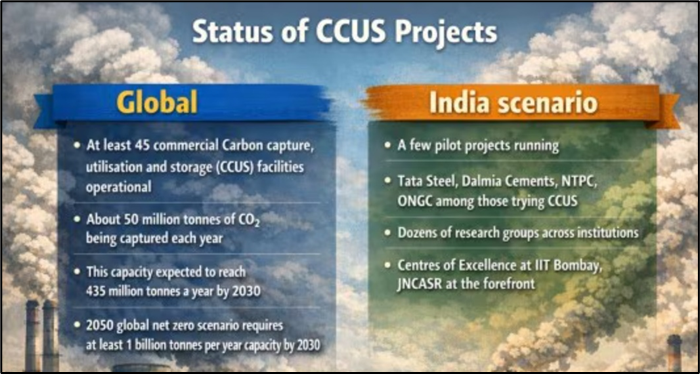
- Global status of CCUS - Most active CCUS projects are currently in the US, Europe, and China. Even so, only about 50 million tonnes of CO₂ are captured annually—less than 0.5% of global emissions.
- Crucial for net-zero goals - With global emissions remaining high, CCUS is increasingly seen as essential. There is no credible pathway to achieving net-zero emissions by 2050 or controlling global warming without large-scale adoption of CCUS technologies.
Budget Push for Carbon Capture in India
- With emissions expected to rise in the near and medium term due to rapid industrialisation and infrastructure expansion, CCUS is crucial for India to meet its long-term net-zero by 2070 commitment.
- India’s CCUS journey so far
- Since announcing its net-zero goal at the 2021 Glasgow climate summit, India has accelerated efforts to develop indigenous CCUS technologies tailored to domestic conditions.
- Pilot and demonstration CCUS projects are already running in steel, cement and chemical sectors.
- Potential large-scale capture and storage sites have been mapped, and Centres of Excellence—such as at IIT Bombay and JNCASR Bengaluru—are driving research.
- While CCUS science is well understood, major engineering, process and material innovations are needed across capture, transport, storage and utilisation to improve efficiency, safety and affordability.
- Policy and R&D roadmap
- In December, the Department of Science and Technology released a CCUS R&D roadmap for 2030, identifying key technology, finance and policy bottlenecks slowing adoption.
- Role of the ₹20,000 crore budget outlay
- The five-year budget allocation aims to bridge the critical funding gap for field testing and scale-up.
- Many CCUS solutions have proven laboratory success but require real-world deployment to reach commercial readiness.
- The funding seeks to raise technology readiness levels so systems can capture or store 100–500 tonnes of CO₂ per day.
- Experts expect several CCUS technologies to reach commercial deployment in India within five years.
Economic Benefits of CCUS
- Hard-to-abate industries - CCUS is crucial for sectors like steel and cement, where carbon dioxide emissions arise not just from fuel use but are an inherent part of the production process. Switching to renewable power alone cannot eliminate these emissions.
- Only viable decarbonisation route - In cement and steel, most CO₂ emissions come from chemical processes rather than energy consumption. CCUS is therefore the only practical solution to significantly reduce their carbon footprint.
- Budget focus on major emitters - The ₹20,000 crore budget allocation is aimed at end-use CCUS applications in power, steel, cement, refineries and chemicals—industries that together account for the bulk of India’s CO₂ emissions.
- Boosting export competitiveness - Indian exporters in these sectors face carbon-related trade barriers such as the EU’s Carbon Border Adjustment Mechanism (CBAM). CCUS adoption can help lower embedded emissions, making Indian products more competitive in global markets.

