Why in news?
India’s Prototype Fast Breeder Reactor (PFBR) at Kalpakkam achieved criticality on April 6, 2026, marking a key milestone in its nuclear programme.
While “criticality” is often seen as a major achievement, it is not the final goal but actually the initial stage of reactor operation. It represents the beginning of a controlled nuclear chain reaction, signalling progress but not completion of the project.
What’s in Today’s Article?
- Criticality in Nuclear Reactors
- Conventional PHWRs and Their Limitations
- Working of Fast Breeder Reactors (FBRs)
- India’s Three-Stage Nuclear Programme
- Challenges in Developing Fast Breeder Reactors (FBRs)
- India’s Approach to Fast Breeder Reactors (FBRs)
Criticality in Nuclear Reactors
- Criticality occurs when a nuclear reactor achieves a self-sustaining chain reaction, where each fission event releases neutrons that trigger further fission in surrounding nuclei.
- Engineers carefully control fuel composition, neutron movement, and reactor temperature to maintain this state.
- While criticality indicates a stable and controlled reaction, it does not mean the reactor is ready for commercial operation.
- After reaching criticality, the reactor is run at low power for extended periods to ensure all parameters remain within design limits before progressing to higher operational stages.
Conventional PHWRs and Their Limitations
- Most of India’s nuclear reactors are Pressurised Heavy Water Reactors (PHWRs) that use natural uranium, which contains 99.3% uranium-238 and 0.7% uranium-235.
- Neutrons are slowed using a moderator to enable uranium-235 fission, producing heat, a small amount of plutonium, and more neutrons.
- However, PHWRs are inefficient, as only about 1% of the fuel is utilised before becoming unusable.
Working of Fast Breeder Reactors
- Fast Breeder Reactors (FBRs) are significantly more efficient, with a fuel utilisation rate of around 10% or more.
- Unlike PHWRs, FBRs primarily use plutonium as fuel and do not rely on slowing down neutrons.
- The reactor core is surrounded by a blanket of depleted uranium. When fast neutrons strike this blanket, uranium is converted into plutonium, which can be reprocessed and reused as nuclear fuel.
- Plutonium-based fuel undergoes fission using fast neutrons, releasing more fast neutrons that continue the process.
- This creates a system where the reactor not only generates energy but also produces additional fuel, enhancing efficiency.
India’s Three-Stage Nuclear Programme and FBRs
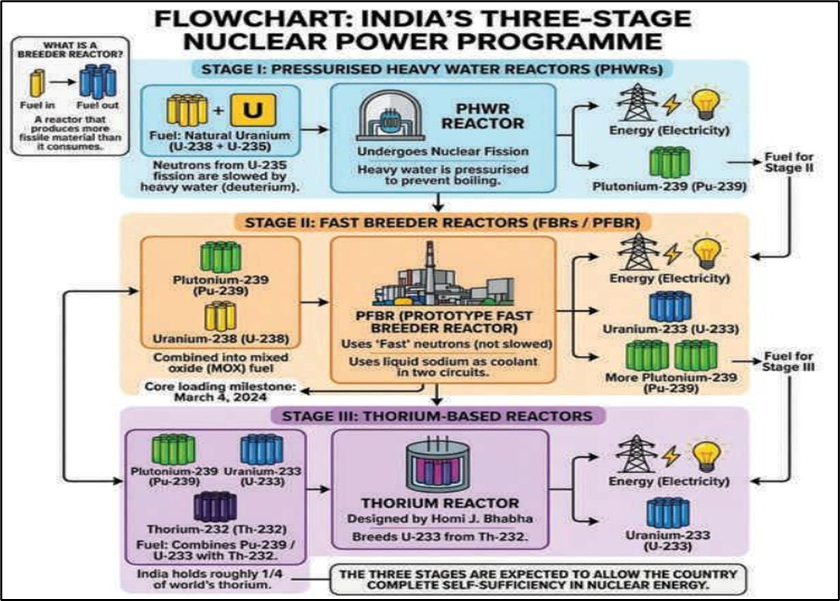
- India’s nuclear programme, conceived by Homi Bhabha, is structured in three stages to achieve long-term energy security.
- In the first stage, Pressurised Heavy Water Reactors (PHWRs) use natural uranium to generate electricity while producing plutonium and depleted uranium as by-products.
- In the second stage, Fast Breeder Reactors (FBRs) utilise this plutonium and depleted uranium to generate more energy and produce additional plutonium.
- In the final stage, advanced reactors will use plutonium and thorium to produce electricity, leveraging India’s abundant thorium reserves.
- FBRs act as a crucial bridge between the initial uranium-based phase and the final thorium-based cycle, enabling self-sufficiency in nuclear power.
Challenges in Developing Fast Breeder Reactors
- Technical Complexity and Delays - Developing FBRs has proven far more difficult than anticipated. India’s Prototype PFBR faced significant challenges during construction despite being designed and executed by specialised institutions.
- Use of Liquid Sodium Coolant - FBRs use liquid sodium as a coolant, which improves heat transfer and avoids the need for high pressure. However, sodium reacts violently with air and water, requiring perfectly sealed systems and strict leak detection, making operations complex and costly compared to water-cooled reactors.
- Japan’s Monju reactor suffered a sodium leak and fire, leading to eventual shutdown.
- France’s Superphénix reactor was closed due to technical problems and high costs.
- Russia continues to operate a limited number of FBRs, showing technical feasibility.
- Economic and Public Acceptance Issues - Although technically feasible, FBRs are not yet economically viable and have struggled to gain public acceptance. High costs and safety concerns remain major barriers.
- Need for Strong Safety and Oversight - FBRs require rigorous monitoring, engineering precision, and a strong safety culture, making their successful operation dependent on both technological capability and institutional discipline.
India’s Approach to Fast Breeder Reactors
- Strategic Focus on Long-Term Fuel Security - India’s pursuit of FBRs is driven by its three-stage nuclear programme, which aims to ensure long-term energy security by efficiently utilising available nuclear resources.
- State-Driven and Insulated Governance Structure - India’s nuclear sector is largely state-controlled, with the Department of Atomic Energy (DAE) reporting directly to the Prime Minister’s Office. This structure has enabled continuity of nuclear projects across political cycles.
- Limited Accountability and Transparency Issues - The insulated decision-making framework has reduced scrutiny. Projects have faced delays and cost overruns, with accountability diffused across agencies. The PFBR’s cost rose from ₹3,500 crore to ₹6,800 crore, alongside multiple deadline extensions.

