Why in news?
The National Green Tribunal (NGT) has approved the ₹81,000-crore Great Nicobar infrastructure project, citing its strategic importance and finding that adequate environmental safeguards are in place.
The decision is significant as it may serve as a precedent for future strategically important projects in ecologically sensitive regions.
The 166 sq km mega project aims to develop Great Nicobar into a strategic and economic hub. However, it involves diversion of about 130 sq km of forest land and the felling of nearly one million trees, raising environmental concerns.
What’s in Today’s Article?
- Overview of the Great Nicobar Project
- Strategic Significance of the Great Nicobar Project
Overview of the Great Nicobar Project
- Great Nicobar Island, spanning 910 sq km and home to India’s southernmost point, Indira Point, is set to be developed as a major economic and defence hub.
- The project aims to transform the island into a strategic gateway in the Indo-Pacific region.
- Four Core Components of the Project
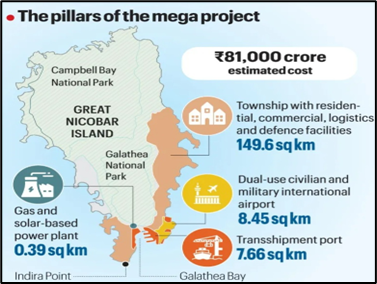
- Integrated Township
- Covers around 149 sq km.
- Will include residential, commercial, tourism, logistics, and defence facilities.
- Designed to anchor long-term economic and strategic activity on the island.
- Transshipment Port
- Proposed at Galathea Bay, on the southern tip.
- Intended to position India as a key maritime logistics hub.
- Located in an ecologically sensitive area, known for Leatherback turtle nesting sites and the Galathea River outflow.
- Civil and Military Airport
- Dual-use international airport proposed east of the port.
- Will be the second air facility after INS Baaz Naval Air Station.
- Requires acquisition of 4.2 sq km of land, affecting 379 families.
- Power Plant
- A 450-MVA gas and solar-based plant.
- Occupies around 0.39 sq km.
- Intended to ensure reliable energy supply for the township and associated infrastructure.
- Land Use and Environmental Footprint
- Total project area: 166 sq km.
- Forest diversion: Significant portions of ecologically sensitive land.
- Land reclamation planned:
- 2.98 sq km for the port
- 1.94 sq km for the airport
- Estimated material requirement: 33.35 million cubic metres, including cement, rocks, sand, and steel.
- Implementation and Governance
- Initially conceptualised by NITI Aayog.
- Now being implemented by the Andaman and Nicobar Island Integrated Development Corporation Ltd (ANIIDCO).
- Pre-feasibility study prepared in 2021 by AECOM India Pvt Ltd.
Strategic Significance of the Great Nicobar Project
- The Centre’s push for the Great Nicobar project is anchored in three strategic drivers: geopolitics, maritime trade ambitions, and geographic advantage.
- Geopolitical and Maritime Advantage
- Great Nicobar is India’s closest territory to the Malacca Strait, a critical maritime chokepoint connecting the Indian and Pacific Oceans.
- Around 94,000 ships pass through the Strait annually.
- It accounts for nearly 30% of global traded goods and about one-third of the world’s maritime oil trade.
- This location gives India a strategic vantage point in Indo-Pacific maritime dynamics.
- Transshipment Hub Ambition
- Expanding India’s Port Capacity
- The proposed Galathea Bay transshipment port will transfer cargo from large vessels to smaller ones for onward distribution.
- India currently has only one operational transshipment port at Vizhinjam, Kerala.
- Competing with Regional Giants
- The Nicobar port aims to compete with:
- Colombo and Hambantota (Sri Lanka)
- Port Klang (Malaysia)
- Port of Singapore
- Projected Capacity
- Estimated to handle 14.2 million TEUs (twenty-foot equivalent units) annually — roughly 14 million standard containers.
- Strengthening Defence Infrastructure
- Existing Military Presence
- The Andaman and Nicobar Command, India’s only tri-services command, has been operational in Port Blair since 2001.
- INS Baaz Naval Air Station is located at Campbell Bay, near the proposed township.
- Integrated Defence Development
- The Great Nicobar project includes defence infrastructure in its first construction phase.
- Ongoing upgrades across the islands include improved airfields, jetties, storage facilities, and surveillance systems.
Environmental and Social Concerns in Great Nicobar
- The Great Nicobar mega project has triggered significant ecological and social concerns due to its scale and location in a fragile island ecosystem.
- Large-Scale Forest Diversion
- The project involves diversion of 130 sq km of pristine forest and felling of over one million trees.
- The Nicobar Islands are part of the Sundaland biodiversity hotspot, one of the world’s richest ecological zones.
- Biosphere and Wildlife Concerns
- Almost the entire island falls under the Great Nicobar Biosphere Reserve.
- It hosts littoral forests, evergreen hill forests, and coastal wetlands.
- The Galathea Bay Wildlife Sanctuary and a megapode sanctuary were denotified for the project.
- The endemic Nicobar megapode, a ground-dwelling bird, faces habitat loss.
- Impact on Leatherback Turtles
- Galathea Bay is a key nesting site for leatherback turtles.
- The environmental clearance acknowledges potential damage.
- As mitigation, authorities proposed new sanctuaries on Little Nicobar, Menchal Island, and Meroe Island.
- Impact on Indigenous Communities
- Shompen Tribe - The Shompen, a semi-nomadic hunter-gatherer group of about 250 people, inhabit interior forests.
- Limited contact with outsiders makes them highly vulnerable to disease and disruption.
- Nicobarese Community - The Nicobarese live mainly in Campbell Bay settlements such as Rajiv Nagar and New Chingenh. Many were displaced by the 2004 tsunami.
- Their long-standing demand to return to pre-tsunami villages remains unresolved.
- Tribal Governance Concerns - The tribal council has alleged pressure to surrender land claims. It previously withdrew consent for denotification of tribal reserves, citing lack of transparency about the project’s scale.
- Demographic Transformation - The island’s population, currently around 8,500, is projected to rise to 6.5 lakh by 2050. Such a sharp increase could fundamentally alter the island’s ecological balance and social fabric.

