Why in news?
On February 28, 2026, Israel carried out a daylight strike on Tehran, calling it a pre-emptive operation. US President Donald Trump confirmed American involvement, stating that major combat operations had begun to stop Iran from developing nuclear weapons.
Iran responded with missile and projectile attacks on Israeli territory and subsequently expanded its retaliation by targeting US bases in Qatar, Bahrain, Jordan, Kuwait, and the UAE.
The widening scope of strikes has pushed the crisis beyond a bilateral confrontation, placing the entire Middle East under threat of a broader regional war.
What’s in Today’s Article?
- What Happened in Iran?
- Iran’s Response
- Trigger: Breakdown of Nuclear Talks and Rising Tensions
- India’s Diplomatic Test Amid Israel–Iran Escalation
What Happened in Iran?
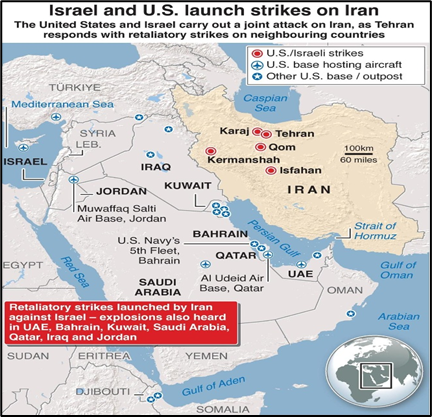
- Explosions were reported in Tehran, with smoke seen rising from several parts of the capital.
- Israel initially announced missile strikes on Iranian targets. A US official later confirmed the attacks were part of a joint military operation.
- Trump called the operation “massive and ongoing,” and the US Department of Defense named it Operation Epic Fury.
Iran’s Response
- Iran retaliated by launching missiles toward northern Israel. Air-raid sirens were activated, and Israeli air defence systems intercepted incoming projectiles.
- Iran expanded its response by targeting US-linked military facilities across the Middle East, including:
- Al Udeid Airbase (Qatar)
- Al-Salem Airbase (Kuwait)
- Al-Dhafra Airbase (UAE)
- US Fifth Fleet Headquarters (Bahrain)
- Reports also indicated explosions in Saudi Arabia and attacks on US bases in Jordan.
Trigger Behind The Attack: Breakdown of Nuclear Talks and Rising Tensions
- The escalation follows mounting strain over stalled US–Iran nuclear negotiations. A recent round of indirect talks in Geneva, mediated by Oman, failed to produce a breakthrough, though technical discussions are set to continue.
- Iran insists on its right to enrich uranium for peaceful purposes, while the US demands strict limits on its nuclear programme.
- President Trump had expressed dissatisfaction with the pace of talks and repeatedly described Iran as an “imminent threat” and the world’s “number one terror sponsor,” signalling growing impatience ahead of the military action.
India’s Diplomatic Test Amid Israel–Iran Escalation
- Less than two days after PM Modi’s visit to Israel, India faced a major diplomatic challenge as US–Israel strikes on Iran and Tehran’s retaliation widened the regional conflict.
- With deep strategic, economic, and diaspora stakes in West Asia, New Delhi called for restraint, de-escalation, and dialogue.
- Diaspora and Evacuation Concerns
- India has significant diaspora exposure:
- ~10,000 Indians in Iran
- Over 41,000 in Israel
- 8–9 million across the wider Gulf
- Embassies issued advisories amid airspace closures and flight disruptions.
- India’s approach reflects past experience, including the evacuation of over 3,000 nationals during the previous Israel–Iran flare-up.
- Strategic and Economic Stakes
- Beyond citizen safety, India’s energy security is at risk.
- Nearly 60% of India’s energy imports come from the region, and threats to close the Strait of Hormuz raise concerns over oil supply disruptions.
- The US role and President Trump’s explicit stance on Iran further complicate India’s balancing act between strategic partner Israel and longstanding partner Iran.
- A Tightrope of Strategic Autonomy
- India’s response mirrors its approach to the Russia–Ukraine war: maintaining strategic autonomy, avoiding public condemnation, keeping communication channels open, and prioritising national interests.
- However, as the Middle East conflict expands and US involvement deepens, India’s room for calibrated neutrality may narrow.
- The evolving regional dynamics will test New Delhi’s diplomatic agility in preserving its core interests.

