Why in news?
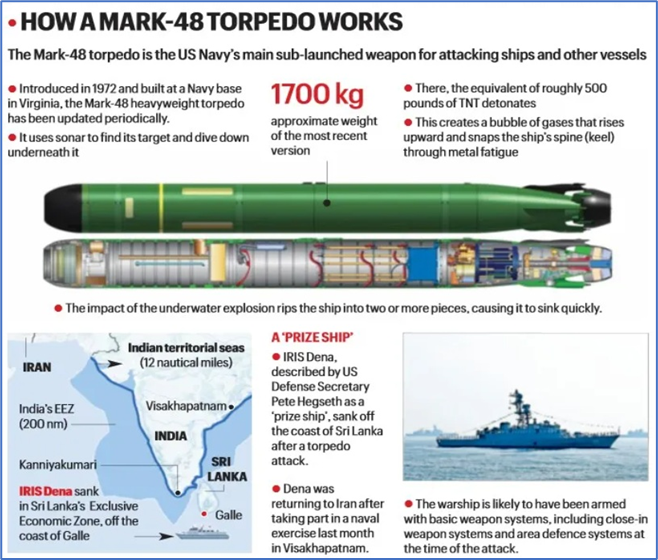
A US submarine torpedoed the Iranian warship IRIS Dena off the coast of Sri Lanka, outside its territorial waters. The ship was returning after participating in the International Fleet Review and MILAN-2026 naval exercise hosted by India near Visakhapatnam.
The attack resulted in the death of at least 80 sailors and expanded the US-Israel–Iran conflict beyond West Asia into the Indian Ocean region.
The incident has also sparked a debate in India over maritime security, especially given India’s strong naval presence in the Indian Ocean.
Experts noted that ships sailing in international waters cannot be protected by another country from hostile action. Once outside a nation’s territorial boundaries, ships are subject mainly to international maritime law and conventions, which govern conduct during naval conflicts.
What’s in Today’s Article?
- Legal Framework Governing Maritime Conflict
- US Sanctions on the Iranian Warship
- Expert Views on the Incident
Legal Framework Governing Maritime Conflict
- International maritime law is mainly governed by the United Nations Convention on the Law of the Sea (UNCLOS), although the United States is not a signatory.
- UNCLOS primarily deals with peacetime maritime governance and does not clearly regulate the conduct of parties during armed conflicts.
- Law of Naval Warfare
- During conflicts, the law of naval warfare operates alongside UNCLOS.
- Under these rules, warships belonging to a belligerent state can be considered legitimate military targets, regardless of whether they are directly engaged in combat.
- Provisions Under the UN Charter
- The UN Charter regulates the use of force in international waters.
- Article 2(4) generally prohibits the use of force, but Article 51 allows states to act in self-defence if they face an armed attack.
- Military action may also be authorised by the UN Security Council under Chapter VII of the UN Charter.
- However, such approval requires a majority vote and no veto from any permanent member, making it difficult to obtain in many situations.
US Sanctions on the Iranian Warship
- The Iranian warship IRIS Dena was sanctioned by the US Treasury in February 2023, along with executives of the Iranian drone company Paravar Pars.
- The sanctions were linked to Iran’s alleged supply of UAVs to Russia for attacks on infrastructure in Ukraine.
- However, these sanctions did not prevent the ship from participating in peacetime multilateral naval exercises, though they restricted its commercial or transactional activities.
- At the time of the attack, the warship was likely equipped with basic defensive weapon systems, including close-in weapon systems and area defence systems.
Expert Views on the Incident
- No Fixed War Zones at Sea - Experts stated that there are no defined war zones in the maritime domain. The attack occurred after the Iranian ship left India, making it part of the wider conflict environment.
- Incident Near Sri Lanka’s EEZ - The attack happened in Sri Lanka’s Exclusive Economic Zone (EEZ). This proximity allowed authorities to begin search and rescue operations quickly. The location also suggests the ship may have been aware of potential threats.
- Legal Concerns Over Use of Force – Critics, however, argued that attacking a foreign warship on the high seas is generally unlawful unless justified as self-defence or within an ongoing armed conflict, as recognised under Article 51 of the UN Charter.
- Escalation of the Conflict
- Analysts described the attack as a major escalation in the US-Israel-Iran conflict.
- The ship was reportedly on a peaceful passage outside the conflict zone, which may have led to the crew being caught off guard despite defensive capabilities.

