Why in news?
India’s new GDP series, with 2022–23 as the base year, has introduced notable changes in the assessment of economic performance. The revised data shows more stable real GDP growth rates for the years beginning 2023–24, ranging between 7.1% and 7.6%, compared to the earlier wider range of 6.5% to 9.2%.
The updated series also indicates a 3–4% reduction in the overall size of the economy in nominal terms (Nominal GDP → Uses current market prices). However, the revision is considered reasonable and reflects a more accurate measurement of economic activity.
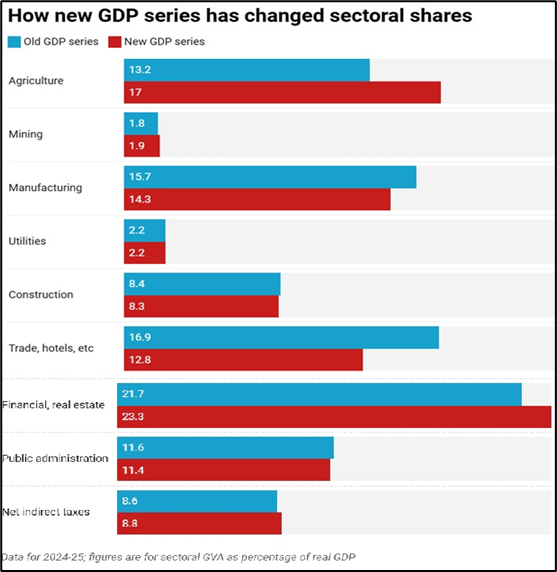
Importantly, the new GDP series offers a clearer picture of how different sectors of the economy are performing.
What’s in Today’s Article?
- Agriculture Sector Larger in the New GDP Series
- Reasons for the Higher Estimate
- Stronger Manufacturing Growth in the New GDP Series
- Informal Economy in the New GDP Series
- Impact on Different Sectors
Agriculture Sector Larger in the New GDP Series
- The new GDP series released by the Ministry of Statistics and Programme Implementation (MoSPI) shows that the agriculture, livestock, forestry and fishing sector is about 5% larger than previously estimated for the years starting 2022–23 in nominal terms.
- Since the overall size of the economy has been revised downward by 3–4%, agriculture’s share in GDP has increased.
- The sector’s share rose to 18.2% in 2022–23, compared with 16.5% in the earlier GDP series.
- Despite the revision, agriculture’s share in the economy continues to decline over time. In 2025–26, agriculture accounts for 16.2% of GDP in the new series, compared with 15.2% in the old series.
Reasons for the Higher Estimate
- Inclusion of More Cash Crops - The new GDP series better captures the shift toward cash crops such as fruits and vegetables. These crops generate higher profits for farmers, increasing the value added in agriculture and raising the sector’s estimated size.
- Reduced Input Costs for Farmers - The new estimates also reflect a decline in fuel costs in agriculture. Diesel use has reduced and is increasingly being replaced by electricity and solar power for irrigation. Lower input costs increase the value added generated by farmers.
- Role of the PM-KUSUM Scheme
- A major factor behind this shift is the Pradhan Mantri Kisan Urja Suraksha evam Utthaan Mahabhiyaan (PM-KUSUM) scheme launched in 2019.
- The scheme provides subsidies for installing solar irrigation pumps, helping farmers reduce dependence on diesel and lower energy costs.
- This transition contributes to higher value added in the agricultural sector.
Stronger Manufacturing Growth in the New GDP Series
- The new GDP series shows that the manufacturing sector has become a stronger driver of economic growth.
- Under the old GDP series, manufacturing grew at an average rate of about 8% between 2023–24 and 2025–26, with a sharp 12.3% growth in 2023–24 largely due to a favourable base effect.
- In contrast, the new GDP series estimates manufacturing growth at an average of 11.2% annually during the same period, indicating a stronger and more consistent expansion of the sector.
- Methodological Improvements in Estimation
- One important reason for the higher growth estimate is the abandonment of the single-deflator method, which was widely criticised for inaccurately converting nominal Gross Value Added (GVA) into real terms.
- The single-deflator method is an economic technique used to calculate real Value Added (or GDP) by deflating nominal value added directly with a single price index, typically the output price index (e.g., WPI or CPI).
- It assumes input and output prices move similarly, often leading to overestimation when they diverge.
- The revised methodology provides a more accurate estimate of manufacturing output.
- Better Data on the Informal Sector
- Improved data sources have also contributed to the revised estimates.
- Surveys such as the Annual Survey of Unincorporated Sector Enterprises (ASUSE) and the Periodic Labour Force Survey (PLFS) now capture more information about the informal manufacturing sector.
- This improved data coverage has helped economists estimate stronger and more consistent manufacturing growth in the new GDP series.
Informal Economy in the New GDP Series
- One major criticism of India’s earlier GDP estimates was the inaccurate measurement of the informal sector.
- The new GDP series attempts to correct this by using data from the Periodic Labour Force Survey (PLFS) and the Annual Survey of Unincorporated Sector Enterprises (ASUSE).
- These surveys reduce the earlier dependence on formal-sector proxies and provide a more realistic picture of informal economic activity.
Impact on Different Sectors
- The improved measurement of the informal economy has contributed to stronger estimates of manufacturing growth, as informal manufacturing activities are now better captured in the data.
- Decline in Estimated Size of Some Service Activities
- However, data for some service-sector activities suggest that the size of the unorganised sector may have been overestimated earlier.
- For example, the sector comprising trade, repair, hotels and restaurants, transport, storage, communication, and broadcasting-related services has seen its Gross Value Added (GVA) fall by nearly 25% annually between 2022–23 and 2025–26 in the revised estimates.
- According to officials, this sector has a large informal component, and better data has led to more accurate and possibly lower estimates of its size.

