Why in news?
Iranian missiles struck Ras Laffan Industrial City, Qatar — home to the world's biggest LNG facility — hours after Israel hit South Pars, the world's largest natural gas field shared between Iran and Qatar. The attack has major implications for global LNG supply and India's energy security.
What’s in Today’s Article?
- The Attack & Its Escalation
- Why Ras Laffan Strike Matters?
- Why Ras Laffan Matters for India?
- India Diversifying Away from the Gulf
The Attack & Its Escalation
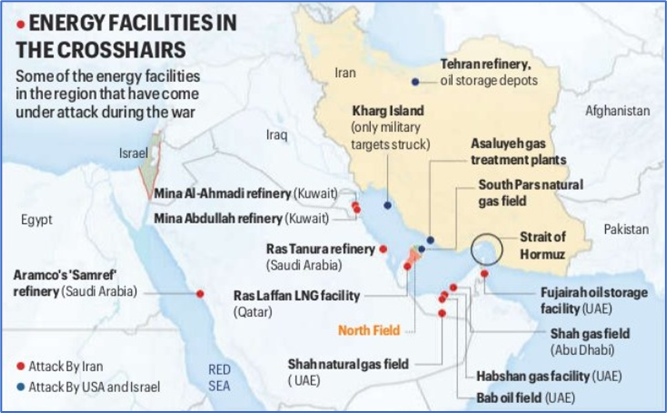
- Israel struck South Pars gas field; Iran retaliated by targeting energy infrastructure in Saudi Arabia (Samref refinery, Yanbu), Kuwait, and Qatar's Ras Laffan.
- Ras Laffan accounts for roughly one-fifth of global LNG supply — its production, liquefaction, and export units are all concentrated there.
- Brent crude, already above $100/barrel, briefly hit $119 before settling at ~$112 — about 50% above pre-war levels.
- Qatar had already suspended LNG production earlier this month following a smaller attack; the latest strikes caused sizable fires and extensive damage.
Why Ras Laffan Strike Matters?
- Unclear how long gas output will take to normalise even if the war stops.
- Concerns have moved upstream to production and supply infrastructure, not just transit routes.
- US President Trump stated Washington had no advance knowledge of the Israeli attack and warned Israel against further strikes on South Pars, threatening to "blow up the entirety" of South Pars if Qatar's LNG facilities were attacked.
- Strategic Importance of Ras Laffan
- Ras Laffan accounts for roughly one-fifth of global LNG supply.
- Disruptions here directly affect global LNG flows and energy security.
- Qatar had already suspended production temporarily after earlier attacks.
Why Ras Laffan Matters for India?
- India imports ~88% of crude oil and ~50% of its gas needs
- Qatar supplies ~one-third of India's LPG and nearly half of its LNG
- Earlier disruptions were limited to Strait of Hormuz shipping delays; now, physical damage to processing facilities makes recovery far slower and uncertain
- India's LNG Dependency
- Qatar is India's largest LNG source — India depends on LNG for roughly half its natural gas demand.
- Over two-fifths of India's LNG comes from Qatar, almost entirely from Ras Laffan.
- In 2024–25, India imported 27 million tonnes of LNG; 11.2 million tonnes (41.4%) came from Qatar.
- QatarEnergy's production capacity is 77 million TPA, expanding to ~81 million TPA by 2025.
- Impact on Long-Term Gas Contracts
- India's major energy firms hold long-term supply agreements with Qatar:
- Petronet LNG imports about 7.5 million tonnes per annum (MTPA)
- GSPC imports around 1 MTPA
- GAIL imports smaller volumes
- India consumes ~189 MMSCMD of natural gas but produces only ~90 MMSCMD
- Gulf import disruptions and force majeure declarations are now squeezing the gap.
- Broader Economic Implications for India
- Rising fuel costs may increase inflation and fiscal pressure.
- Government and oil companies may have to absorb price shocks.
- LPG shortages and delays indicate early signs of domestic stress.
- Qatar as a Trade Partner — Added Stakes
- Bilateral trade touched $14 billion+ in 2024–25, dominated by energy
- India imports LNG, LPG, and petrochemicals; exports cereals, machinery, and metals
- A prolonged conflict risks disrupting both energy supply and trade balance
India Diversifying Away from the Gulf
- Previously, ~60% of LPG imports came from Qatar, UAE, Saudi Arabia, and Kuwait. India is now sourcing from: US, Norway, Canada, Algeria, and Russia
- This reduces geopolitical risk but raises costs due to longer shipping routes.

