Why in news?
Punjab Chief Minister said the Centre has agreed in principle to move the security fence closer to the India–Pakistan border, a step that could restore access to farmland lying beyond the fence.
The proposal, discussed earlier but never implemented, revives questions around its origins, security concerns, and why relief for border farmers has remained elusive.
What’s in Today’s Article?
- Why Punjab’s Border Fence Has Become a Farmers’ Flashpoint?
- Why the Punjab Border Fence Was Built?
- Kapoor Committee and Farmer Compensation
- Farmers Seek Fence Shift Amid Evolving Security Landscape
- Why the Border Fence Remains Unmoved?
Why Punjab’s Border Fence Has Become a Farmers’ Flashpoint?
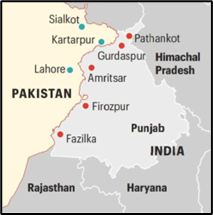
- Punjab’s 532-km border with Pakistan is secured by a barbed-wire fence that, due to uneven terrain, lies anywhere from a few feet to nearly 2 km inside Indian territory.
- As a result, about 21,500 acres of privately owned farmland and 10,000 acres of government land fall between the fence and the International Border.
- Farmers cultivating this land face strict restrictions. Access gates open only for limited hours on fixed days, with caps on the number of people and tractors allowed.
- Each tractor must be escorted by two BSF Kisan Guards, further limiting daily access.
- Border farmers have long demanded that the fence be moved closer to the International Border to ease cultivation.
Why the Punjab Border Fence Was Built?
- The electrified barbed-wire fence along the Punjab–Pakistan border was first installed in 1988 across Gurdaspur, Amritsar and Ferozepur, at the height of militancy in the state. Its primary purpose was to curb infiltration, militancy and drug smuggling.
- At the time, farmers did not protest, as dissent was often viewed with suspicion during those volatile years.
- In 1992, farmers formed the Border Area Sangharsh Committee to raise their concerns, but the issue has remained unresolved.
- With the later creation of Tarn Taran, Fazilka and Pathankot districts, the fence now affects border communities across six districts in Punjab.
Kapoor Committee and Farmer Compensation
- The Kapoor Committee, headed by then Punjab Chief Secretary S L Kapoor, was constituted in 1986 to examine the difficulties faced by farmers whose land lay beyond the border fence.
- It recommended compensating affected farmers, leading to the release of an inconvenience allowance of ₹2,500 per acre in 1988.
- However, farmers say this compensation has been irregular and not paid annually.
Farmers Seek Fence Shift Amid Evolving Security Landscape
- Punjab’s border farmers argue that advances in surveillance and drone monitoring have changed the nature of border security, making the current fence alignment outdated.
- With hundreds of acres trapped behind the fence, farmers face daily checks, delays in using machinery, and hurdles in transporting crops.
- They say shifting the fence closer to the International Border would ease cultivation without compromising security, given improved monitoring and adequate defence resources.
Why the Border Fence Remains Unmoved?
- Despite repeated proposals, shifting the Punjab border fence has not materialised due to practical and administrative hurdles.
- BSF officials say the nearly 40-year-old fence is in poor condition and moving it would require dismantling and rebuilding it with newly procured barbed wire.
- Farmers, meanwhile, remain sceptical, noting that similar assurances have surfaced during elections in the past without any follow-through, including in 2023 when a possible fence shift was announced but never implemented.

