Why in the News?
- Rising tensions in West Asia and the Israel-Iran conflict have led to a sharp disruption of shipping traffic through the Strait of Hormuz, raising concerns about global energy supply and oil prices.
What’s in Today’s Article?
- Strait of Hormuz (Location, Strategic Importance, Major Chokepoints, Current Situation, Legal Status, Impact, Govt Response, etc.)
Strait of Hormuz: Location and Strategic Importance
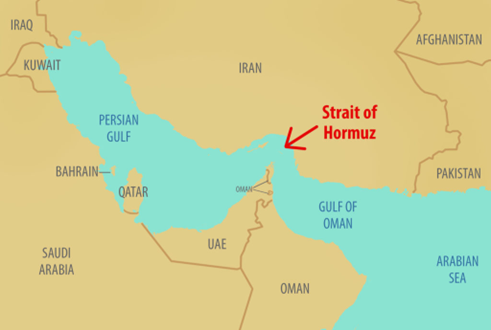
Image Caption: Strait of Hormuz
- The Strait of Hormuz is one of the most strategically important maritime chokepoints in the world.
- It lies between Iran to the north and Oman and the United Arab Emirates (UAE) to the south, connecting the Persian Gulf with the Gulf of Oman and the Arabian Sea.
- At its narrowest point, the strait is about 33 kilometres wide, making it a relatively narrow passage for global shipping traffic. Despite its small size, the strait plays a disproportionately large role in global energy trade.
- A significant share of global oil and gas shipments move through this route. According to estimates, more than 20% of the world’s oil and gas supplies are transported through the Strait of Hormuz, making it one of the most critical energy transit routes in the world.
- Several major oil-producing countries in the Persian Gulf rely on the strait to export their energy resources to global markets. These include Saudi Arabia, Iran, Iraq, Kuwait and Qatar
- Because of this, the strait has become a critical component of global trade and geopolitical strategy.
Major Global Maritime Chokepoints
- The Strait of Hormuz is part of a network of important maritime chokepoints that regulate global trade flows.
- Some other major chokepoints include:
- Strait of Malacca - vital for trade between East Asia and Europe.
- Bab-el-Mandab Strait - located at the entrance to the Red Sea.
- Suez Canal - connects the Mediterranean Sea with the Red Sea.
- Panama Canal - connects the Atlantic and Pacific Oceans.
- Bosphorus and Dardanelles Straits - link the Mediterranean and Black Seas.
- These chokepoints play a crucial role in determining the efficiency and security of global shipping routes.
Current Situation in the Strait of Hormuz
- Recent geopolitical tensions in West Asia have severely disrupted commercial traffic through the Strait.
- Following military attacks involving the United States, Israel, and Iran, ship traffic through the Strait of Hormuz has reportedly fallen by nearly 95%.
- According to maritime intelligence estimates, around 600 ships are currently stranded in the region.
- Several vessels have also faced attacks in or near the strait, increasing the risk perception among shipping companies.
Legal Status of Maritime Routes
- International maritime law generally treats seas and major straits as part of the global commons, meaning that they are open for navigation by ships from all countries.
- While coastal states control their territorial waters and exclusive economic zones (EEZs), they cannot unilaterally block international shipping lanes such as the Strait of Hormuz.
- However, security threats and military conflicts can make navigation extremely risky. In such situations, shipping companies may avoid the route due to fears of damage, loss of cargo, or loss of life.
- As a result, insurance premiums for ships transiting the strait have increased dramatically, rising nearly 10-15 times the normal cost in the current crisis.
Strategic Leverage of the Strait for Iran
- Iran has historically viewed the Strait of Hormuz as a strategic leverage point in geopolitical conflicts.
- Although Iranian officials have given mixed signals about whether they intend to close the strait, some Iranian agencies have threatened attacks on ships passing through the route.
- By threatening to disrupt the strait, Iran seeks to increase global pressure on the United States and Israel to end hostilities.
- This tactic has been used before. During the Iran-Iraq War in the 1980s, the strait witnessed attacks on commercial shipping vessels.
Impact on India’s Energy Security
- India is particularly vulnerable to disruptions in the Strait of Hormuz because of its heavy dependence on energy imports.
- Key concerns include:
- Oil imports: About 40% of India’s crude oil supplies pass through the strait, meaning disruptions could affect fuel availability and prices.
- Liquefied Natural Gas (LNG): Qatar supplies around half of India’s LNG imports, which in turn provide about half of India’s natural gas consumption.
- Natural gas is crucial for Fertiliser production, Power generation, City gas distribution and Industrial energy use.
- Any interruption could therefore affect multiple sectors of the Indian economy.
- Cooking gas supply: India imports nearly 60% of its liquefied petroleum gas (LPG), much of which originates from the Gulf region upstream of the strait.
- A shortage of LPG would have serious implications for household cooking fuel availability.
Government Response and Mitigation Measures
- Diversifying energy imports: India is exploring alternative LNG and crude oil sources such as the United States, Russia, and Australia.
- Increasing domestic refining adjustments: Refineries are being encouraged to produce more propane and butane, which are key components of LPG.
- Diplomatic coordination: India is in discussions with the United States to secure maritime insurance support for ships transiting the region.
- These measures aim to ensure continuity in energy supplies even if the crisis continues.
Impact on Global Oil Prices
- Disruptions in the Strait of Hormuz can significantly affect global energy markets.
- Because a large share of the world’s oil flows through the strait, any conflict or shipping disruption can trigger price spikes.
- Historically, geopolitical crises in the region have caused dramatic increases in oil prices. For example, during the Russia–Ukraine war, oil prices rose above $125 per barrel.
- Currently, global oil prices remain below $90 per barrel, but prolonged disruption could lead to higher prices and inflation worldwide.

