Why in news?
The assassination of Ayatollah Ali Khamenei, Iran’s 86-year-old Supreme Leader, marks the end of a defining era in the country’s post-1979 Islamic Revolution leadership. He was killed in an attack by US and Israeli forces.
Following his death, the constitutional process to appoint a successor was immediately activated. The Assembly of Experts has begun deliberations to select the next Supreme Leader.
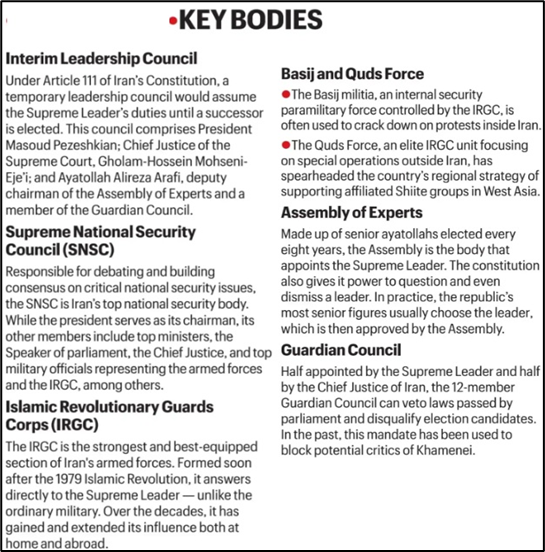
In the interim, a three-member Interim Leadership Council has taken over his duties, as provided under Iran’s Constitution. These developments highlight the structured mechanisms within Iran’s political system to manage leadership transitions during crises.
What’s in Today’s Article?
- Religion and Politics in Iran: Historical Roots
- Khomeini and Khamenei: Shaping Iran’s Supreme Leadership
- Iran After the Supreme Leader
Religion and Politics in Iran: Historical Roots
- The close relationship between religion and politics in Shia-majority Iran predates the 1979 Islamic Revolution.
- Shia clerics often adopted an anti-monarchist stance and actively participated in political movements.
- Important examples include:
- the 19th-century Tobacco Movement against British concessions,
- the Constitutional Revolution of 1906–11 demanding a constitutional monarchy,
- protests against the Shah’s 1963 White Revolution reforms, and
- finally the 1979 Revolution.
- The 1979 Revolution and Clerical Leadership
- The ideological leadership of Ayatollah Khomeini, even while he was in exile in France, played a decisive role in shaping the 1979 Revolution and the Islamic Republic that followed.
- Although diverse groups such as workers and communists joined the anti-Shah protests, the religious establishment gained greater legitimacy and influence after the Revolution due to its strong ideological direction.
- Mosques as Political Spaces
- One key factor behind the clergy’s rise was the central role of mosques in political mobilisation. Friday prayer gatherings became important platforms for religio-political expression.
- In a repressive environment where public spaces were monitored by the Shah’s secret police, SAVAK, mosques functioned as relatively safe spaces (bast) for organising resistance.
- Consolidation of a Religio-Political System
- Over the past 47 years, Iran developed a political system made up of hierarchical yet interconnected institutions rooted in revolutionary ideology.
- Ayatollah Khamenei led this system, which blends religious authority with political power and reflects the long historical intertwining of Shia clerical leadership and state governance in Iran.
Khomeini and Khamenei: Shaping Iran’s Supreme Leadership
- Before and during the 1979 Revolution, religious scholars and intellectuals reinterpreted Islamic ideas in a revolutionary way.
- Thinkers like Ali Shariati linked faith with social justice and anti-imperialist politics, though he did not support clerical political rule.
- Ayatollah Khomeini, however, advanced the doctrine of velayat-e-faqih (rule of the jurisprudent).
- He argued that a senior Islamic jurist should lead the state. This idea became the foundation of Iran’s political system.
- Constitutional Framework of the Islamic Republic
- The 1979 Constitution combined Khomeini’s theory of clerical rule with elements of republicanism.
- It created the post of Supreme Leader with overarching authority over political and religious affairs.
- After Khomeini’s death in 1989, constitutional amendments redistributed some executive powers and abolished the Prime Minister’s post.
- However, the core structure of clerical supremacy remained intact.
- Rise of Ayatollah Khamenei
- Ayatollah Ali Khamenei succeeded Khomeini in 1989. His selection was controversial, as Ayatollah Montazeri had earlier been designated successor.
- Khamenei had served as President from 1981 to 1989, during the Iran-Iraq War.
- The war years shaped his political outlook and strengthened his image as a defender of the Islamic Republic.
- Leadership Style and Challenges
- As Supreme Leader, Khamenei combined religious authority with political control.
- Internationally, he was seen as a hardliner, though some analysts described him as pragmatic.
- Domestically, his leadership faced criticism.
- The Mahsa Amini protests in 2022 and later economic demonstrations reflected dissatisfaction with authoritarian governance and economic isolation.
- His policy of a “resistance economy,” aimed at reducing dependence on the West and countering sanctions, did not fully resolve Iran’s economic challenges.
- Continuity and Change
- Both Khomeini and Khamenei shaped Iran’s unique system of clerical governance.
- While institutional adjustments occurred over time, the central principle of Supreme Leader supremacy remained the defining feature of Iran’s political order.
Iran After the Supreme Leader
- Iran has regularly held elections for the President, the Majlis (Parliament), and local bodies. Politics has long been shaped by rivalry between reformists and hardliners.
- Ayatollah Khamenei, though often supportive of hardliners, developed a practice of balancing factions and managing internal differences.
- His religious decree (fatwa) against nuclear weapons and his approval of the 2015 Joint Comprehensive Plan of Action (JCPOA) showed a mix of ideology and pragmatism in state policy.
- Role of the Islamic Revolutionary Guard Corps (IRGC)
- The Islamic Revolutionary Guard Corps (IRGC), created after the 1979 Revolution, became a key pillar of the regime.
- Beyond defending the revolution internally, it expanded Iran’s regional influence by supporting groups such as Hamas in Gaza and Hezbollah in Lebanon.
- Khamenei regarded the IRGC as central to maintaining political stability.
- Growing Gap Between State and Society
- Years of sanctions and international isolation have strained Iran’s economy. Many citizens have demanded greater political participation and accountability.
- This has created a widening gap between public expectations and the state’s performance.
- Economic hardships and political restrictions have intensified domestic dissatisfaction.

