Jan. 31, 2026
Mains Article
31 Jan 2026
Context:
- Amid growing geopolitical uncertainties and the reconfiguration of global production networks, India’s manufacturing sector has regained momentum.
- As supply chains diversify away from single-country dependence and industrial policy regains global prominence, India’s manufacturing revival provides a strong base for the next phase of industrialisation.
- The Economic Survey underscores that sustaining this momentum hinges on improving competitiveness and deeper integration into Global Value Chains (GVCs).
Manufacturing Revival - From Capacity Creation to Capability Building:
- India’s manufacturing policy has progressively focused on:
- Lowering entry barriers through targeted incentives
- Infrastructure investments
- Ease of Doing Business (EoDB) reforms
- These measures have boosted investor confidence and capacity creation.
- However, the next challenge is to shift from mere capacity expansion to capability building, supported by stronger industrial ecosystems.
Strategic Industrialisation and Technology Leadership:
- Countries commanding critical technologies, complex manufacturing processes, and trusted production capabilities enjoy greater global bargaining power.
- India’s next phase of industrialisation must:
- Prioritise strategic and technology-intensive sectors
- Scale up traditional manufacturing
- Allow higher experimentation and tolerance for firm-level failures
- This approach is essential to move up the value chain and ensure strategic indispensability.
Moving up the Value Chain - Sectoral Success Stories:
- India’s manufacturing profile is increasingly technology- and export-oriented. For example,
- Electronics manufacturing: Production expanded almost 6 times, and exports grew nearly 8 times over the last 11 years.
- Pharmaceuticals: India’s pharma production is among the world’s largest by volume. India supplies over 50% of global vaccine demand, and it is the major producer of generic medicines.
- To replicate such success across sectors, India needs:
- Higher private sector participation
- Stronger R&D-led innovation
- Deeper industry–academia linkages
- Faster technology absorption
- Robust skilling ecosystems
Spatial Reorganisation - Rethinking Industrial Clusters:
- As capabilities deepen, spatial concentration of industry gains importance.
- As existing clusters are often small and fragmented, limiting productivity gains, focus must shift from creating clusters to building large, integrated industrial ecosystems.
- Tier-2 and Tier-3 cities are emerging as anchors due to:
- Affordable land and real estate
- Lower wage and operating costs
- Large labour pools
- Improved infrastructure and liveability
Infrastructure and Logistics - The Competitiveness Backbone:
- India has made notable progress. For example,
- Logistics costs declined to around 7.97% of GDP (FY 2023–24) — close to global benchmarks.
- Improved port efficiency, with several ports in the Top 100 of the World Bank’s Container Port Performance Index 2024.
- Key initiatives: PM Gati Shakti, National Logistics Policy, and Accelerated highway construction.
- Suggestions: Rebalance freight movement by increasing share of railways and coastal shipping. Promote multimodal logistics integration to unlock further efficiency gains.
Quality Control Orders (QCOs) - Raising Standards, Not Costs:
- QCOs can strengthen competitiveness in strategic and safety-critical sectors.
- By aligning with international standards, they encourage capability upgradation, and global market credibility.
- Success depends on phased implementation, adequate testing infrastructure, and continuous industry consultation.
MSMEs - Backbone of Manufacturing Growth:
- MSMEs contribute significantly to employment, output, and exports.
- Recent gains are greater formalisation, improved access to finance, and stronger supply-chain integration.
- Key challenges are persistent credit gaps, and limited technology adoption.
- Solutions include deeper MSME integration into strategic value chains, strengthening skilling, technology access, and quality infrastructure.
Governance and EoDB - The Factory-Floor Reality:
- While regulatory reforms have improved formal EoDB metrics, firms value speed, predictability, and consistency.
- Persistent bottlenecks include land acquisition delays, utilities and regulatory approvals, and weak dispute resolution mechanisms.
- With manufacturing becoming spatially concentrated, state and local governments play a decisive role through stable regulatory regimes, effective single-window systems, and time-bound approvals.
Challenges and Way Forward:
- Fragmented industrial clusters and scale constraints. Deepen GVC integration; build large, integrated industrial ecosystems in Tier-2/3 cities.
- Limited R&D intensity and weak innovation ecosystems. Prioritise technology-intensive and strategic sectors.
- MSME credit and technology gaps. Strengthen MSME participation in strategic value chains by filling credit and tech gaps.
- Overdependence on road transport for freight. Promote multimodal logistics and freight rebalancing.
- Regulatory delays and implementation inconsistencies. Ensure predictable, time-bound regulatory governance.
Conclusion:
- India’s next manufacturing leap will be defined not just by the scale of production, but by technological depth, strategic relevance, and global competitiveness.
- The proposed National Manufacturing Mission offers a platform to align reforms, infrastructure, skilling, and innovation under a coherent industrial strategy.
- Ultimately, India’s success will rest on building globally competitive firms embedded in strategically indispensable sectors—positioning manufacturing as a durable engine of growth and resilience.
Mains Article
31 Jan 2026
Why in the News?
- A 2024 government-commissioned survey revealed that while nearly 98% of rural households have tap connections under the Jal Jeevan Mission, only about three-fourths receive a reliable and safe water supply.
What’s in Today’s Article?
- Jal Jeevan Mission (Overview, Current Status, Quality Concerns, Regional Variations, Challenges, Way Forward)
Overview of Jal Jeevan Mission
- The Jal Jeevan Mission (JJM), launched in 2019, is a flagship programme of the Government of India aimed at providing Functional Household Tap Connections (FHTCs) to all rural households.
- The scheme seeks to ensure 55 litres of potable water per person per day on a regular basis, with an emphasis on water quality, sustainability of sources, and community participation.
- Unlike earlier water supply programmes that focused primarily on infrastructure creation, JJM adopts a service delivery approach, where functionality, water quality, and regularity are central performance indicators.
- The mission is implemented in partnership with States, with funding shared between the Centre and States.
Current Status of Rural Tap Water Coverage
- According to official data, the Jal Jeevan Mission has expanded tap water coverage at an unprecedented scale.
- From less than 20% rural coverage in 2019, India has reached close to universal household tap connectivity by 2024-25.
- States such as Goa, Gujarat, Andhra Pradesh, and several Union Territories report over 97% tap availability.
- As of early 2026, more than 2.7 lakh villages have been certified as “Har Ghar Jal” villages, indicating that all households and public institutions in these villages have tap connections.
- However, coverage certification is largely based on infrastructure availability and does not always reflect actual water delivery or quality.
Functionality and Water Quality Concerns
- The core objective of the Jal Jeevan Mission is not merely tap installation but a functional and safe water supply.
- The recent Functionality Assessment of Household Tap Connections highlights significant gaps in this regard.
- Only 83% of surveyed households reported receiving water through taps at least once in the previous seven days.
- Even fewer households consistently received the prescribed 55 litres per capita per day, with just 80% meeting the quantity norm.
- Water quality emerged as a critical concern. Tests for E.coli, faecal coliform, and pH levels showed that only 76% of households received water meeting basic safety standards. When availability, regularity, and quality were assessed together, only three-fourths of households were found to be benefiting from the scheme as intended.
Regional Variations in Performance
- The survey revealed sharp inter-State variations. While coastal and better-performing States recorded high functionality, States such as Bihar, Uttar Pradesh, Nagaland, and Sikkim lagged behind on water availability and quantity benchmarks.
- For instance, Bihar reported water flow in only about 61% of households, while Sikkim showed particularly low compliance with per capita water supply norms.
- These disparities underline differences in source sustainability, groundwater availability, terrain, and institutional capacity at the State and district levels.
Financial and Implementation Challenges
- The Jal Jeevan Mission is among the most resource-intensive welfare programmes undertaken by India.
- Since 2019, over 3.6 lakh crore has been spent on rural water infrastructure.
- However, recent budgetary trends indicate underutilisation of allocated funds, with actual expenditure falling significantly short of provisions in some years.
- The original target of achieving 100% functional coverage by 2024 has now been extended to 2028, acknowledging the complexity of last-mile delivery, operation and maintenance, and source sustainability challenges.
- Estimates suggest that the remaining uncovered and non-functional households may require nearly Rs. 4 lakh crore in additional investment.
Institutional and Monitoring Framework
- To address implementation gaps, the Jal Jeevan Mission relies on multiple monitoring tools, including third-party surveys, village-level water committees, and real-time dashboards.
- The functionality assessment survey conducted in 2024 covered over 2.3 lakh households across certified Har Ghar Jal villages, offering a more nuanced picture beyond official coverage figures.
- However, the Ministry has cautioned that results are not directly comparable with earlier assessments due to changes in methodology and survey scope.
Way Forward for Sustainable Rural Water Supply
- Ensuring the long-term success of the Jal Jeevan Mission requires a shift from infrastructure expansion to system sustainability.
- Key priorities include strengthening local operation and maintenance mechanisms, improving water source recharge, enhancing water quality surveillance, and empowering Panchayats and user committees.
- Greater emphasis on climate-resilient water planning, especially in water-stressed regions, and integration of JJM with sanitation, groundwater management, and health programmes will be essential to translate tap coverage into real welfare gains.
Mains Article
31 Jan 2026
Context
- The passage of Pakistan’s 27th Constitutional Amendment (PCA) marks a significant turning point in the country’s constitutional evolution.
- Introduced under the pretext of reorganising aspects of military command, the amendment fundamentally alters the structure of constitutional governance.
- By transferring original jurisdiction over constitutional interpretation, fundamental rights, and federal–provincial disputes from the Supreme Court to a newly created Federal Constitutional Court (FCC), the PCA reshapes the balance of institutional authority.
- This change raises serious concerns about judicial independence, executive dominance, and the long-term stability of constitutional checks and balances.
The Marginalisation of the Supreme Court of Pakistan
- The Supreme Court of Pakistan has historically served as the principal guardian of the Constitution, particularly through its original jurisdiction.
- This authority enabled it to adjudicate landmark political cases, including the Panama Papers and Memogate controversies, placing the Court at the centre of constitutional accountability.
- The PCA removes this pivotal role, fragmenting constitutional adjudication and weakening the Court’s position as the final arbiter of constitutional meaning.
- This reallocation of authority is not merely procedural. It risks institutional marginalisation, especially in a political system where executive influence has frequently tested judicial autonomy.
- By sidelining the apex court from the most consequential constitutional questions, the amendment undermines coherence in constitutional interpretation and diminishes the Court’s ability to function as an effective check on power.
Judicial Independence and the Rule of Law
- At the heart of constitutional governance lies the rule of law, articulated most famously by A.V. Dicey.
- This doctrine rests on the absence of arbitrary power, equality before the law, and the central role of independent courts as protectors of rights.
- Courts, within this framework, are not passive institutions but active guardians that restrain authority and preserve liberty.
- The PCA unsettles this equilibrium. While specialised constitutional courts are not inherently problematic, their legitimacy depends on demonstrable independence.
- The FCC’s creation, coupled with the scope for executive influence over its composition and functioning, raises the risk that judicial review may become an extension of political power.
- This concern is particularly stark given that the 18th Amendment had sought to insulate the judiciary by strengthening the Judicial Commission of Pakistan and reducing executive interference. The PCA appears to dilute these safeguards.
Historical Warnings and Constitutional Lessons
- The tension between executive authority and judicial autonomy has deep historical roots.
- In early 17th-century England, King James I claimed the right to personally adjudicate disputes, a claim firmly rejected by Sir Edward Coke, the Chief Justice.
- Coke’s insistence that the monarch was subject to the law established a foundational constitutional principle: judicial authority must remain separate from executive will.
- This episode underscores that constitutional governance relies not on the goodwill of rulers but on institutional insulation from power.
- Courts operating under political pressure cannot serve as neutral arbiters.
- The PCA echoes this historical struggle by relocating constitutional interpretation to a forum potentially vulnerable to political preferences, thereby weakening the structural foundations of judicial neutrality.
Regional Context and Implications for India
- The PCA must be understood within a broader South Asian context marked by political instability, security pressures, and institutional strain.
- In such environments, governments are often tempted to prioritise control over constitutional restraint.
- For countries in the Global South, where democratic institutions remain fragile, constitutional design choices carry lasting consequences.
- For India, developments in Pakistan are instructive rather than comparative. As the region’s largest constitutional democracy, India has a vested interest in the health of constitutional norms across its neighbourhood.
- The erosion of judicial independence or the normalisation of executive dominance elsewhere in South Asia offers a cautionary lesson.
- History demonstrates that democratic decline is often incremental, achieved through formally valid legal changes rather than abrupt ruptures.
- The experience of inter-war Europe illustrates this danger vividly. Democratic systems were hollowed out through constitutional amendments enacted in the name of stability and necessity.
- Power was consolidated legally, even as institutional checks were steadily dismantled.
- The PCA reflects a similar pattern, preserving constitutional form while weakening constitutional substance.
Conclusion
- Pakistan’s 27th Amendment represents more than an administrative restructuring; it signals a shift in constitutional philosophy.
- By diminishing the role of the Supreme Court and empowering a potentially executive-influenced FCC, the amendment risks transforming the Constitution from a shield against power into an instrument of governance.
- For India and the wider region, the lesson is clear: constitutional democracy depends not merely on written texts but on sustained respect for judicial independence, institutional boundaries, and constitutional restraint.
- The choices republics make today will determine whether this century is defined by democratic renewal or by the quiet erosion of constitutional spirit.
Mains Article
31 Jan 2026
Context
- India stands at a pivotal moment where economic expansion and climate responsibility must advance together.
- The commitment to submit a more ambitious Nationally Determined Contribution (NDC) places pressure on the country to move beyond incremental change towards economy-wide
- Among all sectors, steel emerges as the most consequential. Its transformation will shape India’s ability to meet climate goals while sustaining development, competitiveness, and global leadership in sustainable industrialisation.
The Centrality of Steel to India’s Growth and Emissions Challenge
- Steel underpins India’s development ambitions, enabling infrastructure, urbanisation, and industrial growth.
- To unlock its full economic potential, steel production would need to more than triple from roughly 125 million tonnes annually to over 400 million tonnes by mid-century.
- This scale of expansion is unprecedented and poses a serious climate challenge. The steel sector currently contributes around 12% of national carbon emissions, primarily due to dependence on coal-based blast furnaces.
- India faces a dual imperative common to emerging economies: maintaining rapid growth while aligning with long-term climate targets.
- The central risk lies in locking in high-carbon infrastructure through present-day investments. Steel assets are long-lived, and continued reliance on conventional technologies could embed emissions for decades.
- Such lock-in would undermine climate commitments and weaken India’s long-term economic attractiveness in a world rapidly transitioning towards low-carbon production.
Global Signals and Competitive Pressures
- Global trends reinforce the urgency of transition. Major steel-producing economies are actively reducing emissions.
- China is expanding scrap-based secondary steelmaking and investing in green hydrogen to curb coal dependence.
- The European Union has advanced decarbonisation for decades and introduced the Carbon Border Adjustment Mechanism (CBAM), which penalises carbon-intensive imports.
- These developments signal that access to premium global markets will increasingly depend on demonstrable low-carbon production.
- Countries that fail to adapt face border charges, reputational risks, and declining export competitiveness.
- Conversely, early movers in green steel will secure a durable advantage. Delay, therefore, is no longer a neutral option but a strategic liability for India.
Industry Action: Progress and Its Limits
- India’s steel industry has begun responding. Leading producers are piloting low-emission technologies and diversifying energy sources.
- Initiatives include hydrogen injection trials, expanded renewable energy procurement, modernisation of facilities, and exploration of carbon capture.
- These efforts reflect growing leadership commitment and recognition of the climate challenge.
- However, pilot projects alone are insufficient. The sector must move swiftly towards demonstration plants and full-scale deployment of near-zero-emission technologies.
- Continued investment in business-as-usual blast furnace capacity risks diluting progress.
- Small and medium producers also need to adapt by adopting best available technologies and raw materials to improve carbon efficiency, ensuring that the transition remains equitable across the sector.
Policy Framework: Momentum Without Sufficient Incentives
- Policy direction has improved, but implementation gaps remain.
- The Greening Steel Roadmap outlines a practical transition pathway, while the Green Steel Taxonomy positions India as a global first-mover in defining low-carbon steel.
- Supporting initiatives such as the National Green Hydrogen Mission, expanded renewables, and emissions intensity targets under the Carbon Credit Trading Scheme indicate momentum.
- Yet, strong incentives to decisively shift investments away from coal-based technologies are still lacking.
- Without them, India risks continuing to add outdated infrastructure while others accelerate ahead.
- Key barriers include high hydrogen costs, limited industry-dedicated renewables, an underdeveloped scrap market, constrained natural gas availability, financing challenges, and workforce skill gaps.
- These challenges are significant but solvable, as demonstrated by India’s rapid renewable energy expansion over the past decade.
The Way Forward: Towards a Market-Aligned Transition
- Long-term investment requires clear and credible policy signals.
- Setting stringent short-, medium-, and long-term emission targets would allow firms to plan capital allocation with confidence.
- Early rollout of carbon pricing is essential to internalise emissions costs and distribute them across the value chain.
- Experience from Europe shows that near-zero steel technologies become viable only when carbon prices reach $90–$100 per tonne of CO₂.
- Additional measures include widespread adoption of the Green Steel Taxonomy, public procurement to create domestic demand, robust certification and labelling systems, and the creation of shared infrastructure hubs for energy, hydrogen, gas, and carbon transport.
- Given that low-carbon steelmaking has 30–50% higher capital intensity, targeted fiscal support—especially for smaller producers, is critical for a just transition.
Conclusion
- Green steel is no longer optional. It is central to India’s climate ambitions, industrial competitiveness, and global leadership.
- Having demonstrated capability in renewables and climate diplomacy, India now faces its next decisive test.
- By aligning bold corporate action with a coherent, market-oriented policy framework, the country can decarbonise steel, protect economic growth, and shape global standards for low-carbon industrialisation.
Mains Article
31 Jan 2026
Why in news?
- The Union Budget for 2026–27, to be presented by Nirmala Sitharaman, will outline three core aspects:
- the government’s expectations for economic growth and planned spending across schemes and departments;
- projected revenues from tax and non-tax sources; and
- the level of borrowing required to bridge the gap between income and expenditure, known as the fiscal deficit.
- While the Budget formally marks a fresh financial year, it is rarely a blank-slate exercise.
- In practice, fiscal realities and policy commitments from previous years significantly limit the scope for major shifts, leaving only constrained room for fundamental change.
What’s in Today’s Article?
- Why a New Budget Has Limited Room for Change?
- What Current-Year Data Signals: Three Key Macro Concerns?
Why a New Budget Has Limited Room for Change?
- A Union Budget is constrained by committed expenditures and policy continuity.
- Salaries, pensions, and many subsidies cannot be easily altered year to year, nor can tax rates be frequently changed.
- Crucially, the Finance Minister’s choices are shaped by the state of government finances in the ongoing year.
- Shocks or stresses—such as exports hit by US tariffs—often carry over, setting priorities for the next Budget.
- As a result, reviewing the year just ended offers key clues to what the Budget can realistically address.
What Current-Year Data Signals: Three Key Macro Concerns
- Current-year economic data point to several issues, but at the macroeconomic level, three broad concerns stand out as especially relevant for the upcoming Budget.
- Weak Nominal GDP Growth: A Key Budget Worry
- While India’s real GDP growth often makes headlines, it is nominal GDP—the total value of goods and services at current prices—that matters most for Budget-making.
- Nominal GDP is the base on which tax revenues, spending plans, and borrowing needs are calculated.
- The Budget Arithmetic Problem
- If nominal GDP grows slower than expected, government revenues fall short.
- For example, lower-than-anticipated nominal growth means less tax collection, forcing the government to either:
- Borrow more, which can crowd out private borrowers and push up interest rates, or
- Cut spending, potentially reducing funds for R&D, infrastructure, or welfare.
- A Sustained Slowdown
- India’s nominal GDP growth has been decelerating for years. For the current year, it is expected to grow by just 8%, markedly lower than the levels seen over the past two decades.
- This is below the 10.1% growth assumed in last year’s Budget and reflects a recent secular slowdown.
- Implications for Budget 2026
- The First Advance Estimates now peg nominal GDP growth at 8%, tightening fiscal space.
- The foremost challenge for the Finance Minister is to devise a strategy to lift nominal GDP growth in the coming year to stabilise revenues and avoid difficult trade-offs between borrowing and spending.
- Weak Tax Buoyancy: Revenues Falling Short of Expectations
- Tax buoyancy measures how tax revenues respond to economic growth.
- A buoyancy of 1 means tax collections rise in line with GDP. If GDP grows 10%, taxes grow 10%. Budgets often assume buoyancy above 1 to fund spending.
- If nominal GDP grows less than expected and tax buoyancy is lower, revenue shortfalls multiply.
- For instance, slower GDP growth combined with a buoyancy of 0.5 can slash expected additional revenues sharply.
- What’s Happening This Year?
- Actual tax collections are lagging Budget assumptions across categories.
- Year-to-date growth in taxes trails the government’s targets—and is even below the weak nominal GDP growth rate (around 8%).
- Data show that while the Budget assumed tax buoyancy of 1.1, the actual buoyancy is closer to 0.6.
- In other words, tax revenues are growing at barely half the pace anticipated relative to GDP.
- Implications for the Budget
- Weak tax buoyancy tightens fiscal space.
- With revenues underperforming, the government faces tougher choices between higher borrowing and spending restraint, complicating Budget 2026 planning.
- Weak Private Corporate Investment: A Persistent Growth Challenge
- A central policy objective of the government has been to expand the role of the private sector under the idea of “Minimum Government”.
- Since 2019, this has translated into sharp corporate tax cuts, higher public capital expenditure, and targeted incentives like the Production Linked Incentive (PLI) scheme to lower costs and crowd in private investment.
- When investment did not respond as expected, the government shifted focus to boosting demand—raising income tax exemptions and cutting GST rates—to improve sales prospects and create a stronger business case for private investment.
- Investment Still Below Pre-Pandemic Levels
- Despite these measures and strong headline GDP growth, data show that private corporate investment remains below pre-pandemic (2019) levels.
- Firms are hesitant to invest widely, largely because sales growth has not been strong enough to justify fresh capacity creation.
- Adding to concerns, foreign investors have also reduced exposure to India in recent periods.
- This has put pressure on the rupee, creating economic and political challenges for Nirmala Sitharaman.
- The Budget Dilemma
- The key question for the upcoming Budget is how to revive private investment—what additional incentives or reforms can restore confidence, lift demand, and persuade both domestic and global investors to commit capital more decisively.
Mains Article
31 Jan 2026
Why in news?
The latest Economic Survey, led by V Anantha Nageswaran, has reassessed India’s long-term economic prospects and raised the country’s potential growth rate from 6.5% to 7%.
This reassessment comes amid an active debate on India’s current GDP growth trajectory and reflects the Survey’s view of improved structural and medium-term growth capacity of the economy.
What’s in Today’s Article?
- What Is Potential Economic Growth and Why It Matters?
- What Determines a Country’s Potential Growth Rate?
- India’s Declining Potential Growth: The Trend
- Why the Economic Survey Sees Higher Potential Growth?
What Is Potential Economic Growth and Why It Matters?
- A country’s potential growth rate differs from its annual GDP growth.
- While GDP growth measures how fast the economy expands in a given year, potential growth shows the pace at which it can grow without causing high inflation.
- If growth exceeds this level, demand outstrips supply and prices rise; if it falls below, resources remain underused.
- Therefore, to achieve sustainably higher growth, governments must focus on raising the economy’s potential growth rate, not just boosting short-term demand.
What Determines a Country’s Potential Growth Rate
- Capital Stock - Potential growth depends on the size and quality of physical assets—such as roads, bridges, ports, factories, and machinery—that support production and expansion in the economy.
- Labour Input - This includes not just the number of workers, but also their skills, productivity, and capacity, which directly influence how much an economy can produce.
- Total Factor Productivity (TFP) - TFP reflects how efficiently labour and capital are used together. Higher efficiency allows faster growth without inflationary pressure.
India’s Declining Potential Growth: The Trend
- Research by the Reserve Bank of India shows that India’s potential growth rate has declined over time:
- 2003–2008: around 8%, India’s highest growth phase
- 2009–2015: fell to 7%
- Around the Covid-19 period: declined further to 6.5%, as acknowledged by the Chief Economic Adviser.
- This decline underscores the need for sustained reforms to rebuild long-term growth capacity.
Why the Economic Survey Sees Higher Potential Growth?
- Reforms Lifting Medium-Term Growth - The Chief Economic Adviser notes that the cumulative impact of recent policy reforms has raised India’s medium-term potential growth to around 7%, reversing earlier declines.
- Manufacturing and Supply-Side Push - Key reforms over the past three years—PLI schemes, FDI liberalisation, and logistics improvements—have strengthened manufacturing capacity and boosted the economy’s ability to expand supply.
- Labour Market Improvements - Measures such as labour law consolidation, lower regulatory compliance, and state-level reforms, along with investments in education, skilling, and apprenticeships, have reduced labour market frictions and improved employability.
- Conditions for Sustained Gains - The Survey stresses that credible increases in potential growth require persistent reforms and macroeconomic stability—conditions it says India currently meets.
- The Caveat: External Risks - Despite domestic strengths, the Survey cautions that geopolitical conflicts and global disruptions could still constrain India’s ability to fully realise its growth potential.
Jan. 30, 2026
Mains Article
30 Jan 2026
Context
- Recent statements by U.S. President Donald Trump linking trade concessions to political approval illustrate a deeper transformation in the world economy.
- What is eroding is not only international commerce but the political framework that once governed it.
- The liberal system of globalisation is giving way to mercantilism, where economic exchange is subordinated to national interest and coercive bargaining.
- This shift marks a decisive break from the post-war order and signals a return to power-driven economic relations.
Globalisation as a Political Order
- Globalisation was never merely about markets. It was a political arrangement that shaped how states organised economies and interacted through multilateralism.
- This order rested on assumptions of open markets, mobility of capital, and rule-based cooperation, and it was closely associated with liberalism and institutional legitimacy.
- The weakening of shared rules and collective restraint has undermined this system, replacing cooperation with transactional bargaining rooted in sovereignty and strategic self-interest.
Historical Foundations of the Global Economy
- The global economy long predates liberal norms. Early integration relied on force, extraction, and unequal exchange, benefiting industrialised nations at the expense of colonies.
- The mid-20th century marked a turning point, as newly independent states and war-torn economies demanded a rules-based order.
- International institutions emerged to provide legitimacy and manage power asymmetries. Even unilateral actions were justified through normative language.
- The open abandonment of such restraint today reflects a fundamental historical reversal.
Unintended Consequences of Liberal Globalisation
- The liberal order generated significant economic expansion but also deep structural distortions.
- Rising inequality emerged as returns to capital far outpaced gains for labour, hollowing out manufacturing regions and intensifying migration pressures.
- These stresses fuelled political backlash and the rise of populism, as economic insecurity was channelled into nationalist sentiment.
- A second destabilising force was the rise of China, which integrated into global markets while retaining strong state control over finance, production, and information.
- This model allowed China to accumulate economic and geopolitical power without fully adhering to liberal norms.
- Persistent trade imbalances and export-driven growth constrained the industrial ambitions of poorer nations, reshaping global hierarchies.
The Return of Mercantilism and Decline of Multilateralism
- Together, inequality and geopolitical rivalry transformed how major economies viewed cooperation.
- Global engagement increasingly appeared as a constraint rather than a benefit. States turned inward, privileging industrial policy, border control, and economic coercion.
- Trade surpluses became symbols of strength, while deficits were framed as vulnerabilities.
- This environment encouraged nationalism and eroded confidence in shared governance, accelerating the collapse of the liberal multilateral order.
Consequences for the Developing World
- The retreat from cooperation has been particularly damaging for developing countries. International aid is now frequently conditioned on donor interests, while weakened institutions reduce collective bargaining power on issues such as climate change and financial regulation.
- At the same time, domestic pressures are rising as youthful populations demand jobs, mobility, and dignity.
- Without a supportive global framework, these states face heightened economic and political fragility.
India’s Position in the Emerging Global Order
- India occupies an uneasy position in this shifting landscape. It is geopolitically significant but constrained by internal weaknesses.
- Over the past decade, the country has failed to translate favourable demographics into broad-based productivity.
- While potential exists in digital public infrastructure, renewable energy, and services, limited state capacity and uneven governance hinder progress.
- Social stratification has deepened, weakening national cohesion.
- In a mercantilist world, such constraints carry long-term costs. Without sustained investment in human development and more inclusive growth, aspirations of global leadership risk remaining symbolic.
- Claims of becoming a Vishwaguru cannot substitute for robust institutions and economic foundations.
Conclusion
- The erosion of liberal globalisation represents a systemic shift toward power-centric economic relations.
- Mercantilism, nationalism, and strategic competition have displaced cooperation and shared norms. For developing nations, this new order narrows opportunities and amplifies vulnerabilities.
- India’s future relevance will depend not on rhetoric, but on strengthening institutions, enhancing state capacity, and rebuilding a social contract capable of sustaining inclusive growth in an increasingly unforgiving global economy.
Mains Article
30 Jan 2026
Context
- The recent visit of United Arab Emirates President Sheikh Mohamed bin Zayed Al Nahyan to New Delhi, though brief, marked a significant moment in India–UAE relations.
- With only a single meeting held with Prime Minister Narendra Modi, the visit nonetheless resulted in several important outcomes.
- While economic cooperation remained central to the discussions, the announcement of negotiations towards an India–UAE Strategic Defence Partnership emerged as the most notable development.
- This proposed agreement, unprecedented in India’s relations with the Gulf, must be understood against the backdrop of an increasingly volatile West Asian geopolitical environment.
Strengthening Economic Ties Between India and the UAE
- India and the UAE already share strong economic ties. The UAE is India’s third-largest trading partner, its second-largest export destination, and a major source of foreign investment.
- The two countries further strengthened this partnership through commitments to double bilateral trade to $200 billion, a $3 billion LNG agreement, and new UAE investments in Gujarat.
- These initiatives build upon the Comprehensive Economic Partnership Agreement signed in 2022 and reflect a deepening economic interdependence.
- However, while significant, these measures largely reinforce existing economic trends rather than introduce a strategic shift in relations.
The Strategic Defence Partnership: A New Dimension of Cooperation
- The proposed Strategic Defence Partnership represents a new dimension of engagement between India and the UAE.
- As the first defence framework of its kind between India and a Gulf nation, it signals a move beyond economic cooperation into the sensitive sphere of security.
- Although specific details remain undisclosed, the announcement has attracted attention across West and South Asia, where regional security dynamics are closely interconnected.
Regional Geopolitical Tensions and Shifting Alliances
- The timing of the defence talks is particularly significant given the growing rift between the UAE and Saudi Arabia.
- Once allies in the coalition against the Houthi uprising in Yemen, the two nations are now engaged in a power struggle, especially in Sudan, alongside a breakdown in communication between Sheikh Mohamed bin Zayed and Saudi Crown Prince Mohammed bin Salman.
- This rivalry, increasingly described as a Gulf cold war, coincides with wider regional instability, including protests in Iran, uncertainty surrounding the Gaza ceasefire, U.S. interventionist rhetoric, and Israel’s bombing of Qatar in 2025.
- Saudi Arabia’s subsequent push for a mutual defence pact with Pakistan, with possible Turkish involvement, further illustrates the emergence of competing security blocs.
India’s Diplomatic Caution and Strategic Reassurance
- In this complex environment, India’s defence discussions with the UAE risk being interpreted as alignment with one side of a regional contest.
- Acknowledging these concerns, Indian officials have sought to reassure both domestic and international observers.
- Foreign Secretary Vikram Misri clarified that the proposed defence agreement does not imply India’s involvement in hypothetical future conflicts in West Asia.
- Despite these assurances, India must remain sensitive to regional perceptions, as misinterpretations could strain its carefully balanced foreign policy.
India’s Stakes in the Gulf Region
- India’s cautious approach is shaped by its substantial interests in the Gulf. Nearly ten million Indians live and work in the region, making stability there a critical national concern.
- Furthermore, the Gulf remains a vital source of energy for India, particularly as sanctions have restricted access to alternative suppliers.
- India’s long-term connectivity initiatives, including the Chabahar port, the International North–South Transport Corridor, and the India–Middle East–Europe Economic Corridor, also depend on cooperation among diverse regional actors, all of whom are affected by the current instability.
Conclusion
- The proposed India–UAE Strategic Defence Partnership reflects growing trust and expanding engagement between the two countries.
- At the same time, it underscores the challenges India faces in navigating an increasingly fragmented and volatile West Asian geopolitical landscape.
- With deep economic, energy, and human stakes across the region, India must pursue deeper partnerships without becoming entangled in regional rivalries.
- Strategic restraint, diplomatic balance, and cautious engagement will therefore remain central to India’s approach in the years ahead.
Mains Article
30 Jan 2026
Why in news?
According to documents released by the Ministry of Statistics and Programme Implementation (MoSPI), India’s revised Consumer Price Index, with 2024 as the base year, will significantly lower the weight of food and beverages from 45.86% to 36.75%.
At the same time, housing will account for a larger share of the CPI basket. Along with improved methods to measure rent increases, this change is expected to push up measured housing inflation and place upward pressure on headline retail inflation.
What’s in Today’s Article?
- Why Food’s High Weight in CPI Has Been a Concern?
- Relief for RBI from Lower Food Weight in CPI
- New CPI Basket: What Is Changing
Why Food’s High Weight in CPI Has Been a Concern?
- Food items account for a large share of India’s Consumer Price Index (CPI), meaning sharp swings in food prices often dominate headline inflation, pushing it up or down irrespective of broader price trends.
- From June 2025, food inflation turned negative, with prices consistently lower than a year earlier.
- This sharply pulled down headline CPI inflation, which fell to an all-time low of 0.25% in October 2025, alongside record-low food inflation of –5.02%.
- Impact of New CPI Weights on Inflation Readings
- According to experts, recalculating CPI with new weights but unchanged indices suggests:
- Overall CPI could be 20–30 basis points higher when food inflation is low.
- In periods of high food inflation, CPI could be 20–30 basis points lower than under the current series.
- According to experts, recalculating CPI with new weights but unchanged indices suggests:
- Why RBI Has Been Uneasy with the Current CPI?
- For the Reserve Bank of India, the heavy food weight is problematic because the existing CPI is based on 2011–12 consumption patterns, making it outdated and less representative of today’s economy.
- As per Ernst Engel’s economic theory, the share of income spent on food declines as incomes rise. This trend is reflected in recent Indian data.
- The updated CPI basket draws on the MoSPI’s 2023–24 Household Consumption Expenditure Survey (HCES):
- Rural households: food share fell from 52.9% (2011–12) to 47.04% of monthly per capita consumption.
- Urban households: food share declined from 42.62% to 39.68%.
- Falling food shares in household spending underline why reducing food’s weight in the CPI is seen as necessary—to make inflation data more stable, current, and reflective of actual consumption patterns in India today.
Relief for RBI from Lower Food Weight in CPI
- The RBI influences inflation mainly by managing demand through interest rates.
- However, it has limited ability to address supply-side shocks in food prices, as rate changes cannot quickly alter the supply of vegetables, cereals, or other food items.
- In the past, episodes of high food inflation have kept headline inflation elevated, preventing the RBI from cutting interest rates even when underlying demand conditions were weak. This has complicated monetary policy decision-making.
- Against this backdrop, the Economic Survey 2023–24 suggested exploring whether India’s inflation targeting should focus on inflation excluding food items.
- The RBI opposed this idea.
- Then Governor Shaktikanta Das said that while the central bank can look through temporary food inflation, it cannot ignore persistently high food inflation.
- Current Inflation Targeting Framework
- By law, the RBI must target CPI inflation at 4%, within a tolerance band of 2–6%, under the Flexible Inflation Targeting (FIT) framework.
- This framework is currently under review, with the new target for the next five years, starting April, expected to be announced by March.
- Most economists expect the FIT framework to be retained in its current form, but changes in CPI composition—especially a lower food weight—could give the RBI greater operational comfort in managing inflation and interest rates.
New CPI Basket: What Is Changing
- Timeline for the New CPI Series - The broad weights of categories in the new CPI basket have been released ahead of the first inflation data under the new series, which will come out on February 12 for January. Detailed item-wise weights will be published before that.
- Expanded Coverage: More Items in the Basket - The new basket will include 358 items, up from 299 earlier—reflecting changes in consumption patterns.
- Reclassification of Categories - The MoSPI has reorganised CPI categories, making one-to-one comparisons (with earlier version) difficult. For example, education services now carry a 3.33% weight as a standalone category, whereas earlier education was a sub-group under “miscellaneous” with a 4.46% weight.
- Linking Old and New CPI Series - To ensure continuity, the expert group recommended releasing a linking factor between CPI 2012 and CPI 2024 for all-India, rural, and urban indices with the first CPI 2024 release.
- Food Weight Falls; Housing Gains Prominence - While food’s weight declines in the new series—expected to reduce headline inflation volatility—housing’s weight rises sharply from 10.07% to 17.66%.
- Why Housing Weight Is Rising?
- The increase is driven by:
- Expanded coverage to include residential utilities (water, electricity, gas, other fuels).
- Higher spending on rent, per the 2023–24 HCES:
- Rural rent share rose to 0.56% (from 0.45% in 2011–12).
- Urban rent share increased to 6.58% (from 6.24%).
- The increase is driven by:
- Implications for Inflation
- Lower food weight should reduce volatility in headline CPI.
- However, the higher housing weight, combined with methodological changes—such as excluding employer-provided accommodation from rent measurement—could push housing inflation higher, adding upward pressure to overall inflation.
Mains Article
30 Jan 2026
Why in news?
Recently a President of a prominent political party criticised the Union government for renaming the MGNREGS as VB-G RAM G ahead of Parliament’s Budget session. He alleged that the name change was an attempt to erase Mahatma Gandhi’s presence from public memory and weaken the idea of Gram Swaraj, or village self-rule.
What’s in Today’s Article?
- Background to the Remarks on MGNREGS
- Gram Swaraj: Gandhi’s Vision of Village Self-Rule
- What Happened to Gandhi’s Gram Swaraj Vision
Background to the Remarks on MGNREGS
- Origins of the Employment Guarantee Scheme - The MGNREGS was introduced in 2005 and notified in February 2006. Its objective was to provide basic livelihood security in rural India amid rising concerns, including farmer suicides.
- Addition of Mahatma Gandhi’s Name - The “Mahatma Gandhi” prefix was added to the scheme on October 2, 2009, linking it explicitly to Mahatma Gandhi’s philosophy of village self-reliance and rural empowerment.
- Recent Legislative Changes - In December 2025, the Union government introduced a Bill to repeal the MGNREGA and replace it with VB-G RAM G.
- Ideological Objection - The main opposition party criticised both the repeal and the removal of Gandhi’s name, arguing that it undermines Gandhi’s vision of Gram Swaraj, which emphasised rural self-sufficiency as central to the nation’s well-being.
Gram Swaraj: Gandhi’s Vision of Village Self-Rule
- Across his writings and actions, Mahatma Gandhi envisioned Gram Swaraj as the all-round development and self-reliance of villages.
- He believed excessive urbanisation harmed society and that cities had historically exploited villages, draining their resources and vitality.
- Critique of Urban-Centric Development
- In a June 23, 1946 writing, Gandhi argued that the growth of cities was “unfortunate for mankind,” stating that the prosperity of cities was built on the exploitation of villages.
- He wanted this flow reversed, so prosperity returned to rural India.
- From Thought to Action
- Gandhi’s ideas were reflected in practice.
- His first major satyagraha in Champaran (1917) addressed rural injustice, while Sevagram, the self-sufficient ashram he founded, served as a living experiment in rural self-reliance.
- Village Swaraj as a ‘Complete Republic’
- Writing in Harijan on July 26, 1942, Gandhi described Gram Swaraj as a “complete republic”—independent in meeting its basic needs but interdependent with others where necessary.
- Each village, he said, should prioritise growing its own food and cotton for clothing.
- Social Equality and Non-Violence
- Gandhi’s Gram Swaraj rejected caste hierarchies and graded untouchability.
- Non-violence, along with Satyagraha and non-cooperation, was to be the moral foundation of village life and governance.
- Democratic Village Governance
- Village administration, Gandhi proposed, should rest with a Panchayat of five members, elected annually by adult villagers—men and women alike—forming what he called a “perfect democracy based on individual freedom.”
- Equality Between Village and City
- In a November 13, 1945 letter to Jawaharlal Nehru, Gandhi stressed that every individual must have equal rights and opportunities, arguing for parity between villages and cities in India’s social and economic imagination.
- Together, these ideas form Gandhi’s vision of Gram Swaraj—an ethical, democratic, and self-sufficient village-centred model for India’s development.
What Happened to Gandhi’s Gram Swaraj Vision?
- In the years after Independence, India’s development strategy prioritised urban and industrial growth.
- This widened the rural–urban divide and pushed large-scale migration to cities, often resulting in slum settlements and poor living conditions for rural migrants.
- Rural Policies, But Limited Transformation
- Rural-focused measures were not absent.
- Reforms such as the abolition of the Zamindari system (though uneven across states) and employment schemes like Jawahar Rojgar Yojana and the Employment Assurance Scheme sought to address rural distress.
- However, their impact was limited in creating sustained rural livelihoods.
- Infrastructure Gains Without Social Foundations
- While roads and electricity have reached many villages and improved daily life, quality education and healthcare have lagged.
- Persistent caste-based divisions and limited job opportunities mean migration often remains the best path to upward mobility.
- Demographic Change and Migration
- India remains predominantly rural, but the share of people living in villages has declined—from about 82% in 1960 to around 65% today—reflecting long-term migration trends driven by economic necessity.
- Missing Push for Rural Entrepreneurship
- Rural entrepreneurship has not received the policy backing needed to generate large-scale employment.
- As a result, villages remain dependent on external job markets rather than becoming self-sustaining economic units.
- Decentralisation Without True Devolution
- Although the 73rd Constitutional Amendment gave constitutional status to Panchayati Raj institutions, real self-reliance—as envisioned by Gandhi—has remained elusive.
- Financial, political, and administrative powers largely remain concentrated at higher levels of government.
- Mixed Results from Village-Centric Initiatives
- Activists and leaders have attempted grassroots change with mixed outcomes.
- In 2014, PM Modi launched the Sansad Adarsh Gram Yojana, urging MPs to adopt and develop villages.
- However, most MPs showed limited engagement, curbing its impact.
- The Core Constraint: Political Will
- Genuine devolution of power continues to depend on the willingness of higher authorities to relinquish control.
- Without this shift, policy measures and funding alone are insufficient to realise village self-rule.
- A Lifelong Project
- As Mahatma Gandhi himself acknowledged, building a truly self-sufficient village could take a lifetime.
- For India’s 6.74 lakh villages, his vision of Gram Swaraj remains an unfinished and long-term endeavour.
Mains Article
30 Jan 2026
Why in the News?
- Recent data show that while States have increased health expenditure, the Union government’s health spending as a share of GDP has declined in the post-pandemic period.
What’s in Today’s Article?
- Health Financing (Background, Trends in Health Spending, Govt Spending, Cess, Cuts in Central Sponsored Schemes, Implications, etc.)
Background: Health Financing Commitments in India
- India’s health financing framework has long acknowledged the need for higher public investment.
- The National Health Policy (NHP), 2017, committed to increasing total public health expenditure from 1.15% of GDP to 2.5% by 2025.
- A key pillar of this commitment was enhancing the Union government’s contribution, envisaged at 40% of total public health spending.
- However, the policy target has not been achieved. As of 2025-26, India remains significantly below the stated goals, raising concerns about fiscal prioritisation of health in national budgeting.
Trends in Public Health Spending in India
- India’s public health expenditure remains among the lowest globally.
- Comparative data show that countries such as Bhutan, Sri Lanka, Thailand, and Malaysia spend several times more per capita on health than India. Even among BRICS nations, India’s per capita public health spending is markedly lower.
- During the COVID-19 pandemic, public health spending as a percentage of GDP rose temporarily.
- However, this increase was driven largely by State governments, not by sustained expansion in Union government allocations.
Union Government Health Spending: Declining Priority
- According to Reserve Bank of India data, the Union government’s health expenditure declined from 0.37% of GDP in 2020-21 to 0.29% in 2025-26 (Budget Estimates).
- In real terms, the 2025-26 health allocation is 4.7% lower than actual spending in 2020-21, after adjusting for inflation.
- This decline indicates that the modest priority accorded to health during the pandemic has not been sustained.
- The share of health in the total Union Budget has also fallen from 2.26% to 2.05% during this period, signalling a relative de-prioritisation.
State Governments Driving Health Expenditure Growth
- In contrast, States and Union Territories have increased health spending consistently since 2017-18.
- Health expenditure by States rose from 0.67% of GDP in 2017-18 to 1.1% in 2025-26, with the share of health in State budgets increasing from 5% to 5.6%.
- This trend highlights a structural imbalance: while health is primarily a State subject, the fiscal capacity of States depends heavily on Union transfers. Reduced Central spending, which directly affects frontline healthcare delivery.
Health and Education Cess: Limited Impact on Health Budgets
- The Health and Education Cess (HEC), introduced in 2018-19 at 4% of taxable income, was intended to augment health spending.
- However, evidence suggests that cess collections have largely been absorbed into general revenues rather than used to expand health budgets.
- In FY 2023-24, only about one-fourth of the Rs. 71,180 crore collected through HEC was allocated to health.
- Excluding cess contributions, the Union government’s health spending declined by 22.5% in real terms between 2020-21 and 2023-24.
Cuts in Centrally Sponsored Health Schemes
- Another major concern is the declining share of Union spending transferred to States through Centrally Sponsored Schemes (CSS).
- This share fell from 75.9% in 2014-15 to about 43% in 2024-25.
- Key schemes such as the National Health Mission (NHM), which has been central to strengthening rural and urban health infrastructure since 2005, have seen stagnation or real-term declines in funding.
- During the second tenure of the NDA government, NHM spending declined by 5.5% annually in real terms, weakening public health system capacity.
Implications for Public Health Outcomes
- Low and declining Central investment has several implications:
- Increased out-of-pocket expenditure for households
- Strain on State finances, especially poorer States
- Weakened preventive and primary healthcare systems
- Reduced preparedness for future health emergencies
- These trends undermine India’s ability to achieve Universal Health Coverage and meet Sustainable Development Goal targets related to health.
Mains Article
30 Jan 2026
Why in News?
- The Economic Survey 2025–26, tabled in Parliament by the Union Minister for Finance and Corporate Affairs, Smt. Nirmala Sitharaman, reflects on India’s post-Covid economic resilience amid rising global geopolitical and economic uncertainties.
- The Preface departs from conventional macroeconomic commentary and makes a strong normative case for transforming India into an “entrepreneurial state” capable of navigating uncertainty while pursuing the goal of Viksit Bharat.
What’s in Today’s Article?
- Reconfigured Economic Survey
- Core Theme - Entrepreneurial Policy Making under Uncertainty
- Early Signals of the Entrepreneurial State
- India’s Macroeconomic Resilience in a Turbulent World
- Global Headwinds vs India’s Aspirations
- Three Possible Global Scenarios for 2026
- India’s Relative Strengths
- Running a Marathon and Sprint Simultaneously
- Challenges
- Way Forward
- Conclusion
Reconfigured Economic Survey:
- Structural changes:
- The Economic Survey 2025-26 expanded to 17 chapters - indicating greater depth and breadth.
- Chapters are rearranged based on national priority and relevance, not convention.
- Special essays on:
- Evolution of Artificial Intelligence
- Quality of life in Indian cities
- State capacity, private sector and households in achieving strategic resilience and strategic indispensability.
Core Theme - Entrepreneurial Policy Making under Uncertainty:
- Fundamental shift in the role of the State: From risk-averse, compliance-driven governance to risk-structuring, capability-driven and adaptive governance.
- Key features of an ‘Entrepreneurial State’:
- It acts before certainty emerges, structures and manages risk, rather than avoiding it.
- It will learn from systematic experimentation, and correct course without policy paralysis.
- Significance: This vision is presented as practical and already unfolding, not merely aspirational.
Early Signals of the Entrepreneurial State:
- The Survey highlights ongoing initiatives as evidence of this shift. For example,
- Mission-mode platforms (e.g., Semiconductors, Green Hydrogen).
- Public procurement reforms enabling first-of-a-kind domestic innovation.
- State-level deregulation compacts, replacing inspection-based controls with trust-based compliance.
- These initiatives mark a transition from regulation to capability building.
India’s Macroeconomic Resilience in a Turbulent World:
- Despite the Covid-19 shock, US tariffs imposed (in April 2025), rising global fragmentation, India has demonstrated strong macroeconomic fundamentals.
- For example, expected real GDP growth of over 7% in 2025–26, with momentum continuing into the next year.
- However, the Survey identifies a “Paradox of 2025”:
- India’s strongest macroeconomic performance in decades coincides with a global system that no longer rewards macroeconomic prudence with currency stability, capital inflows, or insulation from shocks.
Global Headwinds vs India’s Aspirations:
- India, with 145 crore people, aims to become a high-income country within a generation, within a democratic framework—a path with no ready-made global template.
- The Survey notes:
- Retreat of the global dominant power from earlier commitments.
- Rising trade frictions, geopolitical rivalries, and economic nationalism.
- These headwinds can become tailwinds only if the State, private sector, and households align and commit to sustained effort.
Three Possible Global Scenarios for 2026:
- Managed disorder:
- Less coordinated world
- Higher risk aversion
- Integrated yet distrustful global system
- Narrower margin of safety
- Disorderly multipolar breakdown:
- Intensified strategic rivalry
- Coercive trade, sanctions, supply chain realignments
- Greater trade-offs between autonomy, growth, and stability
- Systemic shock cascade (low probability, high impact): Financial, technological, and geopolitical shocks amplify each other - potentially worse than the 2008 Global Financial Crisis.
India’s Relative Strengths:
- India is better placed than many countries due to:
- Large domestic market
- Less financialised growth model
- Strong foreign exchange reserves
- Credible strategic autonomy
- Yet, a common risk across all scenarios remains:
- Disruption of capital flows
- Sustained pressure on the rupee
Running a Marathon and Sprint Simultaneously:
- External sector imperative: Rising incomes will inevitably lead to rising imports. Therefore, India must generate export earnings, and foreign investor confidence.
- Policy stance for 2026:
- Focus on supply stability, resource buffers, diversification of routes and payment systems.
- Adopt strategic sobriety, not defensive pessimism.
- India must “India must run a marathon and sprint simultaneously, or run a marathon as if it were a sprint”—maximising growth while absorbing shocks.
Challenges:
- India’s central challenge - Policy and process reforms:
- The Survey underlines that policy reforms are necessary, and process reforms are even more critical.
- Why? Processes govern state–citizen interaction. They determine whether policy intent succeeds or fails.
- Positive signals: State-led deregulation and smart regulation, and shift from control to enabling governance.
- Other challenges:
- Global geopolitical fragmentation and economic coercion
- Capital flow volatility and exchange rate pressures
- Need for rapid institutional adaptation
- Balancing growth with resilience and stability
Way Forward:
- Integrating 3 pillars for Viksit Bharat:
- The Survey integrates three pillars: state capacity, societal participation, and deregulation.
- In a democracy, the State remains the principal development agent, but must upskill and reskill, be mentally prepared for a hostile and uncertain global terrain, and adapt to the reality that old rules no longer apply.
- Strategic opportunity amid global crises:
- Potential global crises may open space for India to shape the emerging global order, and enhance strategic influence and indispensability.
- This demands the most agile, flexible and purposeful governance since Independence.
- Delayed gratification over short-term fixes:
- The Survey advocates resilience over quick wins, innovation and persistence over short-term pressure management.
- This will help India to stay committed to Viksit Bharat amid prolonged global churn.
- Other suggestions:
- Deepen entrepreneurial governance.
- Strengthen process reforms and deregulation.
- Build buffers, redundancy, and liquidity.
- Align state, market, and society towards long-term national goals.
- Invest in state capacity and institutional learning.
Conclusion:
- The Economic Survey 2025–26 Preface redefines India’s economic strategy for an era of uncertainty.
- It calls for an entrepreneurial, adaptive and resilient State that can sustain high growth while absorbing shocks.
- In a volatile global order, India’s path to Viksit Bharat lies not in quick fixes, but in patient resilience, relentless innovation, and strategic sobriety—running the marathon of development at the pace of a sprint.
Jan. 29, 2026
Mains Article
29 Jan 2026
Context
- The signing of the United Nations Cybercrime Convention in late 2024 marked the first new multilateral criminal justice instrument in over two decades.
- Rather than signalling renewed multilateralism, the refusal of several major states to sign revealed deep divisions in governing cyberspace.
- For India, the Convention exposes a strategic dilemma shaped by shifting power balances, contested norms, and weakening global institutions.
The Politics Behind the UN Cybercrime Convention
- The Convention emerged from a 2017 resolution led by Russia and supported by China, aimed at challenging existing cyber governance frameworks.
- Until now, global cooperation in this area had largely revolved around the Budapest Convention, a European-led treaty that excludes non-invited states.
- Its limited inclusivity explains why many countries outside Europe declined to join.
- Although the UN Convention is formally open to all, consensus remained elusive.
- European states signed largely because the treaty incorporates definitions and procedures familiar from earlier frameworks, allowing them to retain influence over rule-making.
- By contrast, several countries, including the United States, expressed concern that vague definitions could legitimise expansive state control and undermine human rights.
- These disagreements illustrate how cyber governance has become deeply entangled with geopolitics, trust, and competing visions of digital order.
India’s Reluctance and the Limits of Global Influence
- India’s decision not to sign reflects a careful cost–benefit calculation rather than disengagement.
- Unlike earlier cybercrime frameworks, New Delhi participated actively in negotiations but failed to secure acceptance of its proposals, particularly those aimed at protecting national sovereignty and control over citizens’ data.
- This outcome points to a broader decline in India’s influence over global norm-setting compared to its earlier successes in climate diplomacy.
- India’s caution is driven by concern over preserving institutional autonomy in a fragmented system.
- While some powers seek to reshape global norms and others aim to preserve their seat at the table, India remains wary of commitments that could constrain domestic policymaking.
- The resulting divisions cut across traditional alliances, highlighting the growing complexity of contemporary governance.
The Growing Gulf Between Principles and Practice
- The Convention also illustrates the widening gap between shared principles and uneven implementation.
- Initial agreement focused on combating universally condemned harms, such as online child sexual abuse.
- However, broad and imprecise definitions of cybercrime allow states significant discretion in expanding criminal liability, potentially at the expense of civil liberties.
- This pattern mirrors developments in the regulation of artificial intelligence.
- Across global forums, governments endorse common values such as safety and trust, yet translate them into highly divergent domestic rules.
- India’s draft requirements for watermarking AI-generated content demonstrate how accepted objectives can lead to unusually prescriptive regulation, complicating cross-border cooperation and raising questions about proportionality.
Polycentrism and the Crisis of Multilateralism
- The Cybercrime Convention must be viewed within a wider crisis of global institutions. Financial retrenchment, institutional paralysis, and declining trust have weakened traditional forums.
- In this environment, global rule-making increasingly relies on smaller, overlapping arrangements, producing polycentricism.
- Multiple frameworks now coexist, interact, and sometimes conflict, placing heavy demands on state institutions.
- Cybercrime and cross-border data governance exemplify this trend. While there is broad agreement on goals, mechanisms differ widely, increasing compliance costs and testing national capacity.
- For countries like India, navigating this dense institutional landscape is becoming progressively more challenging.
Conclusion
- The UN Cybercrime Convention reflects not a unified digital future but a fragmented international order.
- For India, maintaining strategic autonomy will require more than principled restraint.
- It demands sustained investment in technical expertise, regulatory coherence, and the ability to engage simultaneously across multiple forums.
- Without such efforts, India risks losing influence in shaping the rules that will govern its digital and economic future.
Mains Article
29 Jan 2026
Context
- India is a land of extraordinary contrasts and unmatched diversity. Snow-capped mountains, tropical beaches, ancient monuments, and modern cities coexist within one nation, giving it immense tourism potential.
- Yet this richness presents a paradox: despite its scale and appeal, India attracts far fewer foreign tourists than expected.
- With only 5.6 million foreign tourist arrivals by August 2025, India trails significantly behind smaller nations.
- Tourism today is defined not merely by attractions but by the quality of the experience, an area where India must improve to compete globally.
India’s Tourism Performance: A Global Comparison
- A comparison with regional peers reveals India’s weak competitiveness.
- Singapore, despite its small size, attracted more than double India’s foreign tourists, while Thailand earned over $60 billion from tourism revenue.
- These gaps highlight India’s inability to convert assets into sustained economic outcomes.
- In a global market where travellers prioritise ease, comfort, and reliability, India struggles to match the standards set by its neighbours.
The Three Core Challenges: Image, Infrastructure, and India Itself
- Image: The Battle of Perception
- India’s global perception is often shaped by concerns over safety, especially for women, poor sanitation, scams, and bureaucratic hurdles.
- While branding campaigns highlight cultural richness, they cannot fully counter negative narratives.
- Tourists seek reassurance and consistency, qualities that successful destinations carefully cultivate.
- India’s scale makes a single tourism narrative ineffective. Strategic segmentation offers a solution.
- Promoting Spiritual India, Adventure India, Luxury India, and Cultural India through clearly defined circuits can help target different global audiences with precision and clarity.
- Infrastructure: The Foundation of Tourist Experience
- Strong infrastructure is the backbone of tourism. Airports, immigration counters, roads, signage, internet access, and clean public facilities shape first impressions.
- In India, weak last-mile connectivity, poor signage, and inconsistent maintenance often undermine even premium hospitality offerings.
- India also faces a cost disadvantage. While perceived as affordable, mid-range and luxury travel can be expensive compared to Southeast Asia.
- Improving transport, heritage-site upkeep, digital museums, and accessibility is essential for enhancing tourist satisfaction and value for money.
- India Itself: Scale, Service, and Social Challenges
- India’s vastness can overwhelm visitors. Dense crowds, noise, inconsistent service standards, and the presence of touts and scammers reduce comfort and erode trust.
- These issues are worsened by a shortage of trained hospitality staff, driven by the lack of professionalisation in tourism careers.
- Immigration procedures also influence visitor experience. Despite e-visas, India ranks low on ease-of-travel indices.
- A welcoming approach grounded in openness is vital for projecting confidence and hospitality at points of entry.
Strategies for Reform: Fixing the Tourism Deficit
- Rebranding and Targeted Promotion
- Tourism branding must shift from generic messaging to focused storytelling using digital platforms, immersive content, and global influencers.
- Well-marked circuits with strong safety standards should anchor promotion.
- Infrastructure Development
- Public-private partnerships should support heritage conservation and transport upgrades.
- Cleanliness, signage, and digital integration must be prioritised nationwide.
- Safety and Skill Development
- Dedicated tourist police, especially women officers, verified service platforms, and skill training can improve safety and service quality.
- Visa and Immigration Reforms
- Simplified visa processes, long-term visas for frequent travellers, and courteous border management are essential components of meaningful reform.
- Sustainability and Authenticity
- Long-term growth requires sustainability. Regulating footfalls, promoting eco-tourism, and empowering local communities will protect fragile cultural and environmental assets.
Tourism as an Economic and Strategic Imperative
- Tourism generates large-scale employment, especially for the unskilled and semi-skilled, driving social inclusion.
- Compared to manufacturing, tourism delivers higher job returns per unit of investment. In regions vulnerable to youth unemployment, tourism can enhance economic stability.
- Policy support, however, remains inadequate.
- Tax structures affecting hospitality reduce profitability and discourage growth, underscoring the need for coherent economic governance.
Conclusion
- India possesses all the ingredients of a global tourism leader, but success depends on refinement, not reinvention.
- Improving image, infrastructure, and experience requires institutional capacity, policy coherence, and national confidence.
- By addressing these fundamentals, India can move from being an attractive idea to a destination the world actively chooses.
Mains Article
29 Jan 2026
Why in News?
- Recently, the Supreme Court agreed to examine a significant constitutional question: Does the Enforcement Directorate (ED) have the locus standi to file writ petitions under Article 226 of the Constitution?
- The issue arises from a long-running legal battle between the Union agency (ED) and State governments (Kerala and Tamil Nadu), with implications for Centre–State relations, federal balance, and the autonomy of investigative agencies.
What’s in Today’s Article?
- Background of the Case
- What are Writ Petitions?
- Core Constitutional Question
- Arguments by Kerala and Tamil Nadu Governments (Before Supreme Court)
- Union Government or ED’s Defence
- Supreme Court’s Observations
- Challenges and Possible Implications
- Way Forward
- Conclusion
Background of the Case:
- The controversy originates from the Kerala gold smuggling case (2020) involving diplomatic baggage from the UAE at Thiruvananthapuram airport.
- The ED registered a case under the Foreign Exchange Management Act (FEMA), 1999, and the Prevention of Money Laundering Act (PMLA), 2002.
- Allegations surfaced against senior Kerala officials, including the then CM. The ED approached the Kerala High Court seeking a writ of mandamus to access records, and a writ of certiorari to quash a State notification citing lack of jurisdiction.
What are Writ Petitions?
- Meaning:
- A writ petition is a formal request to a higher court (like Supreme Court under Article 32 of the Indian Constitution or High Courts under Article 226) for a court order (a "writ") to enforce fundamental rights or correct legal wrongs.
- It provides an urgent remedy when standard legal avenues fail, typically compelling public authorities or lower courts to act lawfully or cease unlawful actions.
- Specific directives under writ petition:
- Habeas Corpus (release from unlawful detention),
- Mandamus (commanding duty),
- Prohibition (stopping excess jurisdiction),
- Certiorari (quashing decisions), or
- Quo Warranto (challenging public office holding).
- Exemptions:
- Under Article 361 of the Constitution, a writ of mandamus cannot be issued against the President or the Governor of a State with respect to the exercise and performance of the powers and duties of their office.
- A writ also does not ordinarily lie against private individuals or bodies, except in cases where the state is alleged to have acted in collusion with a private party in violation of constitutional or statutory provisions.
Core Constitutional Question:
- Can the ED invoke writ jurisdiction under Article 226?
- Article 226 empowers High Courts to issue writs for enforcement of fundamental rights and “any other purpose”.
- Traditionally, it's being used by citizens, juristic persons, and bodies with enforceable legal rights.
- The dispute is whether the ED qualifies as such an entity.
- High Courts’ stand (Kerala & Madras HC):
- Kerala HC (2021) and later the Madras HC held that the ED is a statutory body with independent powers, and its officers exercise quasi-judicial authority.
- Therefore, the ED cannot be treated as a mere department of the Union. It has statutory capacity to approach courts.
Arguments by Kerala and Tamil Nadu Governments (Before Supreme Court):
- The ED is not a juristic person, and is merely a department of the Union Government. Neither FEMA nor PMLA explicitly grant ED the power to sue.
- Allowing ED to file writs undermines Article 131 (exclusive original jurisdiction of the Supreme Court in Centre–State disputes), and allows the Centre to bypass constitutional safeguards.
- The Kerala government objected to the HC’s characterisation of its challenge to the maintainability of ED’s writ petition as a ‘trivial defect’.
- It pointed out that the SC in the State of Andhra Pradesh vs Union of India (2012), and the Chief Conservator of Forests v. Collector (2003), held that only juristic persons can sue the governments.
Union Government or ED’s Defence:
- Writ petitions were filed by the Deputy Director (ED) in official capacity.
- ED officers are not mere civil servants, they are statutorily empowered (under the PMLA and FEMA) to function as independent authority.
- Hence, denying writ access would hamper effective enforcement, and create procedural roadblocks.
Supreme Court’s Observations:
- The issue (Whether ED can invoke Article 226) is substantial, not merely technical, and involves an important constitutional question of federal importance.
- Hence, the matter has been referred for detailed hearing.
Challenges and Possible Implications:
- Challenges:
- Blurring of federal boundaries between Centre and States.
- Expansion of ED’s powers without explicit legislative backing.
- Risk of executive overreach through constitutional remedies.
- Potential dilution of Article 131’s exclusivity.
- Possible implications:
- If ED is allowed to file writs it may be placed on par with constitutional/statutory bodies like RBI, and enhances central investigative dominance.
- If disallowed, Centre–State disputes may be confined strictly to Article 131, resulting in greater protection of State autonomy.
Way Forward:
- Legislative clarity: In FEMA/PMLA on ED’s legal personality.
- Judicially evolved clear standards: On locus standi of Union agencies.
- Reinforce: Cooperative federalism.
- Ensuring investigative efficiency: Without constitutional overreach.
Conclusion:
- The Supreme Court’s decision will have far-reaching consequences for the scope of writ jurisdiction, and the institutional status of central investigative agencies.
- This case is not merely about procedure, but about constitutional discipline, federalism, and limits on executive power.
Mains Article
29 Jan 2026
Why in the News?
- The Union government has notified the Solid Waste Management (SWM) Rules, 2026, making source-level processing of waste mandatory for bulk generators and local bodies across India.
What’s in Today’s Article?
- Solid Waste Management (Status, Challenges, Regulatory Framework)
- News Summary (New Rules, Core Principles, Significance, etc.)
Solid Waste Management in India: Status and Challenges
- Solid waste management is a critical urban governance challenge in India, driven by rapid urbanisation, changing consumption patterns, and population growth.
- According to recent estimates, India generates about 1.85 lakh tonnes of solid waste per day, of which nearly 30-40% comes from bulk waste generators such as residential societies, commercial complexes, institutions, and government buildings.
- Despite improvements in door-to-door collection and segregation under flagship initiatives like Swachh Bharat Mission (Urban), waste processing has lagged behind waste generation.
- A significant share of collected waste continues to be dumped in landfills, leading to land degradation, groundwater contamination, air pollution, and public health risks.
- Poor segregation at source has been one of the most persistent bottlenecks, increasing the cost and inefficiency of downstream processing.
Regulatory Framework for Solid Waste Management
- India’s solid waste governance is primarily guided by rules framed under the Environment (Protection) Act, 1986.
- The Solid Waste Management Rules, 2016 marked a shift from landfill-centric disposal to scientific waste management, emphasising segregation, decentralised processing, and waste-to-resource approaches.
- Key features of the earlier framework included:
- Mandatory segregation of waste at source
- Responsibilities assigned to urban local bodies (ULBs) for collection and processing
- Inclusion of bulk waste generators within regulatory oversight
- Promotion of composting, biomethanation, and recycling
- However, weak enforcement, limited institutional capacity of ULBs, and the absence of clear accountability mechanisms diluted the impact of these provisions.
- This regulatory gap has been addressed through the newly notified SWM Rules, 2026, which replace the decade-old regime.
News Summary
- The Solid Waste Management Rules, 2026, notified by the Ministry of Environment, Forest and Climate Change, introduce a stricter compliance framework applicable from April 1.
- The most significant change is the mandatory processing of waste at source by bulk generators, who account for nearly one-third of India’s total solid waste.
Core Principles of the New SWM Framework
- The revised framework is anchored in the concept of waste hierarchy, which prioritises:
- Waste prevention and reduction, Reuse, Recycling, Recovery of energy and Disposal as a last resort
- Landfills are to be used only for non-recyclable, non-recoverable, and inert waste, reinforcing the transition towards a circular economy.
- Higher landfill fees have been prescribed for unsegregated waste to discourage dumping and incentivise source-level processing.
Expanded Scope of Bulk Waste Generators
- Entities qualifying as bulk waste generators include:
- Buildings with a floor area of 20,000 sq. m. or more
- Facilities consuming 40,000 litres of water per day or more
- Entities generating 100 kg or more of waste per day
- This covers residential societies, universities, hostels, commercial establishments, and central and state government institutions.
Mandatory Segregation Norms
- The Rules prescribe four mandatory waste streams:
- Wet waste, Dry waste, Sanitary waste and Special care waste (such as batteries, tube lights, and e-waste)
- This detailed categorisation aims to improve recycling efficiency and reduce contamination.
Extended Bulk Waste Generator Responsibility
- Bulk generators are required to:
- Process wet waste on-site wherever feasible
- Obtain an Extended Bulk Waste Generator Responsibility (EBWGR) certificate if on-site processing is not possible
- Ensure environmentally sound collection, transport, and processing
- A centralised online monitoring portal will enable real-time tracking and enforcement.
- New Powers for Local Bodies
- Local authorities in hilly and island regions have been empowered to levy user fees on tourists for waste management and regulate visitor numbers based on waste-handling capacity, recognising ecological fragility.
Significance of the New Rules
- The 2026 Rules shift the burden of waste management away from urban local bodies towards waste generators themselves, improving accountability and reducing fiscal stress on municipalities.
- By directly targeting the largest contributors to urban waste, the framework is expected to significantly enhance processing rates and reduce landfill dependence.
Mains Article
29 Jan 2026
Why in news?
With the Union Budget 2026–27 approaching, attention is shifting from consumer-focused measures to other growth drivers. This makes it timely to assess whether household consumption—after tax and GST support—has truly strengthened.
What’s in Today’s Article?
- Policy Push to Support Consumption
- Inflation-Led Wage Gains Mask Underlying Weakness
- India’s Wage Growth: Inflation Is Doing the Heavy Lifting
- Borrow to Spend: Rising Household Debt Clouds Demand Outlook
- Limited Budget Room to Boost Consumption
Policy Push to Support Consumption
- In 2025–26, the government took multiple steps to boost household consumption.
- Income tax rates under the new regime were cut, followed by long-awaited GST rate rationalisation in September, aimed at lowering prices and stimulating demand.
- Following GST cuts, demand for consumer durables rose, especially vehicle sales.
- Data from TransUnion CIBIL showed consumer durable loan demand during the Dussehra–Diwali period rose about 1.5 times year-on-year, suggesting renewed consumer confidence.
- Lower taxes contributed to a sharp fall in headline retail inflation to a record 0.25% in October. However, the full benefit of tax cuts may not have been passed on to consumers.
- Some of the rise in demand may only be temporary, as many households postponed their purchases earlier and then bought everything at once after-tax cuts reduced prices.
- Consumer Confidence Tells a Mixed Story
- The RBI’s Consumer Confidence Survey (November 1–10) showed improvement in overall sentiment for both rural and urban households.
- Yet, a closer look reveals stress:
- Rural households reported worsening perceptions of current income and spending.
- Urban households saw a slight improvement in income perceptions but reported weaker current spending.
- The Underlying Concern
- Despite supportive policy measures and headline indicators, income and spending perceptions remain fragile, particularly in rural areas.
- This suggests that India’s consumption recovery may be uneven and vulnerable, with wage and income growth emerging as key constraints.
Inflation-Led Wage Gains Mask Underlying Weakness
- While rural demand is widely seen as improving, recent data show that the rebound in real rural wage growth has been driven mainly by falling inflation rather than strong income gains.
- Real rural wages rose to 4.1% in the first quarter of 2025–26 after stagnating for three years, largely because rural CPI inflation dropped sharply to 2.4%.
- Nominal rural wage growth stood at 6.5%, the highest since mid-2023, highlighting that sustaining consumption will depend on continued wage growth, not just low inflation.
India’s Wage Growth: Inflation Is Doing the Heavy Lifting
- According to experts, nominal wages must keep pace with inflation, which bottomed out in late 2025 and is now expected to rise.
- If wages do not increase—especially relative to core inflation—any prolonged fall in food prices could hurt rural incomes and weaken future demand.
- Urban Wages: Growth Limited by Flat Pay Increases
- Urban wage trends are often gauged through staff costs of listed companies.
- RBI data on over 3,000 non-financial firms shows real urban wage growth rose to 5.7% in July–September 2025, the highest in more than two years.
- However, this improvement was mainly due to low inflation of 2.1%.
- In nominal terms, urban wage growth stood at 7.8%, a level that has largely remained unchanged since mid-2023.
- The Core Issue
- In both rural and urban areas, recent gains in real wages are driven more by low inflation than strong pay hikes.
- To sustain consumption as inflation rises, nominal wages will need to increase, not just rely on price softness.
Borrow to Spend: Rising Household Debt Clouds Demand Outlook
- While personal loan growth has picked up, it follows the RBI’s November 2023 move to rein in retail lending, especially unsecured loans.
- This highlights concerns over the sustainability of credit-led consumption.
- Household Balance Sheets Under Stress
- Indian households’ financial health weakened after the pandemic as savings were used to cope with income shocks.
- As a result, household borrowing rose sharply:
- Financial liabilities increased from 3.9% of GDP in 2019–20 to 6.2% in 2023–24, before easing to 4.7% in 2024–25.
- Net financial assets fell to a multi-decade low of 4.9% of GDP in 2022–23, recovering only modestly to 6% in 2024–25.
- Debt Rising Faster Than Income
- According to economists, between FY09 and FY23, industrial wages grew 1.9 times, while real personal bank debt rose 2.9 times, reaching 3.6 times by FY25.
- This points to a rising household debt burden relative to income.
- With households increasingly borrowing to sustain spending and future demand looking uncertain, private investment remains subdued.
- Businesses are hesitant to expand capacity when the strength of long-term consumption growth is unclear.
Limited Budget Room to Boost Consumption
- Economists believe the Union Budget offers little fiscal space for direct measures to drive consumption.
- According to them, existing support will continue as the RBI’s 125 basis points of rate cuts in 2025 are still working through the economy.
- With inflation expected to remain benign, the Budget is likely to stay focused on capital expenditure and supporting labour-intensive export sectors affected by US tariffs, while maintaining fiscal discipline to preserve buffers for any future need to stimulate consumption.
Mains Article
29 Jan 2026
Why in news?
A plane crash in Baramati that killed Maharashtra Deputy Chief Minister Ajit Pawar has drawn attention to earlier warnings by a Parliamentary Standing Committee about gaps in India’s civil aviation safety framework.
Months before the accident, a Parliamentary Standing Committee had flagged serious concerns in a report tabled in Parliament in August 2025. The panel cautioned that India’s rapid aviation growth was outpacing regulatory oversight.
The committee highlighted specific vulnerabilities in the non-scheduled aviation sector, including private jets and charter aircraft. It noted that while this segment has expanded quickly, safety oversight and enforcement mechanisms have not kept pace.
Drawing a contrast with scheduled commercial airlines, the report observed that airlines operate under highly standardised and tightly regulated systems, whereas private and charter operations show uneven compliance, increasing safety risks.
What’s in Today’s Article?
- Private and Charter Aircraft Safety Under Scrutiny
- Aviation Regulator Under Strain
- ATC Capacity and Fatigue Risks
- Learning from Past Aviation Accidents
- Growth Must Not Outpace Aviation Safety
Private and Charter Aircraft Safety Under Scrutiny
- Concerns Over Maintenance and Safety Practices - The Parliamentary Committee raised concerns about maintenance standards, documentation, and operational controls among non-scheduled operators. It noted that some charter firms operate with small technical and safety teams, which can weaken maintenance planning and oversight.
- Need for Stronger DGCA Oversight - The panel urged the DGCA to step up surveillance of private and charter aircraft through surprise inspections and more frequent, stricter audits to ensure compliance with safety norms.
- Gaps in Operational Support Systems - Unlike scheduled airlines, smaller operators often lack layered operational control centres to support pilots, especially during bad weather or diversions. This absence was flagged as a key safety vulnerability.
- Mandatory Safety Management Systems - The committee called for mandatory and fully functional Safety Management Systems (SMS) across all private operators, stressing that safety processes in the charter segment must be on par with scheduled airlines.
- Flight Planning and Risk Assessment - The report highlighted weaknesses in flight planning, weather assessment, and pre-departure risk evaluation in private operations. It stressed that alternate planning and real-time operational oversight should not be compromised simply because flights are non-scheduled.
Aviation Regulator Under Strain
- The Parliamentary Committee flagged that the DGCA is overburdened, facing manpower shortages and expanding responsibilities that often force it into a reactive approach to safety oversight.
- It recommended strengthening technical staffing, improving training, and adopting data-driven, predictive risk assessment tools.
- The report warned that rapid fleet expansion, new airports, and rising aircraft movements require parallel enhancement of safety surveillance, or else the margin for error in civil aviation will continue to shrink.
ATC Capacity and Fatigue Risks
- Controllers Under Rising Workload - The Parliamentary Committee described Air Traffic Control (ATC) as the backbone of aviation safety and warned that controllers at busy airports are managing dense traffic without matching increases in manpower.
- Fatigue and Human Error Concerns - High workload, especially during peak hours and adverse weather, was flagged as a key risk. The panel noted that fatigue and stress among controllers can significantly raise the chances of human error.
- Need for Staffing and System Upgrades - The committee recommended faster recruitment of ATC personnel, better rostering to limit fatigue, and quicker modernisation of communication, navigation, and surveillance systems.
- Redundancy and Airspace Coordination - It also stressed the importance of system redundancy and smoother civil–defence airspace coordination to ensure safer and more resilient air traffic management.
Learning from Past Aviation Accidents
- Human Factors and Training Gaps - The Parliamentary Committee noted that investigations into past crashes repeatedly highlight human error, training quality, and decision-making under pressure as key factors affecting aviation safety.
- Implementing Safety Recommendations - It stressed that findings and safety advisories from accident probe reports must be systematically tracked and implemented, not merely recorded. A centralised mechanism to monitor compliance with safety recommendations was recommended.
- Upgrading Infrastructure at Smaller Airports - The report also flagged the need to upgrade infrastructure at smaller airports, as operations expand under regional connectivity schemes. Improvements are needed in runway safety areas, navigational aids, and emergency response systems to match rising traffic levels.
Growth Must Not Outpace Aviation Safety
- The Parliamentary panel cautioned that India’s rapid aviation growth must be matched by equal, if not greater, emphasis on safety.
- It warned that expansion without strengthening oversight, ATC capacity, and operator discipline—particularly in private aviation—could heighten systemic risks.
Jan. 28, 2026
Mains Article
28 Jan 2026
Why in news?
India and the European Union have agreed to deepen their partnership by adopting the “Towards 2030: India–EU Joint Comprehensive Strategic Agenda.”
The agenda was adopted during talks between Prime Minister Narendra Modi and visiting European leaders Ursula von der Leyen and Antonio Costa.
What’s in Today’s Article?
- India–EU Joint Comprehensive Strategic Agenda (Towards 2030): Key Takeaways
India–EU Joint Comprehensive Strategic Agenda (Towards 2030): Key Takeaways
- This Joint India-EU Comprehensive Strategic Agenda was endorsed at the 16th India-EU Summit.
- It aims to further reinforce the strategic partnership by broadening, deepening and better coordinating EU-India cooperation to deliver mutually beneficial, concrete and transformative outcomes for both partners and for the wider world.
- This agenda is being described as a more ambitious and holistic roadmap for the next five years, aimed at providing clear direction in a complex global environment.
- Five Key Pillars of Cooperation
- The Joint Comprehensive Strategic Agenda seeks to accelerate progress across five pillars:
- Prosperity and sustainability
- Technology and innovation
- Security and defence
- Connectivity and global challenges
- Enablers, including skills, mobility, business cooperation, and people-to-people ties
- The Joint Comprehensive Strategic Agenda seeks to accelerate progress across five pillars:
- Trade, Investment, and Economic Cooperation
- Reaffirmation of trade and economic ties as the foundation of the partnership.
- Timely implementation of the India–EU Free Trade Agreement (FTA).
- Conclusion of Investment Protection Agreement and Geographical Indications (GI) Agreement.
- Enhanced financial services regulatory cooperation, customs cooperation, and macroeconomic dialogue.
- Scaling up Global Gateway investments with EIB participation.
- Supply Chains and Economic Security
- Cooperation on strategic value chains and economic security under the Trade and Technology Council (TTC).
- Implementation of EU–India Semiconductor MoU; collaboration on R&D, chip design, and manufacturing.
- Cooperation on critical minerals, APIs, agrifood supply chains, and biotechnology.
- Clean Transition and Resilience
- Strengthening Clean Energy and Climate Partnership.
- Cooperation on renewables (wind, hydrogen), sustainable mobility, railways, ship recycling, smart cities.
- Collaboration on carbon markets (CCTS–ETS), industrial decarbonisation, circular economy, water security.
- Enhanced cooperation on health systems, disaster risk management, and climate adaptation.
- Critical and Emerging Technologies
- Joint research in AI, quantum, semiconductors, clean tech, biotech.
- Establishment of India–EU Innovation Hubs and Startup Partnership.
- Cooperation on trustworthy, human-centric AI, HPC, space technologies, and critical technology protection.
- Digital Cooperation
- Building a secure, interoperable digital ecosystem.
- Cooperation on data protection, digital public infrastructure (DPI), telecom (6G), e-commerce.
- Exploring interoperability of digital wallets and electronic signatures.
- Research Collaboration
- Deepening engagement under Horizon Europe; exploring India’s association.
- Cooperation in peaceful nuclear research, semiconductors, advanced materials, and ITER.
- Security and Defence Partnership
- Implementation of India–EU Security and Defence Partnership (SDP).
- Annual Security and Defence Dialogue; agreement on Security of Information.
- Defence Industrial Cooperation
- Industry-led India–EU Defence Industry Forum.
- Exploring cooperation under relevant EU defence initiatives.
- Regional and Global Security
- Cooperation for a free, open, and rules-based Indo-Pacific.
- Engagement through IPOI, IORA, IOC, and consultations on the Indo-Pacific.
- Dialogue on global issues, including Ukraine.
- Countering Threats
- Cooperation against terrorism, hybrid threats, cyber risks, drug trafficking.
- Strengthened law enforcement cooperation (CBI–Europol, SIENA).
- Connectivity
- Implementation of EU–India Connectivity Partnership (Global Gateway, MAHASAGAR).
- Deepening collaboration under IMEC, digital corridors, green shipping, aviation dialogue.
- Cooperation in Third Countries
- Trilateral projects in energy, climate resilience, green mobility, digitalisation.
- Cooperation through International Solar Alliance and CDRI.
- Global Governance
- Coordination in UN, G20, and reform of multilateral institutions (UN, WTO).
- Cooperation on Paris Agreement, biodiversity, plastic pollution, maritime decarbonisation.
- Engagement on AI governance, human rights, global health architecture.
- Skills, Mobility, and People-to-People Ties
- Skills and talent mobility, European Legal Gateway Office in India.
- Easier visas, student and researcher mobility (Erasmus+, MSCA, SPARC).
- Recognition of qualifications and gender balance.
- Mutual Understanding
- Academic, think-tank, cultural, and diplomatic exchanges.
- Dedicated Jean Monnet network for India.
- Business and Institutional Mechanisms
- EU–India Business Forum; stronger role for business in TTC.
- Annual summits, strengthened dialogues, and monitoring via TTC and Strategic Dialogue.
Mains Article
28 Jan 2026
Why in news?
The University Grants Commission (UGC) recently notified new regulations to address discrimination, including caste-based bias, in higher education institutions. The move followed intervention by the Supreme Court of India after petitions filed by the mothers of Rohith Vemula and Payal Tadvi, who died by suicide in 2016 and 2019 amid allegations of caste-based discrimination.
These rules are an updated version of the UGC’s earlier “equity” regulations issued in 2012.
However, they have triggered opposition from some quarters, who argue that the provisions could lead to harassment of general category students.
What’s in Today’s Article?
- UGC Notifies New Promotion of Equity Regulations, 2026
- How Will the New UGC Regulations Be Implemented
- How Do the 2026 UGC Regulations Differ from the 2012 Rules
- Controversy Over the New UGC Regulation
UGC Notifies New Promotion of Equity Regulations, 2026
- The UGC has notified the University Grants Commission (Promotion of Equity in Higher Education Institutions) Regulations, 2026.
- The regulations aim to eradicate discrimination in higher education on grounds such as religion, race, gender, place of birth, caste, or disability.
- The particular focus is on protecting Scheduled Castes, Scheduled Tribes, socially and educationally backward classes, economically weaker sections, and persons with disabilities, while promoting equity and inclusion.
- These rules replace the earlier 2012 Promotion of Equity Regulations and apply to all higher education institutions.
- They establish a defined structure and procedure for filing and addressing complaints related to discrimination within campuses.
How Will the New UGC Regulations Be Implemented?
- To operationalise the Promotion of Equity Regulations, 2026, the University Grants Commission has mandated a three-tier institutional mechanism in all higher education institutions.
- Equal Opportunity Centre (EOC)
- Every institution must establish an Equal Opportunity Centre to oversee policies for disadvantaged groups.
- The EOC will coordinate with district administration and police and facilitate legal aid when required.
- It will comprise five faculty members, with no category-wise reservation mandated.
- If a college lacks five faculty members, the university-level EOC of its affiliating university will perform these functions.
- Equity Committee
- The EOC will be supported by a 10-member Equity Committee, chaired by the head of the institution.
- Five members must belong to reserved categories—OBCs, Scheduled Castes, Scheduled Tribes, Persons with Disabilities, and women.
- The committee must meet within 24 hours of receiving a complaint and submit its report within 15 days.
- The head of the institution is required to initiate action within seven days of receiving the report.
- Equity Squads and Helpline
- Institutions must constitute Equity Squads to maintain vigilance and prevent discrimination on campus.
- These squads are expected to remain mobile and regularly visit vulnerable spots.
- A 24-hour Equity Helpline must be set up to report discrimination.
- Institutions are also required to appoint Equity Ambassadors, tasked with promoting awareness and acting as “torch bearers” of equity.
How Do the 2026 UGC Regulations Differ from the 2012 Rules?
- Nature of the Regulations
- 2012 Regulations: Largely advisory, stating that punishment should be proportionate to the discrimination or harassment, without clearly defined enforcement mechanisms.
- 2026 Regulations: Mandatory and enforceable, with clear structures, procedures, and penalties for non-compliance.
- Enforcement and Penalties
- 2012: No provision for action against institutions that failed to comply with the regulations.
- 2026: The UGC can monitor implementation through a national-level monitoring committee and take punitive action against defaulting institutions, including:
- Debarring them from UGC schemes
- Restricting them from offering degree or online programmes
- Removing eligibility for central grants
- Institutional Mechanisms
- 2012: Provided for Equal Opportunity Cells but did not specify their composition or detailed procedures for handling discrimination cases. Mandated an Anti-Discrimination Officer, with an appeal to the head of the institution.
- 2026: Introduces a detailed, multi-tier mechanism—Equal Opportunity Centres, Equity Committees, and Equity Squads—with clearly defined roles, composition, and time-bound procedures.
- Complaint Handling and Procedures
- 2012: Lacked clarity on complaint registration, timelines, and disposal mechanisms.
- 2026: Lays down elaborate procedures for filing, examining, and resolving complaints, with fixed timelines at each stage.
- Coverage of Social Groups
- 2012: Focused mainly on Scheduled Castes and Scheduled Tribes, with no explicit mention of Other Backward Classes (OBCs).
- 2026: Explicitly covers OBCs, along with SCs, STs, persons with disabilities, women, and other disadvantaged groups, reflecting a broader and more inclusive approach.
Controversy Over the New UGC Regulation
- Critics argue that the rules could lead to harassment of students from the general category and deepen caste-based divisions within campuses.
- One of the main objections is the absence of penalties for “false complaints of discrimination”.
- Critics claim that without such a provision, the regulations could be misused, while institutions may face punitive action for non-compliance.
- They allege that the regulations are unfair to general category students and that they promote caste-based divisions, particularly within the OBC community, for political purposes.
Mains Article
28 Jan 2026
Why in the News?
- India and the European Union have concluded negotiations on a long-pending Free Trade Agreement (FTA), described by leaders as the “mother of all deals”.
What’s in Today’s Article?
- India-EU Trade Deal (Background, Key Features, India’s Gains, EU’s Gains, Strategic & Geopolitical Significance, Ratification Process, etc.)
Background of India-EU Trade Relations
- India and the European Union are among the world’s largest economies and long-standing trading partners.
- The EU is India’s largest trading partner in goods, while India is a key market for EU exports and investments.
- Negotiations for a comprehensive trade agreement began in 2007 but faced repeated pauses due to differences over market access, regulatory standards, agriculture, automobiles, and services.
- Talks were revived in 2022 with a more pragmatic approach, leading to the conclusion of the FTA in January 2026 after nearly two decades.
Key Features of the India-EU Free Trade Agreement
- The India-EU FTA is one of the most ambitious trade agreements signed by India to date, covering goods, services, and investment-related issues.
- Tariff Liberalisation Commitments
- The EU has agreed to remove tariffs on 99.5% of the items India exports to the region, with most duties falling to zero immediately upon the agreement coming into force.
- On India’s side, tariff concessions have been offered on 97.5% of the traded value of EU exports, though with phased reductions for sensitive sectors.
- This asymmetrical liberalisation reflects India’s developmental concerns while ensuring substantial market access gains.
What India Gains from the Agreement?
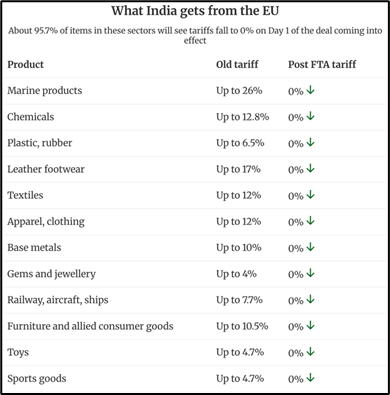
Image Caption: India’s Gains
- India secures tariff reductions across 97% of tariff lines, covering 99.5% of trade value.
- About 90.7% of India’s exports will enjoy zero-duty access to the EU market from day one.
- Key beneficiaries include labour-intensive sectors such as textiles, apparel, leather and footwear, gems and jewellery, marine products, toys, sports goods, tea, coffee, and spices.
- These sectors are critical for employment generation and export-led growth.
- The EU has also made commitments across 144 services subsectors, including IT and IT-enabled services, professional services, education, and business services.
- This enhances opportunities for Indian professionals and firms in a high-income market and strengthens India’s position in global value chains.
What India Has Conceded?
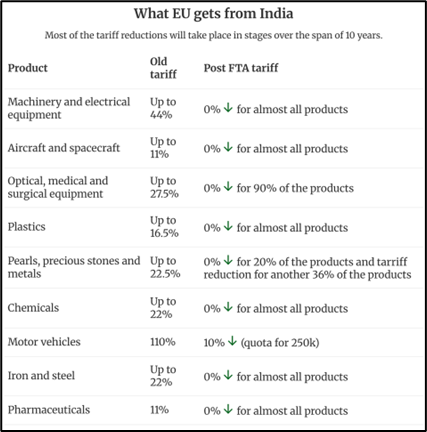
Image Caption: EU’s Gains
- India has agreed to duty elimination or reduction on 92.1% of tariff lines, covering 97.5% of EU exports.
- Nearly half of these tariff lines will see immediate duty elimination, while others will be phased out over 5, 7, or 10 years.
- High-technology imports from the EU, such as machinery, electrical equipment, medical devices, pharmaceuticals, aircraft components, and precision instruments, are expected to reduce input costs for Indian industry and support manufacturing competitiveness.
- Sensitive sectors like dairy and certain agricultural products have been excluded from full liberalisation to protect farmers’ livelihoods.
- Similarly, the EU has retained protections for products such as beef, sugar, rice, poultry, and milk powder.
Handling Sensitive and Contested Sectors
- Automobiles and wine were among the most contentious issues. A compromise was reached through quota-based systems.
- India agreed to lower import duties on European cars priced above Rs. 25 lakh from 110% to as low as 10%, subject to quotas and price-based categories.
- For wines, tariffs will be reduced from 150% to 20-30%, again under a quota mechanism.
- This approach balances consumer access and domestic industry protection.
Strategic and Geopolitical Significance
- For the EU, it reduces over-dependence on a limited set of global suppliers and strengthens supply chain resilience amid geopolitical uncertainties.
- For India, the agreement reinforces its image as a reliable economic partner and complements initiatives such as ‘Make in India’ and ‘Atmanirbhar Bharat’ by integrating domestic manufacturing with global markets.
Ratification and Implementation Process
- The concluded text will undergo legal scrubbing and translation before being sent to all 27 EU member states.
- Ratification by the European Parliament is required before the agreement enters into force. This process underscores the institutional complexity of EU trade governance.
Conclusion
- The India-EU Free Trade Agreement marks a watershed moment in India’s trade diplomacy.
- By opening markets while safeguarding sensitive sectors, the pact promises to boost exports, attract investment, generate employment, and deepen strategic ties between the two major economic blocs.
- Its successful implementation could serve as a template for India’s future trade agreements in an increasingly fragmented global trade environment.
Mains Article
28 Jan 2026
Why in News?
- At the India–EU Leaders’ Summit, the Indian PM, European Council President António Luís Santos da Costa, and European Commission President Ursula von der Leyen announced the successful conclusion of negotiations of the India–EU Free Trade Agreement (FTA).
- The agreement marks a major breakthrough in the India–EU Strategic Partnership, especially at a time of global trade uncertainty, tariff wars, and supply chain disruptions.
What’s in Today’s Article?
- Significance of the India–EU FTA
- Key Components and Takeaways of the Agreement
- Challenges and Way Forward
- Conclusion
Significance of the India–EU FTA:
- India and the EU together account for approximately 25% of global GDP and over one-third of global trade.
- The EU is India’s second-largest export destination after the US.
- The FTA complements India’s recent trade agreements with the UK and European Free Trade Agreement (EFTA).
Key Components and Takeaways of the Agreement:
- Trusted strategic partnership:
- Based on shared democratic values, rule of law, and human rights, highlighting India’s soft power, and diaspora diplomacy.
- Strengthened by people-to-people ties, including 1.7 million Indian diaspora in the EU, and 1.21 lakh Indian students.
- Economic complementarity, scale and diversity:
- India (4th largest economy) and EU (2nd largest economy) are complementary rather than competitive.
- Market integration opens unprecedented trade and investment opportunities.
- Trade diversification, supply chain resilience, and de-risking: This will reduce excessive dependence on China-centric supply chains. It is critical amid US–China trade tensions and rising weaponisation of trade.
- Commercially meaningful ‘Win–Win’ deal:
- For India, major gains in labour-intensive sectors such as textiles & clothing, gems & jewellery, and leather & footwear. These sectors face high EU tariffs, making the FTA economically significant.
- For the EU, India is a large, fast-growing market with relatively higher tariffs, giving the EU a significant advantage vis-a-vis its competitors (with India-EU FTA).
- Safeguarding sensitive agriculture, food security: Core agriculture sectors excluded dairy, cereals, meat, select fruits and vegetables. This addresses concerns of farmers, a key political and electoral constituency.
- Calibrated opening of the auto sector:
- EU automakers allowed entry primarily in higher price segments, encouraging Make in India, future exports from India.
- Auto sector liberalisation will benefit Indian consumers from technology transfer and competition.
- Carbon Border Adjustment Mechanism (CBAM), green protectionism: Despite CBAM being a very sensitive and complex regulation, FTA provides most favoured treatment, dedicated technical dialogue, and EU support to India for climate transition.
- Services as the future growth driver:
- Services are expected to dominate bilateral trade growth, promoting services trade, digital economy, and mobility of professionals.
- Key gains for India are certainty of market access, non-discriminatory treatment, boost to digitally delivered services, ease of mobility and social security coordination, and greater penetration of Indian talent and students.
- Living agreement with review mechanisms:
- Agreement designed as a “living document” includes periodic review clauses, consultation mechanisms for emerging technologies and regulations.
- It relies on mutual trust and strong institutional stewardship.
- Signal to global business and the US:
- Projects India as a supporter of open, fair, stable, rule-based trading order.
- Sends a strong message amid tariff wars, protectionism, unilateral trade actions (including by the US), promoting multilateralism, and trade certainty.
Challenges and Way Forward:
- Managing adjustment costs: In sensitive domestic sectors. Leveraging the FTA to boost manufacturing, services, and exports.
- Aligning regulatory standards and compliance mechanisms: Effective implementation with capacity-building support.
- Addressing CBAM-related competitiveness concerns: Using review mechanisms to adapt to technological and climate transitions.
- Ensuring gains for MSMEs and small farmers: Strengthening domestic competitiveness through reforms.
Conclusion:
- The India–EU FTA is not merely a trade agreement but a strategic economic compact that reinforces India’s commitment to openness, diversification, and rule-based global trade.
- By balancing market access with protection of sensitivities, and embedding flexibility through a living framework, the agreement positions India as a reliable global economic partner in an era of uncertainty—making it a landmark step in India’s evolving trade diplomacy.
Mains Article
28 Jan 2026
Context
- India’s logistics ecosystem has been transformed by the rapid expansion of Light Commercial Vehicles, which underpin last-mile delivery in the e-commerce
- These vehicles operate intensively and travel long daily distances, yet for years they existed in a regulatory blind spot.
- While passenger cars were brought under fuel economy rules, LCVs remained outside mandatory limits.
- This changed in July 2025, when the Bureau of Energy Efficiency proposed fuel efficiency standards for LCVs for the 2027–2032 period, marking a decisive shift in clean transport policy.
The Significance of LCVs in India’s Emissions Landscape
- LCVs accounted for 48% of India’s commercial goods vehicle fleet in 2024, making them central to freight movement and urban air quality.
- Despite this dominance, electrification remains minimal at just 2%.
- The climate implications are substantial: average LCV fleet emissions stood at 147.5 g CO2/km in 2024, and without even this small electric share, emissions would rise to 150 g CO₂/km.
- This demonstrates that limited electrification can still produce measurable gains, reinforcing the importance of regulating this segment within India’s broader decarbonisation strategy.
Industry Resistance and Government Resolve
- Automakers initially lobbied for exemptions, arguing that the LCV market is highly price-sensitive and that compliance would require costly upgrades.
- These concerns mirror earlier industry resistance in the passenger car segment.
- However, the government’s refusal to dilute the proposal signals a clear policy commitment to decarbonisation.
- The experience with passenger vehicles, where electric adoption remains around 3% after years of regulation, illustrates that exemptions and weak targets can significantly blunt the impact of otherwise well-intentioned rules.
Fuel Efficiency Standards and the Economics of Electrification
- The effectiveness of fuel economy regulation depends largely on its stringency.
- Weak standards encourage incremental improvements to ICE vehicles rather than a shift to electric powertrains.
- Research shows that at 116.5 g CO₂/km, further reductions become cheaper through electric vehicles than through ICE optimisation.
- The proposed target of 115 g CO₂/km marginally crosses this threshold, making electric LCVs technically viable but not compelling enough to trigger large-scale transition.
- Market dynamics further complicate adoption. Conventional LCVs typically cost under ₹1 million, while electric equivalents remain more expensive.
- Although battery-powered vehicles offer lower lifetime operating costs, inconsistent policy support undermines demand.
- National schemes exclude LCVs, leaving adoption dependent on uneven state-level incentives, which weakens investor confidence and slows scale-up.
Super Credits, Hybrids, and the Risk of Regulatory Dilution
- To address early barriers, the proposal introduces super credits for electric LCVs and assigns them a zero CO₂ value for compliance, making them attractive for manufacturers seeking cost-effective compliance.
- This approach aligns with international practices and can accelerate early market entry. However, the policy also extends similar benefits to hybrids and offers offset factors for select ICE technologies.
- While intended as transitional measures, these provisions risk delaying full electrification.
- If manufacturers can comply through partial solutions rather than committing to BEVs, investment in dedicated electric platforms may be postponed.
- The plan to phase out super credits for electric LCVs while retaining support for hybrids and ICE technologies could entrench conventional powertrains rather than displace them.
Conclusion
- India has taken a necessary step by bringing LCVs under fuel efficiency regulation, recognising their scale and environmental impact.
- Yet regulation alone is insufficient without careful design. Strong targets that make electrification economically attractive, combined with time-bound incentives that clearly prioritise BEVs, are essential for meaningful transformation.
- Without this alignment, India risks repeating the passenger car experience, where cautious standards have slowed the transition to clean mobility rather than accelerating it.
Mains Article
28 Jan 2026
Context
- The recent decline in the value of the Indian rupee has caused considerable concern among market participants and the general public.
- What makes this episode particularly puzzling is that it has occurred despite strong macroeconomic fundamentals.
- India currently enjoys robust economic growth, historically low inflation, and a manageable current account deficit, conditions that typically support currency stability.
- The depreciation of the rupee, therefore, cannot be adequately explained through conventional economic indicators.
- Instead, it reflects the growing influence of geopolitical tensions and capital flow volatility, especially arising from strained trade relations with the United States.
Strong Macroeconomic Fundamentals
- India’s macroeconomic performance remains strong by both domestic and international standards.
- Economic growth is estimated at 7.4% for the current year, reinforcing India’s position as one of the fastest-growing major economies.
- Inflation has been remarkably subdued, with consumer price inflation falling to 1.33% by the end of 2025, well below the Reserve Bank of India’s lower tolerance band for several consecutive months.
- The external sector also appears stable, with the current account deficit amounting to only 0.76% of GDP in the first half of 2025–26, a significant improvement over the previous year.
- Despite these favourable indicators, the rupee has depreciated by around 6% since April 2025.
Reason Behind Rupee Depreciation
- Capital Outflows as the Primary Cause
- A closer examination shows that the primary driver of the rupee’s decline is not the trade deficit but capital outflows.
- Although India’s merchandise and services trade deficit widened modestly during April-December 2025, it remains within manageable limits and does not justify the magnitude of the currency’s fall.
- In contrast, capital flows have undergone a sharp reversal. Net capital inflows of over $10 billion during April–December 2024 turned into net outflows of nearly $4 billion in the corresponding period of 2025.
- This reversal has exerted significant downward pressure on the rupee and reflects deteriorating investor sentiment rather than economic weakness.
- Geopolitical Tensions and U.S. Trade Policy
- These capital outflows are closely linked to geopolitical developments, particularly the increasingly adverse trade stance of the United States toward India.
- The imposition of a cumulative 50% tariff on Indian exports, initially on a reciprocal basis and later due to India’s import of Russian crude oil, has heightened uncertainty among investors.
- Additional threats of tariffs on countries trading with Iran, despite India’s limited trade exposure, have further intensified fears.
- As tariffs are increasingly weaponised for geopolitical objectives, economic fundamentals have taken a back seat in shaping investment decisions.
Shift from Economic to Diplomatic Determinants and the Role of the Reserve Bank of India
- Shift from Economic to Diplomatic Determinants
- This episode marks a departure from earlier instances of rupee depreciation.
- In 2022, for example, the rupee’s fall could be explained by global economic factors such as aggressive interest rate hikes by the U.S. Federal Reserve.
- The present depreciation, however, lacks a clear economic rationale and is driven largely by non-economic pressures.
- Consequently, the challenge has moved from the economic arena to the diplomatic sphere, implying that conventional macroeconomic tools alone are insufficient to address the problem.
- Role of the Reserve Bank of India
- In this context, the role of the Reserve Bank of India is important but constrained.
- Since the adoption of a market-determined exchange rate regime in 1993, the RBI has intervened in foreign exchange markets primarily to reduce volatility rather than to fix the rupee’s value.
- Although volatility has never been formally defined, RBI actions indicate that it includes moderating sharp and disruptive depreciations.
- Such intervention seeks to minimise the costs of sudden exchange rate shocks while allowing the currency to adjust gradually.
Why Rupee Depreciation is Not a Solution?
- The argument that rupee depreciation could stimulate exports is weak under present conditions.
- India’s exports increasingly depend on imported inputs, reducing the competitive advantage gained from a weaker currency.
- Moreover, high tariffs in the U.S. market significantly limit export growth. On the import side, India relies heavily on essential commodities, particularly crude oil, which accounts for a large share of total imports.
- A weaker rupee would raise import costs and risk fuelling inflation, undermining price stability.
Conclusion
- The recent decline in the value of the rupee is primarily the result of capital outflows driven by geopolitical tensions rather than weak economic fundamentals.
- As long as uncertainty over trade relations with the United States persists, downward pressure on the rupee is likely to continue, with potential spillover effects on financial markets.
- While the Reserve Bank of India can smoothen volatility, a lasting solution lies in diplomatic engagement.
- An early and credible understanding between India and the United States is essential to restore investor confidence, stabilise capital flows, and ensure long-term currency stability.
Jan. 27, 2026
Mains Article
27 Jan 2026
Why in news?
At the 77th Republic Day Parade on Kartavya Path, the Defence Research and Development Organisation (DRDO) unveiled the Long Range Anti-Ship Hypersonic Missile (LR-AShM) for the first time.
This draws attention to other hypersonic missile programmes under development, signalling India’s growing focus on next-generation strategic and tactical weaponry.
What’s in Today’s Article?
- LR-AShM: India’s Hypersonic Glide Missile
- Strategic Significance and Road Ahead of LR-AShM
- India’s Other Hypersonic Cruise Missile Efforts
- Ramjets vs Scramjets
LR-AShM: India’s Hypersonic Glide Missile
- The DRDO showcased the Long Range Anti-Ship Hypersonic Missile (LR-AShM) along with its launcher.
- The system is tailored to meet the Indian Navy’s coastal battery requirements and can engage both static and moving targets at ranges of up to 1,500 km, carrying multiple payload options.
- Quasi-Ballistic, Hypersonic Flight Profile
- The LR-AShM follows a quasi-ballistic trajectory, beginning like a ballistic missile but flying at lower altitudes and manoeuvring mid-course.
- It reaches hypersonic speeds of Mach 10 initially and sustains average speeds of Mach 5, using multiple atmospheric skips to evade interception.
- Low Detectability and High Survivability
- Flying at low altitude with extreme speed and manoeuvrability, the missile remains largely undetectable to enemy ground- and ship-based radars.
- Its flight profile significantly reduces reaction time for adversary air-defence systems.
- Two-Stage Propulsion and Glide Phase
- The missile uses a two-stage solid rocket motor.
- Stage I boosts the missile to hypersonic velocity and then separates.
- After Stage II burnout, the vehicle enters an unpowered hypersonic glide phase, executing controlled manoeuvres within the atmosphere before striking the target.
- High Aerodynamic Efficiency
- According to DRDO scientists, the LR-AShM has high aerodynamic efficiency, enabling it to generate effective lift with minimal drag.
- This allows the missile to travel farther, faster, and more accurately using the same energy, enhancing its operational effectiveness.
Strategic Significance and Road Ahead of LR-AShM
- The hypersonic speed of the LR-AShM makes detection and interception extremely difficult.
- Travelling at such velocities, it can cover a 1,500 km range in about 15 minutes, sharply reducing enemy reaction time.
- Extended-range variants of up to 3,500 km are already under development.
- Boost to Sea Denial Capabilities
- The missile can neutralise all classes of warships.
- Current and future variants are expected to become a critical asset for sea denial operations, especially in the strategically vital Indian Ocean Region, limiting an adversary’s military and commercial use of maritime spaces.
- Multi-Service and Multi-Platform Potential
- Beyond the Navy’s coastal batteries, Army and Air Force versions are under consideration, along with ship-launched variants.
- This versatility across platforms could firmly place India among a small group of nations with advanced hypersonic weapons capability.
- Leveraging Proven Missile Technologies
- The LR-AShM draws on key technologies from India’s existing missile programmes, including the K-15 (Sagarika) from the K-missile family and the BrahMos Aerospace supersonic cruise missile.
- This reflects a convergence of proven propulsion and guidance systems into a next-generation hypersonic platform.
India’s Other Hypersonic Cruise Missile Efforts
- Amid intense global competition, the DRDO is pursuing two parallel hypersonic paths: hypersonic glide and hypersonic cruise.
- A Hypersonic Glide Vehicle (HGV) is launched via rocket into high altitudes, then detaches to glide and maneuver through the atmosphere at speeds exceeding Mach 5.
- Unlike glide vehicles, hypersonic cruise missiles fly within the atmosphere at hypersonic speeds and rely on scramjet engines for sustained, powered flight and high manoeuvrability.
- The LR-AShM represents the glide vehicle track, showcasing major indigenous advances in materials and control systems for sustained hypersonic flight.
Ramjets vs Scramjets
- Ramjets are air-breathing engines that compress incoming air using forward motion; they need assisted take-off and work best around Mach 3, losing efficiency at hypersonic speeds.
- Scramjets keep airflow supersonic in the combustion chamber, enabling efficient operation above Mach 5, but are far more complex to design and operate.
- Recent Breakthrough: Full-Scale Scramjet Testing
- Earlier this month, DRDO achieved a major milestone by conducting ground tests of an Actively Cooled Scramjet Full-Scale Combustor, recording a run time of over 12 minutes.
- This built on a successful subscale test conducted on April 25 last year that ran for more than 1,000 seconds.
- DRDO had earlier demonstrated hypersonic air-breathing scramjet technology with the Hypersonic Technology Demonstration Vehicle flight test in September 2020 from Dr APJ Abdul Kalam Launch Complex.
- This marked a foundational step toward operational hypersonic cruise missiles.
Mains Article
27 Jan 2026
Why in news?
Gold prices have surged past the $5,000 per ounce mark for the first time, even as the US dollar slid to a four-month low. The rally is being driven not just by households, but by aggressive buying from central banks worldwide.
Major central banks have emerged as key buyers of gold, signalling a strategic shift in reserve management. While households traditionally buy gold as a hedge, it is the actions of central banks that underline a deeper structural change in the global financial system.
The underlying driver of this trend is Donald Trump. His trade wars, sanctions-heavy foreign policy, and use of the US dollar as a geopolitical weapon have prompted many countries to reduce reliance on dollar-denominated assets.
As trust in the dollar’s neutrality weakens, gold—being politically neutral and free from sanctions risk—has regained prominence as a reserve asset.
What’s in Today’s Article?
- RBI’s Gold Holdings Drive Forex Reserve Growth
- Debasement of the US Dollar: What’s Driving the Shift
- Weaponising Capital Flows: De-Dollarisation Accelerates
- The Past: How De-Dollarisation Gained Momentum?
RBI’s Gold Holdings Drive Forex Reserve Growth
- India’s central bank, Reserve Bank of India, reported a sharp rise in foreign exchange reserves, with nearly one-third of the increase coming from gains in the value of its gold holdings.
- Although the RBI added only a small quantity of gold, the 70% rise in gold prices over the past year significantly boosted the value of its reserves, far outpacing gains from foreign currency assets.
- Gold’s Rising Share in Reserves
- What matters more than absolute purchases is gold’s share in total reserves.
- In India’s case, gold now accounts for 17% of forex reserves, up from 12% a year ago. Similar shifts are visible across several emerging and advanced economies.
- Global Central Banks Buy More Gold
- The RBI is not alone. Central banks in Poland, Kazakhstan, and Brazil were among the world’s largest gold buyers in 2025, according to data from the World Gold Council.
- This highlights a coordinated global trend rather than isolated national decisions.
Debasement of the US Dollar: What’s Driving the Shift
- Experts argue that a combination of trade protectionism, sanctions, and the emergence of a multipolar world is gradually pushing global investors away from the US dollar.
- US President Trump has repeatedly asserted the need to preserve the dollar’s global dominance, even threatening BRICS countries with punitive tariffs if they pursue alternatives to the dollar.
- Ironically, his aggressive use of tariffs, sanctions, and economic coercion has accelerated doubts about the dollar’s neutrality and reliability.
- These dynamics have contributed to a sharp weakening of the US dollar—down about 9% in 2025, its steepest fall in nearly a decade.
- As confidence in the greenback erodes, investors and central banks have increasingly turned to gold as a safe-haven asset.
- Why It Matters?
- De-dollarisation threatens to dilute US financial power, reducing Washington’s ability to shape global trade and financial systems.
- At the same time, policy uncertainty and geopolitical sabre-rattling have boosted demand for gold, reinforcing its role as a hedge against currency debasement and geopolitical risk.
Weaponising Capital Flows: De-Dollarisation Accelerates
- De-dollarisation is most visible in commodities, with a growing share of global energy trade now priced in non-dollar contracts, weakening the dollar’s traditional dominance.
- The trend is extending to government bond holdings.
- The Reserve Bank of India has steadily reduced its US Treasury exposure, with holdings falling to $186.5 billion in November 2025 from $234 billion a year earlier.
- China’s US government bond holdings have also dropped to a 16-year low.
- Institutional Investors Start Exiting US Treasuries
- Concerns are no longer limited to states.
- Denmark’s major pension funds announced plans to exit US Treasuries, citing geopolitical uncertainty, including comments by Donald Trump, and Danish pension funds have taken similar positions.
- Earlier this month, Deutsche Bank warned that US threats against Europe could prompt the continent to cut holdings of US debt, effectively weaponising capital flows.
- The European Union holds about $10.4 trillion in US portfolio assets, accounting for nearly 29% of foreign ownership.
- Trump has warned of “big retaliation” if Europe sells US bonds, underscoring how financial flows are becoming tools of geopolitical leverage.
The Past: How De-Dollarisation Gained Momentum
- The move away from the US dollar gathered pace after United States Government froze Russia’s foreign exchange reserves following its invasion of Ukraine in February 2022.
- This action heightened concerns among countries about the safety of holding dollar-denominated assets.
- De-dollarisation has been gradual but persistent. Data from the IMF show that the US dollar’s share in global foreign exchange reserves fell to a 30-year low of 58.5% in 2024, down from 71% in 1999, reflecting steady diversification by central banks.
- The Future: Dominance for Now, Uncertainty Ahead
- Despite these shifts, the US dollar remains overwhelmingly dominant, accounting for 89% of global over-the-counter foreign exchange turnover.
- However, if current US policies and rhetoric continue, especially under the Trump administration, the pace of diversification away from the dollar could accelerate, leading to more visible structural change in the global monetary system.
Mains Article
27 Jan 2026
Why in News?
- India records the highest number of road accident fatalities globally, far exceeding China and the United States.
- In this backdrop, the Government of India, through the Ministry of Road Transport and Highways (MoRTH), is planning to introduce Vehicle-to-Vehicle (V2V) communication technology as part of its broader road safety and Intelligent Transport Systems (ITS) initiative.
- The move aligns with India’s commitment to reduce road deaths and improve traffic management through technology-driven solutions.
What’s in Today’s Article?
- Road Accident in India
- What is Vehicle-to-Vehicle (V2V) Technology
- Institutional and Policy Developments in India
- Working of V2V
- Phased Rollout Strategy
- Global Experience with V2V Systems
- Challenges and Concerns
- Way Forward
- Conclusion
Road Accident in India:
- Calendar year 2023: A total number of 4,80,583 road accidents have been reported by Police Departments of States and UTs in the country, claiming 1,72,890 lives and causing injuries to 4,62,825 persons.
- 2024 data given by MoRTH in Parliament: The number of road accident fatalities in India rose 2.3% to over 1.77 lakh in 2024, resulting in the death of 485 persons every day.
- Comparison with other countries: As per the World Road Statistics 2024, the fatality rate per lakh population is 4.3 in China, and 12.76 in the United States of America, as compared to India, where it is 11.89.
- International obligation: The Stockholm Declaration on Road Safety, adopted at the 3rd Global Ministerial Conference on Road Safety (in 2020), sets a new global target to reduce road traffic deaths and injuries by 50% by 2030.
What is Vehicle-to-Vehicle (V2V) Technology?
- V2V is a wireless communication system that allows vehicles to exchange real-time data such as speed, location, acceleration, braking patterns.
- It is a sub-set of Vehicle-to-Everything (V2X) technology and falls under the Intelligent Transport System (ITS) framework.
- The system is inspired by aviation safety technology, where aircraft continuously broadcast their position and speed to nearby aircraft and ground stations.
Institutional and Policy Developments in India:
- 30 GHz radio frequency spectrum has been allocated by the Department of Telecommunications (DoT) under the National Frequency Allocation Plan.
- A Joint Task Force has been constituted between MoRTH and DoT.
- Standards are being developed in collaboration with Original Equipment Manufacturers (OEMs).
- V2V is identified as a key initiative under MoRTH’s road safety programme.
Working of V2V:
- On-board unit (OBU): Vehicles will be fitted with an OBU costing approximately ₹5,000–₹7,000. OBUs enable wireless data exchange between nearby vehicles within a 300-metre range.
- Functional benefits:
- Alerts drivers about sudden braking by vehicles ahead; black spots and accident-prone zones; fog, obstacles, or parked vehicles; potential collision risks.
- Example: If a vehicle brakes suddenly, surrounding vehicles receive an early warning, helping prevent pile-ups and crashes.
Phased Rollout Strategy:
- First phase: Mandatory installation in new vehicles.
- Second phase: Retrofitting in older vehicles.
- Spectrum cost: It will be provided free of cost, reducing compliance burden on OEMs.
- Targeted implementation: Within the current year, post notification of standards.
Global Experience with V2V Systems:
- United States: Global leader in V2V research and regulation.
- Europe: Germany, France, UK integrating V2V in smart city and mobility projects.
- Japan: ITS Connect programme providing real-time traffic and emergency alerts.
- China: Major adopter with strong integration into smart mobility.
- Pilot stages: Like India, countries like the UAE, Saudi Arabia, Brazil, Mexico, etc., are in early pilot stages to roll out V2V communication systems.
- Examples of V2V-enabled vehicles: Volkswagen Golf 8, Cadillac models (USA).
Challenges and Concerns:
- Technological limitations: Frequency bands may not support all vehicle categories uniformly. Risk of miscommunication or signal failure, potentially causing accidents.
- Data privacy and surveillance: Large-scale collection of data related to vehicle movement, driver behaviour, location tracking. Raises concerns under data protection and privacy frameworks.
- Cybersecurity risks: Vulnerability to cyberattacks. Possibility of system hijacking leading to large-scale security threats.
- Regulatory gaps: Need for robust legal and regulatory framework; clear standards on data ownership, liability, and accountability.
Way Forward:
- Comprehensive standards: Formulation of comprehensive V2V standards aligned with global best practices.
- Integration: With India’s Digital Public Infrastructure (DPI) and upcoming Data Protection laws.
- Periodic audits: To strengthen cybersecurity architecture.
- Phased and inclusive adoption: To cover commercial and private vehicles.
- Capacity building: Of enforcement agencies and public awareness campaigns.
Conclusion:
- The introduction of V2V communication technology marks a significant step towards technology-enabled road safety governance in India.
- While the initiative has the potential to substantially reduce road accidents and fatalities, its success will depend on effective implementation.
- If executed prudently, V2V can become a cornerstone of India’s transition to smart, safe, and sustainable mobility, aligning with broader goals of Vision Zero and intelligent transport ecosystems.
Mains Article
27 Jan 2026
Why in the News?
- The Union government has proposed the Draft IT (Digital Code) Rules, 2026, to regulate obscenity and introduce mandatory age-based classification for all digital content.
What’s in Today’s Article?
- Online Content (Background, Legal Basis, etc.)
- Draft IT Rules (Key Features, Classification, Enforceability, Concerns, Significance, etc.)
Background: Regulation of Online Content in India
- India’s digital ecosystem has expanded rapidly with the growth of OTT platforms, social media, and user-generated content.
- While this has strengthened freedom of expression, it has also raised concerns related to obscenity, hate speech, misinformation, and harmful content, particularly for children.
- Online content regulation in India is primarily governed by the Information Technology Act, 2000, and the IT (Intermediary Guidelines and Digital Media Ethics Code) Rules, 2021.
- However, repeated controversies involving social media influencers and OTT content have highlighted regulatory gaps, prompting judicial scrutiny and policy reconsideration.
- In this context, the proposed Draft IT (Digital Code) Rules, 2026 aim to introduce a more detailed content classification and compliance framework for digital platforms.
Legal Basis of the Draft IT (Digital Code) Rules, 2026
- The draft rules have been proposed under Section 87(1) of the IT Act, 2000, read with Sections 67, 67A, and 67B, which deal with the publication and transmission of obscene, sexually explicit, and child sexual abuse material in electronic form.
- The proposal follows a Supreme Court direction asking the government to strike a balance between:
- Freedom of speech under Article 19(1)(a), and
- Reasonable restrictions under Article 19(2), especially in matters of morality, public order, and decency.
Key Features of the Draft IT (Digital Code) Rules, 2026
- Definition of Obscene Content
- The draft borrows heavily from the Programme Code under the Cable Television Networks Rules, 1994, defining obscene content as material that is lascivious, appeals to prurient interests, or tends to deprave and corrupt viewers.
- List of Prohibited Content
- Attack religions, communities, caste, or nationality
- Promote communal attitudes or violence
- Contain defamatory or deliberately misleading material
- Denigrate women, children, or persons with disabilities
- Present criminality, obscenity, or violence as desirable
- Use explicit language or scenes when targeted at children
- These provisions significantly widen the scope of content scrutiny.
Mandatory Age-Based Classification System
- A major structural change proposed is compulsory age classification of all digital content, similar to film certification. The age categories include:
- U - Suitable for all ages
- 7+, 13+, 16+
- Adult-only content
- Specialised categories for professional audiences (e.g., doctors, scientists)
- Each content item must display Age rating & Content descriptors (violence, sex, nudity, drugs, language, horror)
Parental Controls and Age Verification
- The draft mandates:
- Parental control mechanisms for content rated 13+ and above
- Reliable age verification systems for adult-only content
- This places additional compliance obligations on platforms, particularly OTT services and social media intermediaries.
Applicability and Enforcement Framework
- All provisions of the IT (Intermediary Guidelines and Digital Media Ethics Code) Rules, 2021 will continue to apply alongside the new draft code.
- The rules are expected to introduce civil consequences for violations, increasing regulatory accountability for Online Curated Content Providers (OCCPs).
Concerns Raised by Industry and Stakeholders
- The rules blur the distinction between linear television broadcasting and on-demand digital content.
- OTT platforms operate on a “pull” model, where users choose content actively, unlike TV’s “push” model.
- Applying broadcast-era obscenity standards to age-gated, password-protected platforms may reduce creative freedom.
- Broad and subjective terms could encourage arbitrary complaints and regulatory uncertainty.
- These concerns highlight the tension between regulation and innovation in India’s digital economy.
Significance for Governance and Society
- The draft rules reflect the government’s attempt to:
- Protect children and vulnerable audiences
- Standardise content classification across platforms
- Address judicial concerns regarding unregulated online obscenity
Mains Article
27 Jan 2026
Context
- One of the most persistent gaps in science outreach lies in Language itself.
- Scientific knowledge, no matter how advanced, loses impact when conveyed through dense jargon disconnected from everyday realities.
- In climate policy, this failure of communication has serious consequences. Words shape how problems are understood and acted upon; when language narrows meaning, it weakens governance and limits the scope of possible responses.
- The evolving use of the term Loss and Damage in climate discourse demonstrates how linguistic slippage can undermine climate action.
The Semantic Collapse of Loss and Damage
- At international climate negotiations, Loss and Damage refers to climate impacts that exceed the limits of adaptation.
- These include not only physical destruction, but also irreversible losses: cultural identity, ancestral lands, biodiversity, and ecosystems that cannot be restored.
- The term is intended to capture what is permanently lost, not merely what can be repaired.
- As this language moves into national and local administrative systems, its meaning narrows. Through bureaucratic translation, loss becomes a post-disaster assessment exercise, while damage is reduced to compensation determined by fixed norms.
- Climate impacts are absorbed into disaster management categories designed for short-term events rather than slow, cumulative change.
- As a result, international discussions of Loss and Damage finance are often understood locally as routine relief funding, stripping the concept of its broader ethical and political intent.
- This semantic contraction is not trivial.
- When language collapses into what can be quantified and closed, policy responses follow the same logic.
- Irreversible climate harms remain unaddressed, and ambitious global commitments risk becoming abstract promises rather than transformative interventions.
The Data–Decision Paradox in Climate Science
- Climate science capacity has expanded rapidly, producing unprecedented volumes of data on heat, floods, crops, and extreme events.
- Yet this growth has not translated into better decisions. Instead, a paradox has emerged: more information exists, but less clarity about how to act on it.
- Technical assessments often rely on indices and probabilistic models that remain distant from real-world decision-making.
- Local administrators may receive complex reports yet struggle to apply them under time pressure.
- Communities encounter fragmented climate messages that lack consistency or relevance.
- Information alone does not drive behaviour; people act when knowledge aligns with lived experience and practical constraints.
- This gap reveals a fundamental flaw in climate policy practice: science is prioritised as output rather than as a usable input into everyday governance.
Communication as Infrastructure, Not an Add-On
- Climate communication is frequently treated as secondary to technology and policy. In practice, it functions as essential infrastructure.
- Heat advisories that ignore informal labour realities, or flood alerts that assume universal access to smartphones, fail because they overlook social context.
- Sophisticated dashboards often go unused because they are not designed around how choices are made in moments of crisis.
- Where communication succeeds, outcomes improve dramatically. Long-term investment in credibility builds trust, enabling warnings to trigger timely action.
- In such cases, communication becomes as critical to preparedness as physical shelters or sensors.
- Clear messaging also strengthens responses to heat and floods by translating abstract risk into tangible consequences: health emergencies, school disruptions, water scarcity, and income loss.
- This framing helps justify public investment and enables communities to respond proactively rather than reactively.
Towards a Use-Oriented Climate Communication Framework
- Effective climate communication begins with use. It links projections directly to choices: changes in work schedules, public health planning, transport routes, and service delivery.
- This requires localisation across languages and contexts, and the humanising of climate science through everyday experience.
- Co-creation with frontline workers, local leaders, farmers, fishers, teachers, and journalists ensures that information fits decision-making realities.
- To sustain this approach, communication capacity must be embedded within institutions, supported by strong partnerships with the media so climate risks are consistently understood and acted upon.
Conclusion
- When communication fails, science remains trapped in reports and policies struggle to reach practice.
- When it succeeds, resilience becomes a shared social and political outcome. Language is not neutral: it determines which losses are recognised and which actions are considered possible.
- Turning climate knowledge into collective action therefore requires treating communication not as an afterthought, but as a central pillar of climate governance.
Mains Article
27 Jan 2026
Context
- The Viksit Bharat-Guarantee for Rozgar and Ajeevika Mission (Gramin) Act (VB–G RAM G Act) has been presented as a major reform of rural employment policy.
- Supporters portray it as an expansion of employment guarantee provisions, while critics argue that it weakens the legal and moral foundations of rural job security established under MGNREGA.
- A closer examination of the Act and the arguments advanced in its favour reveals that the proposed changes dilute core principles, limit workers’ protections, and prioritise administrative control over social rights.
The Illusion of an Expanded Employment Guarantee
- A central claim is that the VB-GRAMG Act enhances rural employment security by increasing the number of guaranteed workdays from 100 to 125 per household.
- This claim, however, is undermined by the discretionary clause in Section 5(1), which restricts the applicability of the guarantee to areas notified by the Central government.
- Such discretion contradicts the idea of a universal and enforceable right to work.
- By contrast, MGNREGA establishes a non-negotiable entitlement to employment upon demand.
- The possibility that the guarantee may not apply uniformly defeats its purpose and converts a legal right into an administrative privilege.
- Moreover, extending workdays to 125 could have been achieved within the existing MGNREGA framework, as several States have already done. This change, therefore, does not justify replacing the earlier Act.
The Myth of Disentitlement Reform
- Another defence of the VB–G RAM G Act is the removal of a so-called disentitlement provision from MGNREGA.
- The original clause merely suspended unemployment allowance for individuals who refused work after applying.
- It was designed to deter frivolous applications and has never been used in any significant way.
- The removal of this redundant provision has no meaningful effect on workers’ access to employment or benefits.
- Presenting it as a major pro-worker reform exaggerates its importance and distracts from more substantive concerns.
- The protection of workers was neither enhanced nor diminished in practice by this change.
Normative Funding and the Abandonment of Demand-Driven Employment
- A more consequential shift under the VB–G RAM G Act is the move from demand-driven financing to normative funding.
- Fixed allocations determined by the Centre are promoted as a way to improve fiscal discipline and ensure fairness across States.
- However, a genuine employment guarantee cannot coexist with predetermined expenditure limits.
- In reality, normative allocations are likely to operate as budget caps, discouraging States from meeting actual employment demand.
- The claim that MGNREGA spending favours better-off States lacks empirical support, as no consistent correlation exists between employment levels and poverty
- Poorer States would be better served by higher wages, not by funding ceilings and cost-sharing arrangements.
Digital Technology and the Question of Corruption
- Proponents also argue that the VB–G RAM G Act will reduce corruption through greater reliance on digital technology.
- Yet MGNREGA already incorporates extensive systems for electronic payments, monitoring, and digitisation.
- These mechanisms have delivered mixed outcomes, often producing delays, exclusions, and technical failures.
- Such problems have sometimes weakened transparency and incentivised informal arrangements that undermine accountability.
- Rather than correcting these shortcomings, the new Act reinforces faith in technological solutions without addressing their documented limitations.
- Digital systems, when poorly implemented, can erode trust and harm participation.
Repackaging Rather Than Reform
- Several provisions highlighted as innovations in the VB–G RAM G Act, such as strengthened audits and timely wage payments, closely resemble existing MGNREGA clauses.
- Presenting these features as novel obscures the continuity between the two Acts and suggests a strategy of policy rebranding rather than substantive improvement.
- The broader pattern points toward increased centralisation of authority, with diminished space for State initiative and community oversight.
- In this process, workers and their rights risk being subordinated to administrative convenience and political messaging.
Conclusion
- The VB–G RAM G Act does not convincingly strengthen India’s rural employment framework.
- By weakening the universality of the employment guarantee, imposing fiscal constraints incompatible with demand-based work provision, and overstating the benefits of digitisation, the Act departs from the foundational principles that made MGNREGA a landmark policy.
- Rather than replacing an established system, meaningful reform would require reinforcing existing guarantees, addressing wage inadequacies, and prioritising workers’ rights over symbolic restructuring.