Feb. 28, 2026
Mains Article
28 Feb 2026
Why in news?
Pakistan and Afghanistan have entered a sharp new phase of hostilities, with Pakistan bombing Kabul and other provinces after a cross-border attack on its troops. Pakistan’s Defence Minister termed the situation an “open war” with the Taliban-led Afghan government.
The escalation follows months of tensions, with Islamabad accusing Kabul of sheltering militants responsible for attacks inside Pakistan. However, the strain between the two countries is rooted in a much longer history.
Since 1947, relations have largely been marked by distrust, hostility, and recurring confrontations. These tensions have persisted across changes in governments in Pakistan and major upheavals in Afghanistan, including the Soviet intervention (1979–1989) and the US intervention (2001–2021), during both of which Pakistan supported Afghan resistance groups.
What’s in Today’s Article?
- Regime Changes in Afghanistan: A Turbulent Political History
- Persistent Fault Lines in Pakistan–Afghanistan Relations
- The Durand Line: A Root of Pakistan–Afghanistan Tensions
- Trade and Transit: A Strategic Pressure Point
Regime Changes in Afghanistan: A Turbulent Political History
- End of the Monarchy and Communist Rule (1973–1989) - Afghanistan’s monarchy ended in 1973, followed by a brief nationalist phase and then 11 years of communist rule backed by the Soviet Union. The regime attempted sweeping political and social reforms but failed to stabilise the country.
- Najibullah and Collapse (1989–1992) - After the Soviet withdrawal, President Najibullah led a nationalist government for three years. His administration collapsed in 1992, paving the way for internal conflict.
- Civil War and First Taliban Rule (1992–2001) - Afghanistan descended into civil war between Mujahideen factions and the emerging Taliban movement. Formed in 1994, the Taliban — supported by Pakistan — captured Kabul in 1996 and controlled most of the country.
- US Intervention and Islamic Republic (2001–2021) - Following the September 11, 2001 attacks, the US invaded Afghanistan, ousting the Taliban and establishing the Islamic Republic of Afghanistan. However, the new political system struggled to gain lasting stability, and the Taliban insurgency persisted.
- Taliban Return to Power (2021) - After the US withdrawal in August 2021, the Taliban swiftly defeated Afghan government forces, regaining control of the entire country — once again with Pakistan’s backing — and re-establishing their rule over Afghanistan.
Persistent Fault Lines in Pakistan–Afghanistan Relations
- The Durand Line Dispute - A core dispute remains Afghanistan’s refusal to formally recognise the Durand Line as the international border, fuelling recurring tensions over sovereignty and territorial claims.
- Trade, Transit, and Strategic Control - Disagreements over transit routes and trade access have deepened mistrust, with Afghanistan accusing Pakistan of exerting undue influence and control over its affairs.
- Mutual Resentment - Many Afghans resent what they perceive as Pakistan’s interference since the fall of the monarchy. Conversely, Pakistan views Afghans as ungrateful, citing its hosting of millions of refugees and support for Afghan resistance movements against the Soviet Union and the United States.
- The India Factor - India’s presence and engagement in Afghanistan have long shaped Pakistan’s security concerns, adding another layer of complexity to bilateral tensions.
- Pakistan fears strategic encirclement by India and Afghanistan and seeks to limit Kabul’s ties with New Delhi.
- However, Afghan governments resist external influence over their foreign policy choices.
- Currently, Pakistan views the Taliban’s outreach to India as a betrayal, deepening tensions and reinforcing longstanding suspicions between the two neighbours.
The Durand Line: A Root of Pakistan–Afghanistan Tensions
- The 2,640-km Durand Line was drawn in 1893 by Sir Mortimer Durand, dividing territories of Afghan ruler Amir Abdul Rehman Khan.
- The demarcation split Pashtun tribal lands and was initially meant to define spheres of influence, not a permanent international border.
- Historical and cultural differences between Pashtuns and the Punjab-dominated Pakistani state remain significant.
- While British India later treated the Durand Line as a permanent boundary — a position inherited by Pakistan in 1947 — Afghanistan rejected this interpretation.
- It even opposed Pakistan’s entry into the United Nations, arguing that Pashtun territories ceded to British India should revert to Afghanistan.
- The Durand Line dispute remains unresolved. Even in 2018, Afghanistan objected when Pakistan integrated its Tribal Areas into Khyber Pakhtunkhwa, reaffirming Kabul’s long-standing refusal to accept the border’s finality.
Trade and Transit: A Strategic Pressure Point
- As a landlocked country, Afghanistan depends on transit access through neighbouring states — primarily Pakistan, Iran, and the Central Asian republics.
- Among these, the Pakistan route is geographically and economically the most viable.
- Successive Afghan governments have sought permission for overland trade between India and Afghanistan via the Wagah border. Pakistan has refused to allow Indian exports and aid through its territory, fuelling resentment in Kabul.
- Tensions intensify when Pakistan restricts goods entering Afghanistan through land routes or via Karachi port. Such actions are widely viewed in Afghanistan as the use of connectivity and transit access as instruments of political coercion.
Mains Article
28 Feb 2026
Why in news?
The latest report of the 16th Finance Commission, tabled in Parliament on February 1, highlights renewed support and strengthened financial backing for urban local governments.
What’s in Today’s Article?
- 16th Finance Commission: Overview and Key Recommendations
- 16th Finance Commission Boosts Urban Local Governments
- Rising Urbanisation and the Need for Greater Urban Funding
- 16th FC’s Financial Cushion
16th Finance Commission: Overview and Key Recommendations
- The 16th Finance Commission, chaired by Dr. Arvind Panagariya, submitted its report for the period 2026–27 to 2030–31, tabled in Parliament on February 1, 2026.
- The Commission has recommended that 41% of the divisible pool of central taxes be devolved to states — the same share as recommended by the 15th Finance Commission.
- The divisible pool excludes the cost of tax collection and revenues from cesses and surcharges.
- Criteria for Devolution Among States
- To distribute central taxes among states, the Commission uses a formula assigning weightage to specific parameters.
- Income Distance: Reduced from 45% to 42.5%
- Population (2011): Increased from 15% to 17.5%
- Demographic Performance: Reduced from 12.5% to 10%
- Area: Reduced from 15% to 10%
- Forest Cover: Retained at 10%
- Tax and Fiscal Effort: Removed (earlier 2.5%)
- Contribution to GDP: Newly introduced at 10%
16th Finance Commission Boosts Urban Local Governments
- The Finance Commission (FC) is a constitutional body that recommends how tax revenues should be shared between the Centre and states.
- Reconstituted every five years, it also provides grants to local governments.
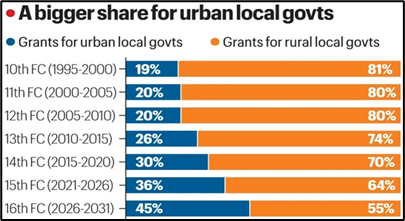
- Since the 10th FC — after the introduction of urban local bodies and panchayats as the third tier — such grants have been a regular feature.
- The 16th Finance Commission has significantly raised the share of grants for urban local governments to 45%, up from 36% under the 15th FC and 26% under the 13th FC.
- In absolute terms, it has recommended ₹3.56 lakh crore for urban local bodies — more than double the 15th FC’s ₹1.55 lakh crore and nearly 15 times the allocation of the 13th FC (post-2011 Census).
- These allocations determine the financial capacity of the lowest tier of government to address local infrastructure, service delivery, and grassroots governance challenges as India’s urban population continues to grow.
- Uneven Distribution Across States
- Grants are distributed according to the 16th FC’s population-based formula, resulting in varied outcomes for states.
- Kerala’s allocation increased by over 400%.
- Maharashtra saw a rise of over 300%.
- Odisha’s allocation grew by only 13%.
- Bihar experienced an 8% reduction.
Rising Urbanisation and the Need for Greater Urban Funding
- The 16th Finance Commission’s higher allocation to urban local bodies acknowledges India’s projected urbanisation level of 41% by 2031.
- With each decade, a larger share of India’s population is moving to cities, increasing the demand for stronger urban governance.
- Data Gaps and Policy Challenges
- The 2011 Census recorded 31% of Indians living in urban areas — lower than countries like China (45%), Indonesia (54%) and Brazil (87%).
- However, other estimates vary widely. A 2015 World Bank report suggested that 54% lived in cities and another 24% in urban clusters, pointing to significant discrepancies. Rapid migration trends further complicate accurate measurement.
- Inconsistent data hampers effective policy planning and resource allocation. Urban local bodies are particularly affected due to uncertain funding projections.
16th FC’s Financial Cushion
- The increased 45% share for urban bodies is seen as a buffer against future demographic revisions.
- If Census 2027 data shows higher urbanization — say 48% — the enhanced allocation would prevent urban governments from being financially underprepared, unlike earlier cycles when allocations were lower (36% or 26%).
- The 16th Finance Commission’s recommendations reflect India’s accelerating urban transition, though variations in state-level allocations highlight ongoing complexities in balancing demographic trends and fiscal federalism.
Mains Article
28 Feb 2026
Why in the News?
- The government has released the New GDP Series 2022-23 base year, revising FY26 growth to 7.6% and Q3 growth to 7.8%.
What’s in Today’s Article?
- New GDP Series (Introduction, Revisions in Growth Rates, Methodological Improvements, Sectoral Growth Trends, Impact, etc.)
Introduction of the New GDP Series
- The Ministry of Statistics and Programme Implementation (MoSPI) has introduced a new GDP series with 2022-23 as the base year, replacing the earlier 2011-12 base year.
- Base year revision is a standard statistical exercise undertaken periodically to reflect structural changes in the economy, incorporate new data sources, and improve methodology.
- The last major revision was done in 2015, when the base year was shifted to 2011-12.
- Under the new series, India’s GDP growth for October–December 2025 (Q3 FY26) has been estimated at 7.8%, while full-year growth for FY26 is projected at 7.6% as per the second advance estimates.
- This is higher than the earlier estimate of 7.4% for FY26 under the old series.
Revisions in Growth Rates
- The new series has led to significant revisions in past growth numbers.
- FY23-24 growth has been revised downward to 7.2% from 9.2% under the old series.
- FY24-25 growth has been revised upward to 7.1% from 6.5%.
- FY25-26 growth is estimated at 7.6%.
- Quarterly revisions also show changes:
- Q1 FY26 growth: 6.7%
- Q2 FY26 growth: 8.4%
- Q3 FY26 growth: 7.8%
- These revisions reflect updated methodology and improved data coverage.
- MoSPI has indicated that a full back series, recalculated historical GDP data, will be released by December 2026.
Methodological Improvements
- The most important methodological change is the shift from the “single-deflator” method to the “double-deflation” method for calculating real Gross Value Added (GVA).
- Earlier, a single price deflator was used to adjust nominal values to real terms in most sectors. This could sometimes overstate growth when input and output prices behaved differently.
- Under double deflation, both inputs and outputs are adjusted separately using their respective inflation rates.
- This allows for more accurate measurement of real economic growth and aligns India’s methodology with international best practices.
- The new series also incorporates additional data sources, such as:
- GST data
- e-Vahan vehicle registration data
- Annual Survey of Unincorporated Sector Enterprises
- Periodic Labour Force Survey
- Further, national accounts have been integrated with Supply and Use Tables to reduce the “discrepancy” between production-based and expenditure-based GDP estimates.
Sectoral Growth Trends in FY26
- Secondary Sector
- The secondary sector is expected to grow at 9.5% in FY26, up from 7.3% in FY25.
- Manufacturing is projected to grow at 12.5%, compared to 8.3% in the previous year.
- Construction growth is estimated at 6.9%, slightly lower than 7.1% in FY25.
- Primary Sector
- The primary sector is expected to slow to 2.8% in FY26 from 5% in FY25.
- Agriculture growth is estimated at 2.5%, down from 4.3%. Mining and quarrying growth is projected at 5%, compared to 11.2% earlier.
- Tertiary Sector
- The services sector is expected to grow at 8.9%, up from 8.3% in FY25.
- Trade, hotels, transport and communication are projected to grow at 10.3%, while financial, real estate, IT and professional services are expected to grow at 10%.
- This indicates strong momentum in manufacturing and services, offset by a moderation in agriculture.
Downward Revision in Nominal GDP
- While real growth has been upgraded, the nominal size of the economy has been revised downward.
- India’s nominal GDP for FY26 is estimated at Rs. 345.47 lakh crore, about 3.3% smaller than earlier estimates under the old series.
- The size of the economy for FY24 and FY25 has also been revised downward by about 3.8% each.
- Nominal GDP represents the current-price value of the economy and is crucial for calculating fiscal ratios.
Impact on Fiscal Ratios
- Since fiscal indicators such as fiscal deficit-to-GDP and debt-to-GDP are expressed as a percentage of nominal GDP, a lower GDP base automatically increases these ratios.
- The fiscal deficit for FY26 is now estimated at 4.51% of GDP instead of 4.36%, even though the absolute deficit amount remains unchanged.
- Similarly, the debt-to-GDP ratio for FY27 is pegged at 57.5%, compared to the earlier target of 55.6%.
- This makes the government’s debt consolidation path toward its FY2031 target of reducing debt to 50% of GDP steeper.
Mains Article
28 Feb 2026
Context:
- The Supreme Court’s recent suo motu intervention regarding an NCERT textbook passage allegedly portraying judicial corruption has highlighted the importance of protecting the reputation and dignity of public institutions.
- The Court’s action underscores that public confidence is central to constitutional governance.
- However, the episode also raises a broader constitutional issue: whether the principle of dignity and protection from misrepresentation should apply equally to institutions and social communities, especially in educational content.
Supreme Court’s Assertion of Institutional Responsibility:
- Protection of institutional credibility:
- The Court emphasised that constitutional institutions depend on public trust, not merely legal authority.
- The misrepresentation in textbooks can cause long-term reputational damage, particularly among young students.
- Swift judicial intervention signals the need to protect institutional legitimacy in a democracy.
- Significance of suo motu action: It demonstrates judicial vigilance in safeguarding constitutional institutions, reinforcing the idea that reputational harm can weaken governance structures.
Education and Civic Imagination:
- Role of textbooks in nation-building:
- Textbooks shape civic consciousness and democratic values.
- Curriculum choices influence how citizens understand history, society, and constitutional values.
- Omission or selective representation can produce distorted public understanding.
- Recent curriculum changes:
- Recent NCERT revisions have drawn attention to omissions and modifications -
- Removal of references to the Gujarat riots (Class XII Political Science).
- Dilution and later removal of references to the Babri Masjid demolition.
- Reduced coverage of Mughal history, Caste struggles, and Dalit movements.
- While curriculum revision is normal in governance, cumulative changes raise concerns about sanitised history and selective narratives.
- Recent NCERT revisions have drawn attention to omissions and modifications -
Representation and Social Perception:
- Risks of partial narratives:
- Communities represented mainly through conflict narratives (which reinforce stereotypes), and victimhood narratives (which obscure agency and achievements).
- Partial truths, repeated over time, can become deep-rooted prejudice.
- Importance of balanced representation:
- Honest history must include oppression and injustice, reform movements, intellectual traditions, and contributions to society.
- Balanced representation strengthens democratic citizenship.
Constitutional Doctrine of Dignity:
- Justice Ujjal Bhuyan: Emphasised that vilification of communities on grounds of religion, caste, language, or region is constitutionally impermissible.
- Centrality of fraternity:
- Fraternity is a core constitutional value. It ensures social cohesion, mutual respect, and shared belonging.
- Without fraternity, equality becomes formal, and liberty becomes fragmented.
Constitutional Framework:
- The principle of dignity is supported by multiple constitutional provisions.
- For example,
- Preamble: Fraternity assures the dignity of the individual.
- Fundamental Rights: Article 14 (Equality before law), Article 15 (Prohibition of discrimination), Article 21 (Right to life including dignity).
- Fundamental Duties: Article 51A(e) – Promotion of harmony and brotherhood.
- Together, these provisions establish a normative framework for respectful public discourse.
Statutory Safeguards:
- Legal provisions addressing hate speech and vilification include -
- IPC Section 153A – Promoting enmity between groups.
- IPC Section 153B – Imputations prejudicial to national integration.
- IPC Section 295A – Outraging religious feelings.
- IPC Section 505 – Statements causing public mischief.
- These laws form the legal backbone against communal incitement, though enforcement often appears uneven.
Challenges:
- Selective vigilance: Strong protection of institutions but inconsistent protection of communities creates a perceived hierarchy of dignity.
- Curriculum politicisation: Educational content influenced by political priorities risk of historical sanitisation.
- Uneven legal enforcement: Hate speech laws applied inconsistently. Normalisation of stereotypes in public discourse.
- Weak emphasis on fraternity: Fraternity remains the least discussed constitutional value. The concept saw limited integration into policy and education.
Way Forward:
- Ensure balanced curriculum: NCERT revisions should be evidence-based, transparent, academically rigorous, and include multiple perspectives in historical narratives.
- Consistent constitutional protection: Equal protection of institutions, individuals, and communities, to avoid hierarchy of dignity.
- Strengthen legal enforcement: Uniform application of hate speech provisions, and clear standards for intervention.
- Promote constitutional values: Greater emphasis on fraternity, dignity, and social harmony. Integrate constitutional ethics into education.
Conclusion:
- The Supreme Court’s intervention on NCERT content goes beyond protecting judicial reputation; it signals a broader constitutional principle — dignity is indivisible.
- A robust democracy must defend both institutions and communities with equal seriousness.
- The true strength of constitutional governance lies not only in safeguarding its institutions but also in ensuring that every citizen and community enjoys equal respect and belonging.
Mains Article
28 Feb 2026
Context
- Escalating geopolitical conflicts, including Russia’s invasion of Ukraine, tensions in West Asia, and controversial actions by major powers, have revived claims that international law is collapsing.
- Some scholars foresee a norm-free world, pointing to institutional withdrawals, unilateral military actions, and a perceived rupture in the global order.
- Despite mounting challenges, international law persists as an indispensable normative framework shaping state conduct and international cooperation.
The Prohibition on the Use of Force: Crisis or Collapse?
- A foundational pillar of modern international law is the prohibition on the threat or use of force under Article 2(4) of the United Nations Charter.
- Recent violations have intensified doubts about its survival; however, repeated breaches do not signify legal extinction.
- During the Cold War, similar concerns emerged amid widespread armed conflicts.
- Wars in Afghanistan, the Falklands, the Gulf, Bosnia, Kosovo, Iraq, Syria, and Libya severely strained the prohibition on force.
- Yet Article 2(4) endured as the central legal benchmark against which state conduct was judged. The persistence of this principle demonstrates that international law can be battered but not extinguished.
Legal Justification and the Power of Normative Constraint
- The Role of Legal Argument in International Politics
- The strength of international law lies partly in its capacity to compel states to justify their actions.
- Legalisation creates expectations that public power must be exercised within recognised rules.
- Historically, even dominant powers sought to frame military interventions within the doctrine of self-defence exception, expanding its interpretation to align actions with existing norms.
- Such practices reveal the enduring force of legal justification.
- The act of offering legal reasoning preserves space for debate, contestation, and normative accountability.
- A Qualitative Shift in the Present Moment
- The contemporary challenge is not merely repeated violations but the declining effort to justify them.
- Rising populist-authoritarianism has introduced a degree of brazenness in which legal reasoning is sometimes sidelined.
- This erosion of deliberative engagement weakens the culture of compliance and threatens the expectation that power must answer to law.
- Yet even this shift does not eliminate the system. It signals a struggle over interpretation and authority rather than a disappearance of norms.
Beyond the UN Charter: The Expanding Scope of International Law
- Over eight decades, the international community has developed dense legal regimes governing trade, investment, aviation, maritime resources, outer space, human rights regime, climate governance, and the control of chemical and biological weapons.
- This expansion reflects deep global interdependence. Legal frameworks underpin economic exchange, environmental protection, and technological cooperation.
- Agreements such as the High Seas Treaty and the Pandemic Agreement illustrate ongoing treaty-making process and sustained multilateral engagement.
- Trade negotiations between major economies further demonstrate reliance on structured legal commitments.
- International law’s vitality is evident not only in crisis management but also in its routine coordination of complex global systems.
The Judicialisation of International Relations
- Courts such as the International Criminal Court and the African Court on Human and Peoples’ Rights exemplify the expanding architecture of international adjudication.
- These institutions embody the judicialisation of international relations, providing structured mechanisms for dispute resolution and individual accountability.
- Though compliance is uneven, their existence reinforces the principle of peaceful dispute resolution and strengthens the institutional architecture supporting global governance.
The Silent Functioning of International Law
- It enables goods to cross borders under predictable trade rules, secures civil aviation routes, regulates maritime passage, and facilitates communication networks.
- This silent operation of law sustains daily life and economic stability: by structuring expectations and reducing uncertainty, international law provides predictability and stability in a fragmented geopolitical environment.
- Its effectiveness is often invisible precisely because it functions smoothly. The absence of headlines in these areas signals not irrelevance but routine success.
Conclusion
- International law is undergoing one of its most challenging periods, particularly concerning the prohibition on force.
- The resilience of Article 2(4), the persistence of legal justification, the breadth of global regulatory regimes, and the proliferation of international courts all demonstrate enduring strength.
- International law remains a dynamic system shaped by contestation and adaptation. Its continued expansion across domains of trade, environment, health, and human rights affirms its structural importance.
- International law endures, not as a flawless order, but as a necessary foundation for global stability in an increasingly turbulent world.
Feb. 27, 2026
Mains Article
27 Feb 2026
Why in news?
The Ministry of Home Affairs has released PRAHAAR, India’s first publicly articulated national counter-terror strategy document. The eight-page framework outlines India’s overall approach to tackling terrorism, detailing past measures, existing mechanisms, and future plans.
What’s in Today’s Article?
- What PRAHAAR Outlines?
- What Is New About PRAHAAR?
- How Does PRAHAAR Compare with Western Counter-Terror Strategies?
- Strengths and Weaknesses of PRAHAAR
- Conclusion
What PRAHAAR Outlines?
- PRAHAAR frames India’s terrorism challenge as multi-dimensional, shaped by decades of cross-border violence, global jihadist networks like Al-Qaeda and ISIS, and the growing misuse of advanced technologies such as drones, encrypted platforms, dark web tools, crypto-financing, cyberattacks, and potential access to CBRNED materials.
- It avoids limiting the threat to any single region or group.
- The Seven-Pillar Response Framework
- Intelligence-Led Prevention - Focus on proactive disruption of propaganda networks, sleeper cells, funding channels, and arms supply chains through real-time inter-agency coordination.
- Swift and Proportionate Response - Local police-led action backed by specialised counter-terror forces to ensure rapid and calibrated operational response.
- Capacity Aggregation - Modernisation of police forces, standardised training, and enhanced coordination across agencies to strengthen preparedness.
- Rule of Law and Human Rights - Firm commitment to legal safeguards, due process, and protection of civil liberties while combating terrorism.
- De-radicalisation and Community Engagement - Graded interventions targeting vulnerable groups, especially youth and women, alongside community outreach and rehabilitation efforts.
- International Alignment - Strengthened global cooperation through intelligence sharing, legal assistance, extradition treaties, and multilateral designations.
- Recovery and Resilience - A whole-of-society approach involving civil administration, professionals, NGOs, and communities to rebuild and enhance societal resilience.
- Guiding Principle - PRAHAAR is anchored in a political stance of zero tolerance for terrorism, while explicitly avoiding the association of terrorism with any religion or identity.
What Is New About PRAHAAR?
- Not New Tools, But a Unified Framework
- Most mechanisms cited in PRAHAAR — such as MAC, NSG, NIA, UAPA, CAPFs, and community outreach programmes — are already operational.
- The document does not create new agencies or confer new powers.
- Its novelty lies in consolidating these elements into a single, publicly articulated national counter-terror strategy.
- Bringing Coherence to India’s CT Architecture
- Previously, India’s counter-terror (CT) framework was dispersed across laws, standard operating procedures, Cabinet decisions, and state-level arrangements.
- PRAHAAR unifies these scattered components under one national policy statement.
- Elevating Previously Implicit Elements
- Human Rights and Rule of Law - PRAHAAR formally recognises human rights and legal safeguards as a named pillar of counter-terror policy.
- Linking Security and Development - The strategy explicitly connects counter-terror efforts to poverty alleviation, education, housing, employment, scholarships, and women’s empowerment in vulnerable communities.
- Clear Political Messaging - It affirms that India does not associate terrorism with any religion or community — a position that carries diplomatic significance in international forums.
- More than introducing new powers, PRAHAAR serves as an articulation of intent, signalling to citizens and adversaries alike that India’s counter-terror approach is coordinated, comprehensive, and resolute.
How Does PRAHAAR Compare with Western Counter-Terror Strategies?
- PRAHAAR is a concise eight-page framework outlining guiding principles.
- In contrast, the US National Strategy for Counterterrorism (34 pages) and the UK’s CONTEST strategy (78 pages) provide far more detailed and operational blueprints.
- Level of Detail and Operational Clarity
- PRAHAAR emphasises intelligence-led policing, inter-agency coordination (MAC, JTFI), roles of police and specialised forces, training, and socio-economic interventions.
- However, it does not publicly specify agency-wise responsibilities, sub-programmes, or measurable objectives.
- The US strategy translates broad goals into specific “lines of effort” and concrete commitments — such as tightening border screening, disrupting terror financing through anti-money laundering standards, and strengthening global CT partnerships.
- The UK’s CONTEST framework provides detailed implementation structures, including a Counter-Terrorism Operations Centre (CTOC) and clearly defined roles for local authorities, schools, and councils under the Prevent/Protect/Prepare architecture.
- Oversight and Accountability
- PRAHAAR stresses adherence to the rule of law but does not commit to public reporting or independent review mechanisms.
- By contrast:
- The US framework includes annual assessments to Congress and measurable targets.
- The UK system operates through formal reporting lines and structured oversight across departments and local CT bodies.
- Ideological Scope
- PRAHAAR primarily focuses on cross-border and jihadi terrorism.
- Western strategies explicitly address a wider ideological spectrum, including extreme right-wing and hybrid forms of extremism.
Strengths and Weaknesses of PRAHAAR
- Strengths
- Explicit rejection of religious profiling.
- Formal recognition of human rights and rule of law as core pillars.
- Integration of security and development approaches.
- Weaknesses
- Limited operational detail in the public document.
- Absence of clear oversight and measurable benchmarks.
- Challenge of converting aspirational goals into routine practices at district and police station levels.
Conclusion
- PRAHAAR’s impact will ultimately depend on effective implementation, clear division of responsibilities, capacity-building at the grassroots, and robust coordination across agencies and states.
Mains Article
27 Feb 2026
Why in news?
Recent observations by the Allahabad High Court have brought renewed scrutiny to the practice of “bulldozer justice” in Uttar Pradesh, where properties of individuals accused of crimes are demolished soon after allegations arise.
Critics argue that such punitive demolitions bypass the constitutional sequence of allegation, investigation, adjudication, and sanction, effectively turning executive discretion into punishment without due process.
Although the Supreme Court in 2024 issued clear directions against unlawful demolitions, their continued occurrence highlights an ongoing tension between executive action and constitutional safeguards in a democratic system.
What’s in Today’s Article?
- The Present Episode Before the Allahabad High Court
- The Court’s Guidance on Demolitions
- Larger Constitutional Implications
- A Necessary Balance Between Regulation and Rights
The Present Episode Before the Allahabad High Court
- A family from Hamirpur district approached the Allahabad High Court after authorities threatened demolition of their home and commercial property following an FIR against a relative.
- Although the petitioners were not accused, municipal notices were issued and properties sealed soon after the case was registered.
- Court’s Observations
- Punishment Is a Judicial Function - The Division Bench noted that such demolition sequences were becoming routine and reaffirmed that punishment lies solely within the judiciary’s domain, not with administrative authorities.
- Constitutional Questions Raised - The court framed five key questions, including whether such demolitions violate Supreme Court directives and infringe constitutional guarantees under Articles 14 (equality) and 21 (right to life and liberty).
- Legal Framework Governing Demolitions
- Under laws such as the Uttar Pradesh Municipal Corporation Act, 1959, and the Uttar Pradesh Urban Planning and Development Act, 1973, authorities can remove unauthorised constructions.
- However, demolition must follow due process:
- Identification of violation
- Written notice with grounds
- Opportunity to respond
- Consideration of objections
- Reasoned order
- Appeals and regularisation options are also available.
- Limits of Executive Power
- Municipal laws are regulatory in nature and do not determine criminal guilt.
- The mere registration of an FIR does not render a property illegal or justify expedited demolition.
- Demolition is intended as a last-resort regulatory measure, not a substitute for judicial punishment.
The Court’s Guidance on Demolitions
- In Re: Directions in the Matter of Demolition of Structures (2024), the Supreme Court held that property cannot be demolished merely because its owner is accused of a crime.
- Criminal guilt must be established through proper judicial adjudication.
- Limits on Municipal Powers
- Regulatory, Not Punitive - While municipal laws permit demolition of unauthorised constructions, these powers cannot be used as parallel instruments of punishment. Doing so would undermine the presumption of innocence and the rule of law.
- Substance Over Form - Courts examine not just the legal authority invoked but the intent and timing of action. Demolitions issued immediately after FIRs and targeting those linked to the accused may indicate punitive intent.
- Colourable Exercise of Power
- Using lawful municipal powers to achieve an impermissible objective — such as punishing without trial — constitutes a “colourable exercise of power.”
- Such actions blur the separation of powers and allow the executive to impose consequences reserved for the judiciary.
- Depriving individuals of homes or livelihoods based solely on allegations violates core constitutional principles, including due process, presumption of innocence, and separation of powers.
Larger Constitutional Implications
- The Allahabad High Court’s intervention raises critical questions about whether even the threat of demolition can violate fundamental rights, what standards should govern preventive judicial relief, and how accountability can be ensured when municipal powers are misused.
- These concerns are far from theoretical. Demolitions can cause immediate and irreversible harm to families who may later be found innocent, while also weakening public trust in fair and impartial governance.
A Necessary Balance Between Regulation and Rights
- Enforcing Law Within Constitutional Limits - Urban authorities must enforce building regulations to maintain order. However, such powers must operate strictly within constitutional boundaries and administrative neutrality.
- Due Process as a Constitutional Safeguard - The Constitution protects individuals from deprivation of property without lawful procedure — including notice, hearing, a reasoned decision, and judicial oversight. Demolition before adjudication reverses this process and undermines due process.
- Distinguishing Regulation from Punishment - Bulldozers serve a legitimate purpose in urban governance, not as tools to determine guilt. When regulatory powers are used punitively, they become legally unsustainable and threaten the rule of law.
Mains Article
27 Feb 2026
Why in the News?
- India and Israel elevated their ties to a “Special Strategic Partnership” and signed 17 pacts during Prime Minister Narendra Modi’s 2026 visit to Israel.
What’s in Today’s Article?
- India-Israel Bilateral Relationship (Background, Defence & Security, Agriculture & Water Management, Trade, Innovations & Technology)
- PM Modi’s Visit to Israel (Key Outcomes of the Visit)
India-Israel Bilateral Relationship
- India and Israel established full diplomatic relations in 1992. For several decades prior to that, engagement was limited due to India’s support for the Palestinian cause and the geopolitical realities of the Cold War era.
- However, after the end of the Cold War and the launch of India’s economic liberalisation, ties expanded steadily.
- A major turning point came in 2017, when Prime Minister Narendra Modi became the first Indian Prime Minister to undertake a standalone bilateral visit to Israel. During that visit, the relationship was elevated to a “Strategic Partnership.”
Defence and Security Cooperation
- Defence cooperation forms the backbone of India-Israel relations. Israel is one of India’s top defence suppliers, particularly in advanced technologies such as missile systems, UAVs, radar systems and border surveillance equipment.
- The two countries share strong intelligence cooperation and have consistently expressed a common position against terrorism.
- Counter-terrorism collaboration has intensified over the years, reflecting shared security concerns.
Agriculture and Water Management
- Agricultural cooperation has emerged as a model of practical partnership.
- Israel has supported the establishment of multiple Centres of Excellence in Indian states, focusing on horticulture, micro-irrigation, and precision farming. These initiatives have helped Indian farmers improve productivity and water-use efficiency.
- Water conservation, drip irrigation, and desert farming technologies are key areas where Israel’s expertise has benefited India.
Trade, Innovation and Technology
- Bilateral trade has diversified beyond defence to include diamonds, chemicals, pharmaceuticals, electronics, and high-technology sectors.
- From US$ 200 million in 1992 (comprising primarily of diamonds), merchandise trade has diversified and reached a peak of US$ 10.77 billion (excluding defence) in FY 2022-23.
- In FY 2023-24 and FY 2024-25, the bilateral trade (excluding defence) was US$ 6.53 billion and US$3.75 billion, respectively, witnessing a decline due to the regional security situation and trade route disruption.
- Innovation and start-ups have become a major area of cooperation. Israel’s reputation as a “Start-Up Nation” complements India’s large digital ecosystem. Joint research initiatives, academic exchanges, and innovation funds have strengthened knowledge partnerships.
Convergence in West Asia
- India and Israel share increasing strategic convergence in West Asia. While India continues to maintain balanced relations with Arab countries and Iran, its engagement with Israel has become more open and multidimensional.
- India’s large diaspora presence and energy security interests in the Gulf region make regional stability a key concern. Both countries view peace and stability as essential for long-term development.
Key Outcomes of PM Modi’s 2026 Visit
- Prime Minister Modi’s 2026 visit marked a new phase in bilateral ties. The two countries elevated their relationship to a “Special Strategic Partnership for Peace, Innovation and Prosperity.”
- Overall, 27 outcomes were announced, including 17 pacts across multiple sectors.
Technology and Emerging Domains
- Technology was central to the visit. A Critical and Emerging Technologies Partnership was launched, covering artificial intelligence, quantum technologies, cybersecurity, and critical minerals.
- An Indo-Israel Cyber Centre of Excellence will be established in India.
- The Joint Commission on Science and Technology was elevated to the ministerial level.
- An MoU on geophysical exploration was signed to enhance cooperation in mineral exploration using advanced geophysical and AI technologies, with a focus on sustainable development.
Defence and Counter-Terrorism
- Both sides acknowledged the significant expansion of defence cooperation and laid out a roadmap for joint development, joint production and transfer of technology.
- The joint statement strongly condemned terrorism in all its forms and manifestations, including cross-border terrorism.
Trade and Economic Cooperation
- The leaders noted progress in negotiations for a Free Trade Agreement and directed officials to work towards its early conclusion.
- An agreement was reached for the use of India’s Unified Payments Interface (UPI) in Israel, expanding digital public infrastructure cooperation.
- Cooperation was also expanded in digital health, civil nuclear energy, space, and financial dialogue mechanisms.
Agriculture and Rural Development
- India set a target of expanding Centres of Excellence to 100 and moving towards creating “Villages of Excellence” to bring Israeli agricultural technology directly to Indian villages.
- An India-Israel Innovation Centre for Agriculture will support research and future-ready farming solutions.
Connectivity and Regional Cooperation
- The two sides agreed to work closely on the India-Middle East–Europe Economic Corridor (IMEC) and the I2U2 initiative.
- Regional tensions, including developments involving Iran and the United States, were discussed. PM Modi reiterated India’s belief in dialogue and peaceful resolution of conflicts, noting that India’s security interests are directly linked to peace and stability in West Asia.
Mains Article
27 Feb 2026
Why in News?
- The Ministry of Statistics and Programme Implementation (MoSPI) is releasing a new series of National Accounts Statistics (NAS) with 2022–23 as the base year, replacing the 2011–12 base year.
- The revised series aims to provide a more accurate and granular measurement of Gross Domestic Product (GDP) and Gross Value Added (GVA).
What’s in Today’s Article?
- Why the New GDP Series Matters?
- Key Structural Changes
- Better Measurement of Household Sector
- Integration of New Data Sources
- Improved Consumption Estimates
- Financial Sector Improvements
- Informal Sector and Agriculture
- Major Methodological Upgrade - Double Deflation
- Possible Impact
- Challenges and Way Forward
- Conclusion
Why the New GDP Series Matters?
- Updating the economic structure: Since the last revision in 2015, India’s economy has undergone major transformations. For example,
- Expansion of digital economy and e-commerce
- Increased formalisation due to GST
- Changes in consumption and employment patterns
- Growth of financial and services sectors
- Updating the base year ensures: Better measurement of real economic growth, improved sectoral representation, and reliable policy formulation.
Key Structural Changes:
- Base year revision: The base year updated from 2011–12 to 2022–23, reflecting current economic structure, and improving comparability across time.
- Improved sector-wise measurement:
- Private corporate sector: Old method: Entire company’s GVA allocated to the dominant sector. New method: Activity-wise revenue share approach. Captures sectoral contributions more accurately.
- General government sector: New inclusions are housing services provided to government employees. Better coverage of autonomous bodies, local governments. This improves measurement of government output.
Better Measurement of Household Sector:
- The household sector, a major contributor to India’s economy, will now be estimated more accurately.
- Improved data sources: Annual use of Annual Survey of Unincorporated Sector Enterprises (ASUSE), and Periodic Labour Force Survey (PLFS). Earlier, data was extrapolated, but direct annual estimation now.
Improved Consumption Estimates:
- Private Final Consumption Expenditure (PFCE) will be estimated using -
- Household Consumer Expenditure Surveys
- Production data
- Administrative datasets
- This improves measurement of domestic demand, and consumption-driven growth.
Integration of New Data Sources:
- GST data: Expanded use of Goods and Services Tax (GST) data, which will be applied for -
- Regional output estimation
- Corporate value addition measurement
- Identification of active companies
- Impact: Better measurement of formal economy, and reduced estimation errors.
Financial Sector Improvements:
- Banking sector: The new series will use the Statistical Table Related to Banks in India (STRBI) published by the Reserve Bank of India (RBI) to estimate the activity of both public sector banks as well as private sector banks.
- NBFC sector:
- The earlier proxy-based approach to estimate the activity of private Non-Banking Financial Companies (NBFCs) is being replaced by the use of actual financial data of NBFCs from the Ministry of Corporate Affairs.
- Result will be improved financial sector GVA estimates.
Informal Sector and Agriculture:
- Better coverage of informal sector:
- Enhanced use of ASUSE data captures insurance agents’ activity, informal enterprises, and Gross Fixed Capital Formation (GFCF) in the unincorporated sector.
- Significance: Better representation of India’s informal economy.
- Agriculture sector improvements:
- Updated methodologies and datasets based on studies by -
- Inland Grassland and Fodder Research Institute
- Central Marine Fisheries Research Institute
- Central Inland Fisheries Research Institute
- Agricultural Development and Rural Transformation Centre
- Impact: Improved estimation of livestock, fisheries, and fodder production.
- Updated methodologies and datasets based on studies by -
Major Methodological Upgrade - Double Deflation:
- Old system - Single deflator method:
- Same inflation rate applied to inputs, and outputs, resulting in overestimation when input prices fall slower than output prices, and underestimation when input prices rise faster.
- Example: Real GDP growth in 2025 possibly overstated due to this method.
- New system - Double deflator method:
- Separate inflation adjustment for inputs, and outputs, resulting in more accurate real GVA and GDP, sector-specific deflators, and reduced growth distortions.
- Significance: Major statistical reform in GDP estimation.
- Integration with Supply and Use Tables (SUT):
- SUT will be integrated into national accounts. They show production sources, imports, intermediate consumption, final consumption, and exports.
- Benefits: Reduced statistical discrepancy, and improved consistency between production approach, and expenditure approach.
- Data improvements from States: Enhanced reporting by States includes local bodies, and autonomous institutions, resulting in increased direct estimation, and reduced imputation.
- Release timeline:
- The new series of national accounts data to be released on February 27, 2026.
- However, it will take almost a year to get a ‘back series’ that shows GDP data for years before 2022-23 as per the new GDP series.
Possible Impact:
- On growth estimates:
- GDP revisions may raise growth estimates in some years, lower estimates in others.
- Previous revision (2015): 2013–14 growth revised from 4.7% from ~6.4–6.9%
- New revision: May change recent growth estimates significantly.
- International statistical standards:
- The 2008 System of National Accounts (SNA 2008) – the international statistical standard for national accounts data – is currently being used by India and other countries to compile GDP.
- Last year, the United Nations Statistical Commission adopted an updated version of these norms, called SNA 2025.
- India plans to shift to SNA 2025 in its next base year revision.
Challenges and Way Forward:
- Statistical challenges: Complexity of double deflation, large data integration requirements, and back-series reconstruction difficulties.
- Statistical reforms: Regular base-year revisions (every 5 years), faster release of back-series data, and improved administrative data integration.
- Institutional challenges: State-level data quality variations, informal sector measurement gaps, and data lag from surveys.
- Institutional measures: Strengthen State statistical systems, improve survey frequency, and enhance digital data collection.
- Credibility issues: Past GDP revisions triggered debates, and there is the need for transparency in methodology.
- Global alignment: Timely adoption of SNA 2025, and improved international comparability.
Conclusion:
- The 2022–23 GDP base-year revision marks one of the most significant statistical upgrades in India’s national accounts in over a decade.
- If implemented transparently and updated regularly, the revised GDP framework will strengthen evidence-based policymaking and international confidence in India’s economic statistics.
Mains Article
27 Feb 2026
Context
- Three years ago, at the start of India’s G20 presidency, critical minerals were not central to strategic policy.
- Minerals such as lithium remained classified as atomic minerals, restricting private participation.
- Recent policy reforms and the Union Budget mark a decisive transformation: critical minerals are now integral to India’s industrial strategy, energy transition, and geopolitical positioning.
- The national focus has shifted from policy formulation to large-scale execution, emphasising speed, depth, and technological capability.
The Policy Shift: From Peripheral Concern to Strategic Priority
- Emergence of a Comprehensive Framework
- India has established a structured framework to strengthen mineral security.
- A list of 30 critical minerals has been identified, royalty rates rationalised, and private exploration liberalised.
- In January 2025, the government launched the National Critical Mineral Mission (NCMM) with a ₹16,300 crore outlay, signalling long-term commitment.
- This framework places India among countries pursuing resource resilience through coordinated planning and investment.
- The Execution Challenge
- Despite policy clarity, execution remains complex. Mineral discovery and development require sustained capital and long gestation periods.
- More critically, global processing capacity is highly concentrated, with China controlling up to 90% for several key minerals.
- This dominance creates vulnerabilities in global supply chains.
- Therefore, India’s strategy must extend beyond mining to strengthening domestic refining, value addition, and downstream integration.
India’s Existing Capabilities and Industrial Potential
- According to the Council on Energy, Environment and Water, domestic industries already produce high-purity copper, graphite, rare earth oxides, tin, and titanium, often exceeding 99.9% purity.
- These capabilities demonstrate technical competence in high-purity processing.
- However, production volumes remain limited and largely oriented toward conventional industries.
- Meeting the demands of clean technologies, defence manufacturing, and advanced electronics requires technological upgrading, capacity expansion, and deeper refining.
- Established strengths in chemicals, pharmaceuticals, and textiles provide transferable skills for scaling complex mineral processing.
Priority Areas for Effective Implementation
- Creating Domestic Demand for Processed Minerals
- Budget 2026 advances implementation by removing import duties on capital goods used in mineral processing, easing the burden of high capex investements.
- Yet investor confidence depends primarily on assured domestic demand.
- Government initiatives promoting electric vehicles, batteries, solar modules, and wind turbines create an opportunity for backward integration, but delays increase uncertainty for midstream processors.
- Expanding the deployment of domestically manufactured clean technologies would stimulate demand for processed minerals, strengthen upstream mining, and deepen industrial ecosystems.
- Adopting an AI-First Approach to Exploration
- The NCMM targets 1,200 exploration projects by FY2031, supported by tax deductions for exploration expenditure on nine critical minerals, including previously restricted elements such as beryllium, tantalum, lithium, and niobium.
- Exploration, however, remains inherently risky and capital-intensive.
- An AI-first approach can significantly enhance prospectivity analysis and reduce uncertainty.
- Aligning the IndiaAI Mission, the National Geospatial Policy, and Mission Anveshan can strengthen the use of geospatial analytics and seismic AI tools.
- Leveraging Geopolitical Disruption for Technological Sovereignty
- The weaponisation of rare earth magnets and battery supply chains in 2025 exposed systemic fragility in global industrial networks.
- India’s initiatives, including rare earth corridors and reduced import duties on monazite sands, reflect efforts to build technological sovereignty.
- To succeed, states must utilise existing infrastructure and skilled manpower to serve global markets, generate employment, and strengthen regional economies.
The Importance of International Partnerships
- Domestic reforms must be complemented by strategic global engagement.
- India should deepen partnerships with technologically advanced countries such as Australia, Japan, the United Kingdom, the United States, and European nations.
- These countries possess advanced mineral processing and component manufacturing expertise.
- Encouraging firms from these regions to establish operations in India will require regulatory certainty, strong legal safeguards, research collaboration, and predictable market access.
- Institutional mechanisms such as the India-European Union Free Trade Agreement provide a framework for structured cooperation.
- Financial incentives, including the ₹7,280 crore scheme for rare earth permanent magnets, must be supported by long-term stability and transparent governance to foster durable international collaboration.
Conclusion
- India’s repositioning of critical minerals marks a structural shift in its development strategy.
- By prioritising mineral security, expanding domestic processing, encouraging demand creation, adopting AI-driven exploration, and strengthening global partnerships, India aims to build a resilient and integrated ecosystem.
- Sustained inter-ministerial coordination, proactive state leadership, and technological advancement will determine success.
- In a volatile global environment, leadership in critical minerals will depend not only on resource availability but on coherent execution, innovation, and strategic foresight.
Mains Article
27 Feb 2026
Context
- It was the best of times; it was the worst of times,” wrote Charles Dickens in A Tale of Two Cities.
- The phrase captures India’s economic trajectory between 2014 and 2025, a period marked by visible prosperity alongside deepening distress.
- While narratives of growth and declining inequality dominate public discourse, patterns of income mobility, vulnerability, and distributional change reveal a more complex reality.
- The dominant trend over the decade points toward rising downward mobility, uneven upward mobility, and persistent structural inequality shaped by caste, religion, and geography.
Understanding Income Mobility: Concept and Method
- Defining Mobility
- Households are grouped into three categories based on 2014 per capita income: top 10 percent, next 40 percent, and bottom 50 percent.
- Mobility is measured relative to this benchmark: movement upward, downward, or remaining unchanged. This framework captures shifts in economic position rather than isolated income levels.
- Data and Periodisation
- The analysis relies on real per capita income data from the Consumer Pyramids Household Survey (2014–2025), structured as a balanced panel.
- The decade is divided into two phases, 2014–19 and 2019–24, to assess shifts around the 2019 general election.
- This approach enables assessment of longitudinal trends, election cycles, and structural shifts.
National Trends: A Tilt Toward Decline
- Downward mobility nearly doubled from 14 percent in 2015 to 26.8 percent in 2025. Meanwhile, the proportion of households remaining in the same income group fell from over 70 percent to below half.
- Although upward mobility rose from 14.1 percent to 23.5 percent, it consistently lagged behind decline. By 2025, more than one in four households were worse off relative to 2014.
- The balance of movement increasingly favoured descent rather than ascent, reflecting growing economic insecurity, fragile household resilience, and widening income dispersion.
- The pattern suggests that aggregate growth has not translated into broad-based progress.
Rural–Urban Divide: Uneven Gains
- Rural India: Persistent Vulnerability
- Rural areas experienced sharper deterioration. By 2025, nearly 29 percent of rural households had slipped below their 2014 income rank.
- The steepest fall occurred during 2014–19, with continued instability thereafter. Limited diversification, dependence on agriculture, and stress in the informal sector intensified rural fragility.
- Urban India: Relative Advantage, Limited Assurance
- Urban households fared relatively better, with stronger upward mobility and slower increases in decline.
- Yet downward mobility rose steadily even in cities. Gains were concentrated in specific sectors and regions, reinforcing regional disparities.
- Urban advantage did not eliminate volatility; it merely moderated it.
Caste as a Structural Determinant of Mobility
- Downward mobility increased across all caste groups, with sharper rises among OBC and SC households.
- By 2025, roughly a quarter or more of these households were worse off than in 2014.
- Upward mobility improved for Unreserved groups and OBCs but remained limited for SC households, reflecting constrained social mobility and reduced access to asset ownership and quality education.
- Scheduled Tribes displayed comparatively lower downward mobility and occasional stronger upward gains, possibly linked to targeted interventions.
Religious Inequalities in Mobility
- Downward mobility rose among all major religious groups, with pronounced increases among Hindu and Muslim households.
- Upward mobility grew more steadily for Sikh and Christian households in earlier years, though momentum weakened later.
- Muslim households exhibited weaker upward mobility relative to Hindus, indicating barriers to economic ascent.
- The pattern reflects constraints rooted in discrimination, limited opportunity expansion, and uneven access to employment networks.
Political and Economic Turning Points and The Broader Implications
- Political and Economic Turning Points
- The 2019 general election consolidated power for the Bharatiya Janata Party, marking a decisive political moment. Soon after, the COVID-19 crisis generated widespread humanitarian and economic disruption.
- Prolonged stress in agriculture and informal employment weakened recovery, exposing limited policy responsiveness and gaps in social protection.
- The absence of a coherent strategy to revive employment-intensive sectors slowed upward income shifts.
- The Broader Implications: Mobility and Social Stability
- An economy where downward mobility outpaces upward movement risks eroding social stability. When inequality solidifies into reduced mobility, aspiration yields to frustration.
- Visible affluence among a minority contrasts sharply with expanding precarity among vulnerable groups.
- Static poverty metrics fail to capture this churn; mobility analysis reveals lived volatility and growing distributional stress.
Conclusion
- Between 2014 and 2025, India’s economic landscape combined expansion with regression. Downward mobility rose more sharply than upward mobility, particularly in rural areas and among historically marginalised communities.
- Caste, religion, geography, and local inequality continue to shape economic life chances.
- Sustainable progress requires strengthening public health, expanding employment-intensive growth, investing in education, and reinforcing social protection.
- Addressing discrimination is integral to restoring mobility and renewing faith in economic progress.
- Without reversing entrenched inequality, the promise of upward mobility will remain uneven, fragile, and uncertain.
Feb. 26, 2026
Mains Article
26 Feb 2026
Why in news?
The Union government is preparing to launch a nationwide single-dose HPV vaccination drive targeting 14-year-old girls to curb cervical cancer in India.
Cervical cancer is the second most common cancer among Indian women, and nearly 90% of cases are caused by persistent human papillomavirus (HPV) infection. Since HPV-related cancers are vaccine-preventable, widespread immunisation can significantly reduce disease burden.
Beyond cervical cancer, HPV vaccination can also lower the incidence of anal, penile, vaginal, vulvar, and throat cancers. The campaign is therefore a major public health step toward reducing cancer-related morbidity and mortality in India.
What’s in Today’s Article?
- HPV Vaccination Drive: Eligibility and Rollout Plan
- HPV Vaccination Drive: Vaccine Choice and Supply
- Is a Single Dose of the HPV Vaccine Sufficient
- Why the HPV Vaccination Campaign Matters?
- Is This India’s First HPV Immunisation Programme?
HPV Vaccination Drive: Eligibility and Rollout Plan
- The HPV vaccine targets a common sexually transmitted infection, with certain strains responsible for cervical and other cancers.
- Vaccination during early adolescence — before sexual activity begins — provides stronger and longer-lasting immunity.
- The upcoming 90-day nationwide campaign will offer a single-dose HPV vaccine to all 14-year-old girls across India.
- Eligible beneficiaries must book appointments at government health centres through the U-Win digital platform, similar to the Co-Win system used during the Covid-19 vaccination drive.
- After the initial campaign phase, HPV vaccination will continue under the routine immunisation programme at health and wellness centres.
- Each year, around 1.15 crore girls turning 14 will be eligible to receive the vaccine.
HPV Vaccination Drive: Vaccine Choice and Supply
- Types of HPV and Cancer Risk - There are at least 14 cancer-causing HPV strains, with types 16 and 18 responsible for nearly 70% of cervical cancer cases worldwide. HPV vaccines prevent infection from the most common high-risk strains.
- Vaccine Being Used: Gardasil - For the current nationwide campaign, the government will use Gardasil, manufactured by MSD Pharmaceuticals. The vaccine has established global efficacy and safety data.
- Why Not the Indigenous Vaccine Yet?
- India’s locally developed vaccine, Cervavac by the Serum Institute of India, is not being used at present because:
- It is awaiting WHO approval.
- The ICMR is still evaluating its effectiveness as a single-dose vaccine.
- Officials indicate that a shift to Cervavac may occur in about two years, once regulatory approvals are completed.
- India’s locally developed vaccine, Cervavac by the Serum Institute of India, is not being used at present because:
- Role of GAVI and Supply Plan
- The GAVI Vaccine Alliance will supply 2.6 crore doses to India for the campaign, sufficient for two years.
- One crore doses have already arrived.
- The remaining doses will be delivered over this year and the next.
Is a Single Dose of the HPV Vaccine Sufficient
- In 2022, the WHO’s Strategic Advisory Group of Experts on Immunization recommended a single-dose HPV vaccine for girls and women up to 20 years of age, citing strong and lasting protection.
- The group found “strikingly high efficacy” among children aged 9–14 years.
- Women above 21 are advised to take two doses six months apart, while immunocompromised individuals, including those with HIV, should ideally receive three doses — or at least two if three are not feasible.
Why the HPV Vaccination Campaign Matters?
- India’s High Cervical Cancer Burden - India accounts for nearly 20% of global cervical cancer cases. Cervical cancer remains the second most common cancer among Indian women, affecting about 1.25 lakh women and causing 75,000 deaths annually.
- Proven Effectiveness of the HPV Vaccine - Research initially showed that the HPV vaccine prevents infection and pre-cancerous lesions. Subsequent studies confirmed that it significantly lowers cervical cancer incidence.
- Indirect Protection (Herd Immunity) - Vaccinating girls also reduces transmission of HPV to boys, protecting them against other HPV-related cancers and strengthening community-level immunity.
- Global Evidence: The Australia Example
- Australia introduced HPV vaccination in 2007 (and extended it to boys in 2013). Within a decade:
- HPV prevalence among young women dropped from 22.7% to 1.5%.
- Among older unvaccinated women, it fell from 11.8% to 1.1%.
- This demonstrates strong direct and indirect protection effects.
- Australia introduced HPV vaccination in 2007 (and extended it to boys in 2013). Within a decade:
- Long-Term Public Health Gains
- Although cervical cancer rates in India are gradually declining, widespread HPV vaccination could dramatically reduce mortality and ease pressure on healthcare systems, allowing better focus on other cancers.
- Since the first HPV vaccine approval in 2006, nearly 158 countries have introduced national immunisation programmes, underscoring its global public health importance.
Is This India’s First HPV Immunisation Programme?
- The upcoming nationwide campaign is not India’s first HPV vaccination effort. Several states have previously introduced targeted immunisation programmes.
- State-Level Initiatives
- Sikkim (2018) - Sikkim became the first state to launch a statewide HPV vaccination drive in 2018, achieving over 95% coverage for the recommended two doses.
- Punjab (2016) - Punjab initiated its programme in Mansa and Bhatinda districts, later expanding to other high-burden areas. The initial phase recorded more than 97% coverage.
- Delhi (2016) - Delhi launched vaccination through the Delhi State Cancer Institute. However, the programme saw limited uptake as beneficiaries had to visit the hospital to receive the vaccine.
Mains Article
26 Feb 2026
Why in news?
Carbon Capture and Utilisation (CCU) involves technologies that capture carbon dioxide from industrial emissions or directly from the air and convert it into useful products such as fuels, chemicals, construction materials, or polymers.
Unlike carbon capture and storage (CCS), which stores CO₂ underground permanently, CCU reuses the captured carbon within the economy, turning emissions into productive inputs instead of waste.
What’s in Today’s Article?
- Why India Needs Carbon Capture and Utilisation (CCU)
- India’s Progress on CCU
- Global Efforts to Advance CCU
- Risks and Challenges in Scaling CCU in India
- Way Forward
Why India Needs Carbon Capture and Utilisation (CCU)?
- India is the world’s third-largest CO₂ emitter, with major emissions coming from power generation, cement, steel, and chemical industries.
- While renewable energy can curb future emissions, several industrial sectors remain hard to decarbonise due to their carbon-intensive processes.
- CCU provides a solution by reducing emissions from these “hard-to-abate” sectors while creating new industrial value chains.
- It also supports India’s net-zero target for 2070 and promotes a circular, low-carbon economy.
India’s Progress on CCU
- Policy and Research Support - India has begun advancing CCU through research funding by the Department of Science and Technology, which has developed a dedicated R&D roadmap.
- The Ministry of Petroleum and Natural Gas has also released a draft 2030 CCUS roadmap identifying potential projects.
- Industry-Led Pilot Projects
- Ambuja Cements (Adani Group), in collaboration with IIT Bombay and Swedish partners, is piloting technology to convert captured CO₂ into fuels and materials.
- JK Cement is developing a CCU testbed to use captured CO₂ in products like lightweight concrete blocks and olefins.
- Organic Recycling Systems Limited (ORSL) is leading India’s first pilot-scale Bio-CCU platform, converting CO₂ from biogas streams into bioalcohols and specialty chemicals.
Global Efforts to Advance CCU
- European Union: Linking CCU to Circular Economy - The EU’s Bioeconomy Strategy and Circular Economy Action Plan promote CCU as a tool to convert CO₂ into fuels, chemicals, and materials, supporting sustainability and circularity goals.
- United States: Incentives and Funding Support - The US encourages CCU through tax credits and public funding, particularly for projects producing CO₂-derived fuels and chemicals, helping scale industrial applications.
- United Arab Emirates: Integrating CCU with Green Hydrogen - The UAE’s Al Reyadah project and proposed CO₂-to-chemicals hubs combine CCU with green hydrogen, aiming to decarbonise heavy industry while creating new value chains.
- China - China is rapidly scaling CCUS projects, particularly in coal-based power and chemical industries. It is investing in pilot projects that convert captured CO₂ into fuels and building materials.
Risks and Challenges in Scaling CCU in India
- Cost Competitiveness - Capturing, purifying, and converting CO₂ is energy-intensive and expensive. Without policy incentives or carbon pricing, CCU-derived products may struggle to compete with cheaper fossil-based alternatives.
- Infrastructure Gaps - Effective CCU deployment requires co-located industrial clusters, CO₂ transport systems, and integration with downstream industries. Such infrastructure remains unevenly developed across India.
- Regulatory and Market Uncertainty - The lack of clear standards, certification systems, and stable market signals creates uncertainty for investors and limits demand for CO₂-based products.
Way Forward
- Although India has developed policy roadmaps for CCU, successful implementation, supportive regulations, and financial incentives will be crucial to achieving long-term climate and industrial goals.
Mains Article
26 Feb 2026
Context:
- The Union Budget 2026–27 has significantly increased defence expenditure, allocating ₹7.85 lakh crore (~$86.7 billion) — a 19% increase from the previous year’s ₹6.81 lakh crore.
- The increase is driven primarily by a 21.8% rise in capital outlay to ₹2.19 lakh crore, aimed at accelerating military modernisation and strengthening deterrence.
- The enhanced allocation reflects a strategic shift toward credible deterrence, operational readiness, and defence self-reliance, rather than military escalation.
Key Features of Defence Budget 2026–27:
- Increased defence allocation: One of the largest increases (total ₹7.85 lakh crore, 15.19% increase over previous year) in recent years, reflecting growing recognition of hard-power requirements in national security.
- Focus on capital modernisation:
- Capital outlay of ₹2.19 lakh crore (21.8% increase), with fighter aircraft, submarines, drones and unmanned systems, air defence systems, and modern combat platforms as focus areas.
- This marks a shift from manpower-heavy expenditure to technology-driven capability building.
- Push for defence indigenisation:
- Around 75% of modernisation funds earmarked for domestic procurement, reinforcing Atmanirbhar Bharat in defence manufacturing.
- This will promote indigenous weapons platforms, domestic defence industry, strategic autonomy, and reduced import dependence.
- Strengthening operational readiness:
- Revenue expenditure of ₹3.65 lakh crore will support logistics, maintenance, training, and operational preparedness.
- Increased spending partly linked to recent operational requirements after Operation Sindoor.
Deterrence Consolidation vs Arms Race Narrative:
- International criticism: Some international observers interpret India's defence expansion as destabilising, escalatory, triggering an Asian arms race.
- Strategic reality:
- The budget increase reflects deterrence consolidation, closing capability gaps, and reducing vulnerability to coercion.
- India’s modernisation is characterised by defensive orientation, capability correction, and strategic realism.
Structural Weaknesses:
- India's military preparedness:
- Air power deficiencies: Fighter squadrons below sanctioned strength, aging aircraft fleets, and limited air defence coverage.
- Naval constraints: Increasing maritime responsibilities in the Indian Ocean Region (IOR), overstretched naval assets, and need for submarine expansion.
- Army modernisation gaps: Continued reliance on legacy platforms, slow mechanisation, and equipment obsolescence.
- Impact: These deficiencies affect deterrence credibility and adversary perceptions.
Changing Security Environment:
- Pakistan factor: Pakistan's strategy is closely linked with nuclear deterrence doctrine. Potential reliance on risk-taking behaviour during crises. Possibility of limited conflicts under the nuclear umbrella.
- China challenge: Rapid military modernisation, expanding naval presence, military infrastructure along the Line of Actual Control (LAC), and lessons from the 2020 Galwan crisis.
- Two-front threat: Growing China–Pakistan strategic coordination, possibility of simultaneous pressure along: Western and Northern borders.
- Strategic autonomy concerns:
- Global uncertainty and transactional foreign policies among major powers. Reduced reliability of external security guarantees.
- True strategic autonomy requires independent military capability, defence self-reliance, and crisis resilience.
Strategic Significance of Defence Spending:
- Deterrence as a material condition:
- Deterrence depends on military capability, technological superiority, and operational readiness.
- Underinvestment in defence can encourage adversary coercion, increase their risk-taking abilities, and raise conflict probability.
- Defence spending as strategic insurance:
- The defence budget aims to prevent quick military advantage by adversaries, increase conflict costs, strengthen crisis stability, and improve resilience.
- It is not intended to match adversaries platform-for-platform, and pursue militaristic expansion.
Challenges and Way Forward:
- Fiscal constraints: Defence spending competes with social sector spending, infrastructure investment, and welfare schemes.
- Build sustainable defence financing: Multi-year defence budgeting, efficient expenditure management, and lifecycle cost planning.
- Fast-track procurement: To minimise slow acquisition processes, bureaucratic hurdles, and cost overruns.
- Technology gaps: Dependence on foreign technologies. Limited domestic R&D capacity.
- Prioritise emerging technologies: AI-enabled warfare, Autonomous systems, Cyber warfare, and Space capabilities.
- Capability-planning gap: Persistent mismatch between strategic ambitions and military capability.
- Strengthen defence indigenisation: Expand the domestic defence ecosystem. Promote private sector participation. Improve technology transfer.
- Limited two-front preparedness: Simultaneous conflict readiness remains limited.
- Improve jointness and integration: Strengthen theatre commands, improve tri-service coordination, and enhance integrated planning.
- Maintain credible deterrence on: Northern border, Western front, and Maritime domain.
Conclusion:
- The Defence Budget 2026–27 represents a strategic course correction rather than militaristic escalation.
- The increased allocation reflects India's recognition that peace is preserved through credible deterrence and capability, not restraint alone.
- By addressing long-standing capability gaps and strengthening defence self-reliance, India is moving toward a more secure and strategically autonomous posture.
- This is essential for maintaining stability in an increasingly uncertain Asian security environment.
Mains Article
26 Feb 2026
Why in the News?
- The United States has imposed preliminary countervailing duties of 126% on solar imports from India following a subsidy investigation.
What’s in Today’s Article?
- Duties on Solar Panels (Background, India’s Expanding Capacity, Impact on Manufacturers, Industry Response, Implications, etc.)
Background to the US Decision
- The U.S. Commerce Department has announced preliminary countervailing duties (CVD) of 126% on crystalline silicon photovoltaic cells and modules imported from India.
- The move follows an investigation into alleged unfair subsidies that enabled Indian manufacturers to sell solar products at lower prices in the U.S. market.
- The investigation also covers Indonesia and Laos, with varying duty rates. These measures are separate from broader global tariffs previously announced by the U.S. administration. The final determination is expected later this year.
- This development comes at a time when India’s solar manufacturing capacity has expanded significantly.
India’s Expanding Solar Manufacturing Capacity
- India’s solar module manufacturing capacity has grown rapidly and now exceeds 140 gigawatts (GW) per annum.
- It is expected to rise further to over 165 GW by March 2027.
- However, domestic demand has not kept pace. Annual solar capacity installations in India are projected at around 45-50 gigawatts direct current (GWDC).
- This creates a structural supply-demand imbalance. The industry has relied partly on exports to absorb surplus capacity.
- Between 2021 and 2024, over 90% of India’s solar photovoltaic module exports were shipped to the U.S.
- Solar exports to the U.S. were valued at $792.6 million in 2024, marking a sharp increase compared to 2022.
- Given this heavy dependence, the U.S. decision has significant implications.
Potential Impact on Indian Manufacturers
- Export Disruption
- Industry analysts warn that the high duty rate could make the U.S. market largely inaccessible for Indian solar manufacturers.
- Pricing Pressure in the Domestic Market
- If export volumes are redirected to India, the already oversupplied domestic market may face intensified pricing pressure.
- With manufacturing capacity far exceeding annual installations, additional supply could reduce module prices and compress profit margins for domestic original equipment manufacturers (OEMs).
- Project and Financing Implications
- Industry experts note that tariffs can alter project-level assumptions, affecting:
- Financing structures
- Power purchase agreement (PPA) timelines
- Electricity tariffs
- Solar project implementation in India is already facing challenges such as slower project award activity, delays in PPA signing, and transmission connectivity constraints.
- Any further disruption may impact renewable energy deployment targets.
- Industry experts note that tariffs can alter project-level assumptions, affecting:
Divergent Industry Responses
- While many experts see the duties as disruptive, some major Indian manufacturers claim limited exposure to the U.S. market.
- Certain firms have reportedly reduced exports to negligible levels in anticipation of U.S. policy tightening.
- Exports to the U.S. are estimated to have declined sharply in 2025 and currently account for only a small share of total production for some players.
- This suggests that the impact may vary across companies depending on their export exposure and business strategies.
Broader Trade and Strategic Context
- The U.S. investigation stems from allegations that Chinese manufacturers, facing high U.S. tariffs, shifted production to countries such as India, Indonesia, and Laos to retain market access.
- India, Indonesia, and Laos together accounted for 57% of U.S. solar module imports in the first half of 2025.
- The duties aim to protect U.S. domestic solar manufacturing and restore “fair competition,” according to U.S. industry groups.
- At the same time, higher import costs may increase solar project costs within the U.S., potentially slowing clean energy deployment there.
Implications for India’s Energy Transition
- India has set ambitious renewable energy targets, including 500 GW of non-fossil fuel capacity by 2030. A robust domestic manufacturing ecosystem is central to achieving these goals.
- The U.S. duties may compel India to:
- Diversify export markets
- Strengthen domestic demand through policy incentives
- Encourage overseas manufacturing investments
- Experts suggest that India may need to shift from exporting products to exporting capital by establishing manufacturing units abroad to retain access to key markets.
Mains Article
26 Feb 2026
Context
- The issue of inheritance rights for tribal women stands at the intersection of gender justice, constitutional protection, and indigenous identity.
- The Hindu Succession Act, 1956 grants daughters equal rights in ancestral property, yet it expressly excludes Scheduled Tribes.
- Consequently, many tribal women remain subject to customary laws that often deny them equal or absolute property rights.
- The Supreme Court’s ruling in Nawang v. Bahadur clarified that the Act cannot apply to Scheduled Tribes unless Parliament decides otherwise.
- While this resolves long-standing legal ambiguity, it sharpens the debate between equality and cultural autonomy.
Historical Background: The Legal Exclusion of Scheduled Tribes
- Section 2(2) of the Hindu Succession Act explicitly bars its application to Scheduled Tribes unless notified by the Central Government.
- This exclusion was intended to preserve tribal customs, social practices, and community-based systems of inheritance.
- However, the result has been a dual framework: non-tribal Hindu women benefit from statutory reform, while tribal women remain governed by traditional norms.
- This distinction produces legal disparity among women based solely on tribal status and reinforces structural inequalities within certain communities.
Judicial Inconsistency and the Practice of “Hinduisation”
- Prior to 2025, courts adopted inconsistent interpretations. In some cases, inheritance rights were extended to tribal women who had adopted Hindu customs, a process described as Hinduisation.
- Courts relied on a broad reading of Section 2(1), treating such individuals as falling within the scope of Hindu.
- This interpretation overlooked the overriding effect of Section 2(2).
- The consequence was judicial inconsistency, uncertainty in property disputes, and pressure on women to negotiate between tribal identity and statutory rights.
- The approach risked weakening constitutional guarantees meant to protect indigenous communities from forced assimilation.
The Supreme Court’s Clarification: Nawang v. Bahadur (2025)
- In Nawang v. Bahadur, the Supreme Court overturned a High Court decision that had granted inheritance rights to ‘Hinduised’ tribal daughters.
- The Bench reaffirmed that only Parliament holds the authority to extend the Act to Scheduled Tribes.
- Two principles were reinforced:
- Legislative supremacy over judicial expansion.
- Continued governance of tribal inheritance by customary practices unless validly amended by statute.
- The ruling restored doctrinal clarity and upheld the constitutional design that provides special protection to indigenous communities.
Equality Versus Cultural Protection: A Constitutional Dilemma
- The judgment followed closely after Ram Charan v. Sukhram, where exclusion of daughters from ancestral property was held to violate fundamental rights and Article 14 guarantees of equality.
- The constitutional tension becomes evident:
- The commitment to gender equality demands equal inheritance rights.
- The framework protecting Scheduled Tribes seeks to preserve distinct customs and institutions.
- Prioritising tribal autonomy without addressing internal inequalities may perpetuate discrimination. Conversely, imposing uniform statutory law risks eroding cultural identity.
- Balancing constitutional morality with respect for tradition remains a central challenge.
Defining Hindu and the Question of Identity
- In Sastri Yagnapurushadji v. Muldas Brudardas Vaishya, Hinduism was described broadly as a way of life, not confined to a single doctrine or prophet.
- Conversion depends on bona fide intention and conduct.
- However, religious conversion does not automatically dissolve tribal membership if customary practices continue.
- Granting rights based solely on religious alignment risks reducing tribal status to a matter of faith rather than recognizing it as a distinct socio-cultural identity.
- The earlier reliance on Hinduisation effectively created a conditional path to equality, undermining the idea that indigenous communities deserve both recognition and protection without sacrificing their heritage.
The Need for Legislative Reform
- The reaffirmation of Section 2(2) leaves unresolved concerns about discrimination under certain customary systems.
- If statutory reform remains inapplicable and customs deny equal rights, tribal women may continue to face exclusion justified as tradition.
- A sustainable solution requires legislative reform. Parliament may consider:
- Enacting a special statute for tribal succession.
- Codifying customary laws with safeguards ensuring gender parity.
- Designing reforms that preserve cultural distinctiveness while securing equality.
- Such an approach would avoid forced assimilation into Hindu law and instead create a framework rooted in both social justice and community autonomy.
Conclusion
- The ruling in Nawang v. Bahadur decisively ends judicial ambiguity surrounding the application of the Hindu Succession Act to Scheduled Tribes.
- It reinforces legislative authority, protects tribal autonomy, and rejects inheritance claims based on conditional Hinduisation.
- Yet the deeper constitutional question persists: how to harmonize equality with cultural preservation.
- Protecting identity cannot justify continued exclusion, and enforcing uniformity cannot erase diversity.
- Meaningful progress depends on thoughtful parliamentary intervention that secures equal inheritance rights, respects customary governance, and advances the broader goals of substantive equality and constitutional justice.
Mains Article
26 Feb 2026
Context
- In September 2018, a five-judge Bench of the Supreme Court of India delivered its landmark judgment in Indian Young Lawyers Association vs State of Kerala, allowing women of all ages to enter the Sabarimala temple in Kerala.
- The ruling sparked nationwide debate and protests, especially in Kerala, reflecting tensions between religious autonomy and constitutional morality.
- At stake was not merely temple entry, but the deeper question of how a secular democracy reconciles faith, equality, and individual dignity.
Background of the Case
- The Practice in Question
- The Sabarimala temple, dedicated to Lord Ayyappa, traditionally barred women between the ages of 10 and 50, citing the deity’s celibate nature and long-standing custom.
- The exclusion was supported by Rule 3(b) of the Kerala Hindu Places of Public Worship (Authorisation of Entry) Rules, 1965.
- The Majority Judgment
- By a 4:1 majority, the Court held that:
- Devotees of Lord Ayyappa did not form a separate religious denomination.
- The exclusion violated women’s freedom of religion.
- Rule 3(b) was unconstitutional and contrary to statutory guarantees of temple access.
- The majority emphasized gender justice, non-discrimination, and the primacy of fundamental rights.
- By a 4:1 majority, the Court held that:
- The Dissenting Opinion: Justice Indu Malhotra’s Perspective
- Justice Indu Malhotra’s dissent advanced a contrasting constitutional vision.
- She argued that collective rights of religious communities must be harmonised with individual rights.
- A broad principle of formal equality, she held, cannot override long-standing religious customs.
- Central to her reasoning was the essential religious practice She viewed the exclusion as integral to the temple’s religious character and therefore constitutionally protected.
The Essential Religious Practices Doctrine
- Origins and Application
- The essential religious practices (ERP) test empowers courts to determine whether a practice is fundamental to a religion.
- If deemed essential, it receives protection under Articles 25 and 26; if not, the State may regulate it.
- In Sastri Yagnapurushadji vs Muldas Bhudardas Vaishya (1966), the Court interpreted Hindu scriptures to define doctrinal essentials.
- Criticisms of the Doctrine
- The ERP doctrine presents serious challenges:
- It invites theological adjudication by secular courts.
- It lacks procedural depth for resolving complex religious disputes.
- It fails to resolve conflicts where an essential practice undermines human dignity.
- By conditioning protection on judicial recognition of essentiality, the doctrine risks entrenching exclusionary practices.
The Anti-Exclusion Test: A Constitutional Alternative
- Conceptual Framework
- To address these limitations, Justice D.Y. Chandrachud proposed the anti-exclusion test. This approach shifts the inquiry from theological necessity to constitutional impact.
- Religious groups retain autonomy in defining their tenets, but practices that systematically exclude individuals in ways that impair dignity must yield to constitutional values.
- The test focuses on whether exclusion restricts access to spaces central to civic or spiritual life and whether it violates equal moral membership.
- Key Distinction from the ERP Test
- The distinction between the two approaches is foundational:
- The ERP test asks whether a practice is essential to religion.
- The anti-exclusion test asks whether its consequences are compatible with equality, liberty, and constitutional governance.
- Under this framework, courts avoid doctrinal evaluation and instead assess the constitutional harm caused by exclusion.
- The emphasis shifts from preserving tradition to safeguarding substantive equality.
- The distinction between the two approaches is foundational:
Broader Constitutional Implications
- The principles emerging from Sabarimala extend beyond temple entry.
- Questions concerning the Dawoodi Bohra community’s practice of excommunication and the rights of Parsi women who marry outside the faith raise similar tensions between communitarian claims and individual conscience.
- India’s constitutional framework recognizes both religious freedom and the authority of denominations to manage their affairs.
- However, these rights are subject to public order, morality, and other fundamental rights.
- In a society, where religion shapes social identity, courts cannot ignore the real-world effects of exclusion.
Religion, Secularism, and Constitutional Morality
- The Indian Constitution envisions a model of principled secularism, neither hostile to religion nor subordinate to it.
- Religious belief remains protected, but its outward expression must align with the Constitution’s commitment to equal citizenship.
- The anti-exclusion approach affirms that faith is autonomous in doctrine yet accountable in practice.
- It reinforces the idea that no community can deny individuals access to institutions central to civic participation and spiritual life in the name of custom alone.
Conclusion
- The Sabarimala verdict represents a pivotal moment in Indian constitutional jurisprudence.
- It exposes the limitations of the essential religious practices doctrine and foregrounds the need for a dignity-centred framework.
- If the individual is the core unit of constitutional concern, then communitarian autonomy cannot override access to public religious spaces.
- By placing dignity, non-discrimination, and constitutional supremacy at the heart of the inquiry, the anti-exclusion test aligns religious freedom with the Constitution’s transformative vision.
Feb. 25, 2026
Mains Article
25 Feb 2026
Why in news?
President Droupadi Murmu unveiled a statue of C. Rajagopalachari (Rajaji) in the central courtyard of Rashtrapati Bhavan, replacing the bust of British architect Edwin Lutyens. The decision, announced by PM Modi, highlighted Rajaji’s legacy of public service, self-restraint, and independent thinking.
The move symbolically honours Rajaji’s enduring political and moral influence, recognising him not merely as a statesman but as a leader who viewed power as a responsibility rather than a privilege.
What’s in Today’s Article?
- C. Rajagopalachari’s Early Role in the Freedom Movement
- C. Rajagopalachari: Freedom Struggle and the Rajaji Formula
- Rajagopalachari on Hindi Policy and Temple Entry Reform
- Rajaji and the Swatantra Party: A Liberal Alternative to Congress
- Rajaji’s Enduring Significance
C. Rajagopalachari’s Early Role in the Freedom Movement
- Rajagopalachari (Rajaji), born in December 1878 in Thorapalli, Tamil Nadu, grew up in a Tamil-speaking Brahmin family.
- Entry into National Politics - Rajaji attended the 1906 Calcutta and 1907 Surat sessions of the Indian National Congress, marking his early engagement with the national movement.
- Rise in Local Leadership - In 1911, he was elected to the Salem Municipal Council. By 1916, he had joined Annie Besant’s Home Rule League and established its Salem unit. In 1917, he became Chairman of the Salem Municipal Council, reflecting his growing political prominence.
- Move to Madras and Meeting with Gandhi - In 1919, Rajaji shifted to Madras to expand his public role. There, he met Mahatma Gandhi during his visit, a turning point that would deepen Rajaji’s involvement in the Independence movement.
C. Rajagopalachari: Freedom Struggle and the Rajaji Formula
- Rowlatt and Non-Cooperation Movements (1919–20) - Rajaji was an early supporter of the Rowlatt Satyagraha in 1919. He later led the Non-Cooperation Movement in Tamil Nadu, giving up his successful legal practice and advocating boycott of elections, institutions, and official titles.
- Salt Satyagraha in the South (1930) - In April 1930, he led the historic march from Trichy to Vedaranyam as part of the Salt Satyagraha. He was arrested multiple times for defying colonial authorities and distributing satyagraha material.
- Differences During the Quit India Movement (1942) - While a close associate of Mahatma Gandhi, Rajaji differed with him during the Quit India Movement. He doubted that Britain would leave merely in response to slogans and instead advocated a negotiated settlement with the Muslim League.
- The Rajaji (CR) Formula
- Rajaji proposed a Congress–Muslim League agreement, later known as the Rajaji Formula, which Gandhi agreed to consider.
- Key Provisions
- The Muslim League would cooperate in forming a provisional government.
- Congress would accept a post-independence plebiscite in Muslim-majority districts of the North-West and East to decide on Pakistan.
- In case of partition, mutual agreements would safeguard defence, commerce, and communications.
- In 1944, Rajaji conveyed Gandhi’s acceptance of the proposal to Muhammad Ali Jinnah.
- However, Jinnah rejected it, arguing that the proposed Pakistan was smaller than demanded and conditional upon a plebiscite and treaty arrangements.
Rajagopalachari on Hindi Policy and Temple Entry Reform
- As Premier of Madras in 1938, Rajaji introduced compulsory Hindi for Classes 6–8, describing it as “chutney on a leaf — to be tasted or left alone.”
- Students would not fail for poor performance. However, the move triggered widespread protests.
- During the anti-Hindi agitations of 1965, Rajaji strongly opposed making Hindi the sole official language.
- He criticised its imposition by majority force, arguing English functioned more effectively as a neutral link language. His objection was to coercion, not to Hindi itself.
- Champion of Temple Entry and Social Reform
- Rajaji supported M.C. Rajah’s Bill to remove social disabilities against Dalits, making discrimination in jobs, education, and public access punishable.
- He also backed measures enabling temples to be opened to Dalits by majority approval.
- Though supportive, Rajaji limited the Temple Entry measure initially to the Malabar district, likely to avoid provoking orthodox backlash amid the Hindi controversy.
- The Meenakshi Temple Breakthrough (1939)
- When trustees of the Meenakshi Temple in Madurai showed willingness to admit Dalits but feared legal consequences, Rajaji promised protective legislation.
- On July 8, 1939, Dalits entered the temple with official approval.
- Facing legal challenges and demands for ritual purification, Rajaji introduced the Temple Entry Authorisation and Indemnity Bill (1939), protecting officials who permitted temple access.
- Soon, several temples in Tanjore and other regions opened their doors to Dalits.
- Reformist Outlook
- Responding to scriptural objections at Srirangam, Rajaji remarked that sacred texts were like an “infinite ocean” from which one could draw either wisdom or prejudice.
- His stance reflected a reformist vision balancing tradition with social justice while navigating political sensitivities.
Rajaji and the Swatantra Party: A Liberal Alternative to Congress
- After serving as Home Minister under Jawaharlal Nehru (1950–51), Rajaji grew increasingly critical of Congress policies by the mid-1950s.
- He feared that the party’s dominance and statist, centralising approach could weaken democratic balance.
- Rajaji argued that democracy required a strong Opposition to act as a corrective “brake” on excessive state control.
- He believed only a conservative—or, as he preferred, constitutional—party could provide a true democratic counterweight to Congress.
- Formation of the Swatantra Party (1959)
- In August 1959, Rajaji founded the Swatantra Party (Freedom Party).
- It evolved from earlier platforms like the Forum for Free Enterprise (1956) and the All India Agriculturalists’ Federation (1958).
- The Swatantra Party championed free enterprise but rejected unregulated 19th-century laissez-faire capitalism.
- Rajaji opposed “coercive Soviet-type planning,” advocating regulation and guidance instead of extensive state ownership.
- Despite promoting liberal economic principles, the party faced criticism. Nehru and others portrayed it as representing feudal and elite interests, dismissing it as a party of “Lords, castles and Zamindars.”
Rajaji’s Enduring Significance
- Replacing a colonial-era statue with that of C. Rajagopalachari at Rashtrapati Bhavan aligns with the emphasis on cultural nationalism and reinterpreting colonial legacies.
- A Bridge from Colonial to Republican India
- He became Premier under the Government of India Act, 1935.
- He succeeded Lord Mountbatten as Governor-General in 1948 — the only Indian to hold the post.
- He served as Chief Minister of Madras (1952–1954).
- His career reflected India’s transition from colonial rule to sovereign republic.
- Intellectual and Cultural Contributions
- Rajaji is also remembered for his accessible retellings of the Ramayana and Mahabharata, which remain widely read.
- Rajaji’s conservative outlook, particularly his critique of Nehruvian socialism, resonates with contemporary political currents, including the BJP’s economic and ideological positioning.
- Respected by both Mahatma Gandhi and Jawaharlal Nehru, Rajaji was awarded the Bharat Ratna in 1954 and accorded a state funeral in 1972.
- His life exemplified “principled flexibility” in politics — balancing conviction with pragmatic adaptation.
Mains Article
25 Feb 2026
Why in news?
Prime Minister Narendra Modi is on an official visit to Israel, marking his first trip there since his landmark 2017 visit (the first-ever by an Indian Prime Minister after diplomatic ties were established). That visit elevated India-Israel relations into the open and strengthened bilateral cooperation.
However, the current visit takes place in a far more tense regional context, with concerns over a possible US-Iran conflict and a fragile ceasefire in Gaza. Against this backdrop, the visit highlights the evolution of India-Israel ties and underscores their growing strategic significance.
What’s in Today’s Article?
- The Early Years: Recognition Without Full Ties
- India–Israel Relations After 2014
- A Shifting Geopolitical Landscape
- India’s Diplomatic Tightrope
- Conclusion
The Early Years: Recognition Without Full Ties
- India recognised the state of Israel soon after its creation in 1948.
- However, full diplomatic relations were delayed for over four decades due to political sensitivities and regional considerations.
- In January 1992, during Palestinian President Yasser Arafat’s visit to India, Prime Minister P V Narasimha Rao conveyed that diplomatic ties with Israel could strengthen India’s ability to influence the Palestinian cause.
- Arafat publicly respected India’s sovereign decision, paving the way for a historic shift.
- India formally established diplomatic relations with Israel on January 29, 1992 — a move that marked a decisive turning point in bilateral relations.
- Growing Defence Cooperation
- India had sourced Israeli weapons during the 1962 war with China, though engagement remained limited and episodic.
- During the Kargil conflict, Israel swiftly supplied precision bombs from its emergency stockpiles to the Indian Air Force.
- This timely support significantly strengthened defence ties.
- Political Engagement Deepens (2000–2003)
- In 2000, India organised high-profile visits to Israel, including External Affairs Minister Jaswant Singh and Home Minister L K Advani.
- To address domestic political concerns, leaders across party lines — including Jyoti Basu and Najma Heptullah — also visited Israel.
- Israeli Prime Minister Ariel Sharon’s visit to India in September 2003 further consolidated defence and security cooperation.
- Later, the then External Affairs Minister S M Krishna visited Israel in 2012.
- Public discussions focused on science and technology, agriculture, and commerce, while strategic defence ties were kept relatively low-profile.
India–Israel Relations After 2014
- After assuming office in 2014, Prime Minister Narendra Modi brought India-Israel ties into the open.
- He met Prime Minister Benjamin Netanyahu in New York in September 2014 — the first such meeting in a decade — signalling renewed political engagement.
- High-Level Political Exchanges
- Home Minister Rajnath Singh visited Israel in 2014.
- President Pranab Mukherjee made the first-ever Indian Presidential visit in 2015.
- External Affairs Minister Sushma Swaraj followed in 2016.
- Over the past decade, several Indian ministers and parliamentarians have also visited Israel.
- The 2017 Breakthrough Visit
- PM Modi’s 2017 visit was historic not only as the first by an Indian Prime Minister but also because he skipped the customary stop in Palestine, signalling a more confident and independent diplomatic stance.
- His current visit similarly focuses solely on Tel Aviv.
- Reciprocal Engagement
- Prime Minister Netanyahu visited India in January 2018, reinforcing bilateral ties.
- Since Netanyahu’s re-election, the two leaders have spoken at least 10 times in three years, reflecting sustained high-level engagement.
- Expanding Strategic and Economic Cooperation
- India and Israel have deepened defence ties, evident during Operation Sindoor, and enhanced cooperation in cybersecurity, highlighted during the Pegasus disclosures.
- In November 2025, both sides signed defence pacts and launched negotiations for a free trade agreement. Cooperation now spans sectors such as artificial intelligence, agriculture, and advanced technologies.
A Shifting Geopolitical Landscape
- Since PM Modi’s first visit in 2017, West Asia’s geopolitical dynamics have changed significantly.
- Israel and several Arab nations have moved toward normalisation under the Abraham Accords signed during Donald Trump’s first term.
- Gaza War and Fragile Ceasefire
- The Hamas attack on October 7, 2023 triggered a prolonged war in Gaza, resulting in massive casualties and destruction.
- An uneasy truce now holds under a US-backed peace plan, with the key challenge being the disarmament of Hamas.
- Rising Iran Tensions
- Tensions with Iran have intensified following a 12-day Israel-Iran conflict in June 2025, during which the US struck Iranian nuclear facilities.
- The US has since increased its military presence around Iran, further destabilising the region.
India’s Diplomatic Tightrope
- PM Modi’s visit comes amid regional turmoil, making it a sensitive diplomatic move. New Delhi must carefully balance costs and benefits.
- Importance of Israel for India
- A crucial defence and security partner.
- A key economic partner in the India-Middle East-Europe Economic Corridor.
- A significant regional political player with expanding ties in West Asia.
- Regional Sensitivities
- Iran and other regional nations are closely observing India’s growing proximity to Israel and assessing its implications for their own ties with New Delhi.
- Prime Minister Benjamin Netanyahu, facing political pressure at home, is projecting the visit as a diplomatic success.
Conclusion
PM Modi’s Israel visit unfolds in a volatile regional environment and will be closely watched across West Asia. It reflects India’s effort to navigate complex geopolitical realities while safeguarding its strategic and economic interests.
Mains Article
25 Feb 2026
Why in the News?
- The evolving nature of trade agreements has gained attention after the United States signed several “Agreements on Reciprocal Trade” (ARTs), including a proposed deal with India, raising questions about their compatibility with WTO rules.
What’s in Today’s Article?
- Trade Agreements (Background, Global Trade Governance, GATT, WTO, Preferential Trade Agreements, Reciprocal Trade, Implications for India, Broader Trends)
Trade Agreements and Global Trade Governance
- Trade agreements formalise economic relations between countries by reducing tariffs, setting regulatory standards, and facilitating market access.
- Traditionally, international trade governance has revolved around the multilateral framework established under the General Agreement on Tariffs and Trade (GATT) and later the World Trade Organisation (WTO).
- However, recent developments indicate the emergence of new forms of trade arrangements that differ from conventional Free Trade Agreements (FTAs).
- The U.S., under President Donald Trump, has labelled its recent deals as “Agreements on Reciprocal Trade” (ARTs), creating what appears to be a new typology in international trade law.
- This shift has significant implications for global trade multilateralism.
Multilateral Trade Framework under GATT and WTO
- The GATT, established in 1947, laid the foundation for a non-discriminatory global trading regime.
- Its core principle is the Most-Favoured-Nation (MFN) rule, which mandates that any trade concession granted to one member must be extended to all other WTO members.
- The formation of the WTO in 1995 institutionalised this framework by:
- Expanding coverage from goods to services (GATS) and intellectual property (TRIPS).
- Creating a binding dispute settlement mechanism.
- Adopting a one-country-one-vote decision-making principle.
- For developing countries, the WTO system provides a platform to negotiate collectively and challenge unfair trade practices.
- Multilateralism, therefore, is designed to ensure predictability, transparency, and fairness in global trade.
Preferential Trade Agreements and WTO Exceptions
- While the WTO is built on non-discrimination, it permits certain exceptions under Article XXIV of GATT. These include Free Trade Agreements (FTAs) & Customs Unions (CUs).
- Such arrangements allow countries to grant preferential tariff treatment to specific partners without extending the same to all WTO members. However, these agreements must meet strict conditions:
- They must cover “substantially all trade” between members.
- Customs unions must adopt a common external tariff.
- Over the past three decades, FTAs have proliferated. Examples include large regional groupings such as the Regional Comprehensive Economic Partnership (RCEP).
- Many modern FTAs are WTO-plus, meaning they extend beyond tariff reductions to include labour standards, environmental commitments, and investment protection.
- Although FTAs deviate from MFN principles, they are notified to the WTO, allowing scrutiny and transparency.
Agreements on Reciprocal Trade
- The ARTs introduced by the U.S. represent a departure from established WTO-compatible FTAs. Key features include:
- They are not signed under Article XXIV of GATT.
- They are not notified to the WTO.
- They operate independently of multilateral oversight.
- ARTs reflect an “America First” trade policy. While the U.S. continues to impose tariffs that may not align with WTO commitments, partner countries are reportedly pressured into reducing or eliminating tariffs on U.S. goods.
- This asymmetry raises concerns about fairness and legal legitimacy.
WTO-Plus and One-Sided Provisions
- ARTs also contain WTO-plus and unilateral clauses that expand obligations for partner countries. For instance:
- Certain provisions reportedly require partner countries to adopt complementary trade restrictions if the U.S. invokes national security measures.
- Some ARTs restrict data sovereignty by prohibiting customs duties on electronic transmissions.
- These provisions may bind smaller economies more tightly to U.S. strategic and economic interests.
- Unlike WTO-compliant FTAs, ARTs do not provide an institutional mechanism for third-party review or dispute settlement within the WTO framework. This reduces transparency and weakens global oversight.
Implications for India and Developing Countries
- India has traditionally supported multilateralism while simultaneously pursuing bilateral FTAs with partners such as the EU, the U.K., and Australia.
- The proposed India-U.S. trade deal raises important policy questions:
- Should India enter into an ART-style agreement that may fall outside WTO norms?
- How can India safeguard tariff policy autonomy and digital sovereignty?
- What are the long-term implications for developing countries if multilateral rules are bypassed?
- Developing countries benefit from the WTO’s collective bargaining structure. A shift toward unilateral or reciprocal trade arrangements may fragment global trade governance and reduce policy space for smaller economies.
Broader Trends in Trade Governance
- The global trading system is witnessing three parallel trends:
- Multilateral stagnation due to deadlock in WTO negotiations and weakening of the dispute settlement system.
- Rise of bilateral and regional FTAs, many of which are comprehensive and WTO-plus.
- Emergence of unilateral reciprocal deals, which may not conform to WTO norms.
- This evolution reflects geopolitical competition and strategic economic policymaking.
- If ART-style agreements become widespread, they may undermine the foundational principle of non-discrimination and erode the legitimacy of the WTO.
Mains Article
25 Feb 2026
Why in News?
- The Union Cabinet has approved the proposal to rename the State of Kerala as Keralam, reflecting the linguistic and cultural identity of the Malayalam-speaking population.
- The proposed Kerala (Alteration of Name) Bill, 2026 will now be referred to the Kerala Legislative Assembly under Article 3 of the Constitution, after which Parliament will consider the amendment to the First Schedule.
- The move follows resolutions passed unanimously by the Kerala Assembly in 2023 and 2024 and is seen as an assertion of linguistic identity and historical continuity.
What’s in Today’s Article?
- Procedure for Renaming a State
- Rationale Behind Renaming
- Historical Background
- Administrative and Political Dimensions
- Concerns and Significance
- Conclusion
Procedure for Renaming a State:
- Constitutional/ legal basis: Article 3 of the Constitution empowers Parliament to form new states, alter boundaries, change names of states.
- Steps involved:
- Proposal initiated by the state government.
- Examination by the Ministry of Home Affairs (MHA).
- Consultation with departments such as Intelligence Bureau, Survey of India, Registrar General of India, Department of Posts, Ministry of Railways.
- The President refers the Bill to the State Legislature for views.
- Introduction and passage of Bill in Parliament.
- Presidential assent and notification.
- Current status:
- The Union Cabinet has approved the proposal.
- The President will refer the Kerala (Alteration of Name) Bill, 2026 to the Kerala Assembly.
- After receiving the Assembly’s views, the Bill will be introduced in Parliament.
Rationale Behind Renaming:
- Linguistic identity: Kerala was created on 1 November 1956 during linguistic reorganisation of states. The state's name in Malayalam is Keralam. Kerala Piravi Day commemorates the state's formation.
- Constitutional discrepancy: The First Schedule lists the state as "Kerala". Assembly resolutions sought correction to "Keralam".
- Correction of earlier resolution: The 2023 resolution attempted changes in all Eighth Schedule languages, but technical discrepancies required a fresh resolution in 2024.
Historical Background:
- Origin of the name "Keralam": Several theories exist -
- Mention in Ashoka’s Rock Edict II (257 BCE) as Keralaputra, linked to the Chera dynasty.
- Derived from Cheram, referring to the ancient Chera Scholar Herman Gundert linked "Keralam" to Cheram, meaning "joined land". "Alam" denotes land or region.
- Movement for a unified Kerala:
- Aikya Kerala movement: Began in the 1920s, demanding unification of Malayalam-speaking areas - Malabar, Kochi, Travancore.
- Formation of Kerala: Travancore and Kochi merged in 1949. State Reorganisation Commission (Fazl Ali Commission) recommended formation of Kerala. Kerala officially formed in 1956 on linguistic basis.
Administrative and Political Dimensions:
- Union Cabinet decision: The name change decision was approved at the first Cabinet meeting held at Seva Teerth (new PMO complex). It is seen as reflecting the “will of the people”, and is supported across political parties in Kerala.
- Seva Sankalp resolution: The cabinet adopted a governance pledge inspired by "Nagrik Devo Bhava", emphasising citizen-centric governance, transparency and service orientation.
Concerns and Significance:
- Concerns/ challenges:
- Administrative adjustments: Changes required in official records, government documents, maps and surveys, educational materials, etc.
- Past proposals have failed: 2018 proposal to rename West Bengal as Bangla was rejected due to similarity with Bangladesh.
- Political timing: Decision comes ahead of Kerala Assembly elections, raising political interpretations.
- Significance:
- Cultural significance: Reinforces linguistic federalism. Strengthens regional identity within the Union.
- Federalism dimension: Demonstrates cooperative federalism - State initiative, Central approval, Parliamentary process.
- Historical continuity: Aligns constitutional nomenclature with historical usage.
Conclusion:
- The proposed renaming of Kerala to Keralam represents a symbolic but significant exercise in linguistic federalism and cultural recognition.
- While the change requires constitutional formalities and administrative adjustments, it aligns the state's constitutional identity with its historical and linguistic reality, reinforcing India's pluralistic federal structure.
Mains Article
25 Feb 2026
Context
- India’s international economic policy has undergone a major transformation in the last decade.
- Once hesitant about wide-ranging free trade agreements, the country now actively pursues deeper integration with leading global economies.
- The Foreign Trade Policy (FTP) 2023 targets exports of $2 trillion by 2030, reflecting a broader national vision of economic expansion and global influence.
- By 2025, total exports of merchandise and services reached $825.25 billion, showing sustained growth.
- Trade policy now functions not only as an economic mechanism but also as a tool of strategic autonomy, diplomacy, and long-term development.
From Cautious Trade Engagement to Proactive Integration
- Earlier Approach
- For decades, India followed a protectionist orientation, preferring agreements with economies at comparable levels of development.
- Domestic industry protection, economic sovereignty, and controlled market access shaped trade policy.
- Large-scale engagement with advanced industrial economies remained limited.
- The Policy Shift
- India has moved toward a more assertive external trade strategy.
- Negotiations with developed economies have accelerated, and the coverage of exports under free trade agreements (FTAs) is projected to rise from 22% in 2019 to nearly 71% by 2026.
- Partnerships now include the European Union, United States, United Kingdom, Australia, and United Arab Emirates.
- This transition represents a shift from regional trade arrangements to participation in high-value markets and deeper integration into global commerce.
Export-Led Growth and Economic Expansion
- Export expansion has become central to India’s growth strategy.
- Greater access to international markets encourages industrial expansion, investment flows, and employment generation.
- Labour-intensive sectors such as textiles and leather gain new opportunities, while high-growth industries like pharmaceuticals, technology, and services trade strengthen competitiveness.
- Integration of Micro, Small, and Medium Enterprises (MSMEs) into global value chains widens the benefits of trade.
- Expanded exports improve productivity and enable domestic firms to upgrade quality and efficiency. Trade therefore acts as a driver of both economic growth and industrial modernization.
Key Trade Agreements
- The India–European Union Free Trade Agreement
- The India–EU agreement signed on January 27, 2026 marked a major milestone in trade diplomacy.
- The agreement reduces or eliminates tariffs on over 90% of traded goods, expanding market access for chemicals, marine products, pharmaceutical exports, and manufacturing industries.
- Access to advanced European machinery lowers production costs and supports industrial upgrading.
- The agreement strengthens regulatory cooperation, encourages digital trade, and increases investor confidence.
- Enhanced competitiveness helps Indian exporters compete effectively with countries such as Bangladesh and Vietnam while improving the export ecosystem.
- The India–United States Trade Framework
- In February 2026, India and the United States signed an interim framework on reciprocal trade while negotiating a broader Bilateral Trade Agreement (BTA).
- The arrangement gradually reduces tariffs and improves market access for Indian products.
- The partnership also promotes cooperation in rare earths, semiconductors, and electronics manufacturing.
- This collaboration strengthens India’s ambition to emerge as a global manufacturing hub and supports expansion of high-technology production and exports.
Integration into Global Value Chains
- Modern production depends on cross-border supply networks. FTAs reduce barriers on intermediate goods, enabling firms to participate in international supply chains.
- Access to inputs, components, and advanced equipment improves efficiency and productivity.
- Sectors such as electronics, pharmaceuticals, and digital services benefit from seamless movement of goods and technology.
- Integration into global production networks marks a transition from import substitution toward competitive integration in the world economy.
Trade Policy as a Tool of Diplomacy
- Economic partnerships now reinforce foreign policy objectives.
- Stronger ties with advanced economies increase India’s role in global economic governance and provide influence in shaping trade standards and regulatory norms.
- Agreements across multiple regions diversify partnerships and prevent excessive reliance on a single trading partner.
- Economic interdependence enhances political relationships, strengthens negotiating capacity, and expands India’s international standing.
- Trade thus functions as both an economic and diplomatic instrument.
Strategic Autonomy and Domestic Development
- Despite expanding globalization, India continues to emphasize independent decision-making.
- After opting out of the Regional Comprehensive Economic Partnership (RCEP), a balanced strategy emerged.
- Domestic production is supported through production-linked incentives (PLI), infrastructure expansion, and manufacturing promotion, while international integration proceeds simultaneously.
- Diversified partnerships, stronger supply chains, and expanding digital economy activity enhance resilience.
- The policy combines domestic capacity building with international cooperation, ensuring growth without dependency.
Conclusion
- India’s trade strategy represents a major reorientation in economic and foreign policy.
- The country has moved from a cautious, protection-focused system toward proactive engagement with major economies.
- Agreements with global partners expand exports, improve technology access, and strengthen diplomatic influence.
- Trade policy now serves as a central pillar of development, enabling the country to emerge as a leading force in the international economic order.
Mains Article
25 Feb 2026
Context
- West Asia faces an extremely fragile security environment marked by tensions between Iran and the United States, uncertainty surrounding the Gaza ceasefire, and shifting regional alignments involving Saudi Arabia and the UAE.
- These developments raise concerns over regional stability, global trade routes, and energy supplies.
- Within this context, Prime Minister Narendra Modi’s visit to Israel in February 2026 carries major strategic significance.
- The visit reflects India’s expanding diplomatic role, its deepening partnership with Israel, and its attempt to balance relations with rival actors in the region.
- India is gradually moving from a passive observer to an active geopolitical stakeholder in West Asia.
Changing Nature of India’s West Asia Policy
- From Ideological to Pragmatic Diplomacy
- India earlier balanced relations with Israel and Palestine due to political considerations and dependence on Arab energy sources.
- The present standalone visit signals a clear policy shift. Through de-hyphenation, India treats Israel and Palestine as separate diplomatic relationships, emphasizing national interests over ideological positioning.
- Strategic Autonomy and Multi-Alignment
- Despite closer ties with Israel, India continues strong relations with Arab states such as the UAE, Oman, and Jordan.
- Rather than joining rigid alliances, India follows strategic autonomy and multi-alignment, maintaining cooperation across competing regional camps.
Defence and Security Cooperation
- Shared Security Concerns
- Both countries face hostile neighbourhoods and threats from terrorism, creating natural security convergence.
- India has become Israel’s largest defence customer, and cooperation has evolved from purchases to joint development.
- Military Technology Collaboration
- Israel has supplied India with drones, surveillance systems, radars, and missile defence technologies.
- The jointly developed Barak-8 air defence system illustrates this collaboration.
- India’s focus on anti-drone protection and air defence after recent military experiences has increased interest in the Iron Beam laser interception system, capable of neutralizing rockets and UAVs efficiently.
- This partnership now emphasises futuristic defence technologies and co-production.
Technology, Agriculture, and Innovation Cooperation
- Agricultural Development
- Israel’s agricultural expertise supports India’s rural economy through more than 35 Centres of Excellence.
- These initiatives promote precision farming, improved horticulture, and higher productivity in fruits and vegetables, strengthening food security.
- Water Management
- Israeli water-management and irrigation technologies are vital for drought-prone regions such as Rajasthan and Haryana.
- Integrated water resource projects improve conservation and sustainable usage.
- Future Technologies
- Cooperation is expanding into Artificial Intelligence, electronics, and high-technology manufacturing.
- The partnership increasingly resembles a development and innovation collaboration rather than purely defence engagement.
Trade and Economic Engagement
- Expanding Bilateral Trade
- Bilateral trade has grown steadily, traditionally dominated by diamonds, petroleum products, and chemicals, but now expanding into medical equipment, electronics, and communications technology.
- Investment and Free Trade Agreement
- A Bilateral Investment Agreement and negotiations for a Free Trade Agreement (FTA) aim to deepen economic integration.
- Israel is also interested in Indian participation in infrastructure projects and arrangements for skilled labour mobility, indicating increasing economic interdependence.
Strategic Connectivity and the IMEC Corridor
- The India-Middle East-Europe Economic Corridor (IMEC) is a major connectivity initiative linking India to Europe through West Asia.
- The corridor offers a safer alternative to the Suez Canal, reduces shipping risks, and enhances trade efficiency.
- However, its success depends on regional stability, particularly lasting peace in Gaza. Economic connectivity and peace are therefore closely connected.
Gaza Conflict and Regional Diplomacy
- India’s Possible Role in Peace Efforts
- India participated as an observer in international stabilization discussions.
- Its balanced relations with Israel and Arab countries position it as a credible diplomatic participant in future peace initiatives.
- Balancing Competing Alliances
- Israel has suggested broader regional alignments against extremist forces, but India is unlikely to join a formal bloc.
- It maintains engagement with Israel, Gulf countries, and Iran simultaneously to protect diplomatic flexibility and national interests.
India’s Strategic Interests in the Region
- India’s involvement in West Asia is driven by concrete priorities: energy security, protection of trade routes, welfare of overseas workers, counter-terrorism cooperation, and technology transfer.
- Stability in the region directly affects India’s economic growth and foreign policy goals.
Conclusion
- The 2026 visit highlights the transformation of India-Israel relations into a multidimensional partnership encompassing defence, technology, trade, and connectivity.
- At the same time, India continues constructive engagement with Arab states and Iran, reflecting a balanced diplomatic approach.
- India is emerging as a strategically autonomous power capable of engaging multiple rivals without formal alliances.
- By combining security cooperation with economic and technological collaboration and supporting regional stability, India positions itself as a potential stabilizing influence in West Asia.
- The partnership with Israel therefore represents not only bilateral cooperation but also India’s broader rise as an influential actor in regional geopolitics.
Feb. 24, 2026
Mains Article
24 Feb 2026
Why in news?
At its recent ministerial meeting in Paris, the International Energy Agency (IEA) acknowledged progress on India’s request for full membership. India is currently an associate member of the Paris-based body, which focuses on energy security, global energy policy, climate change, and energy transitions.
However, India’s bid for full membership is complex because the IEA’s founding legal framework allows only OECD countries to become members. Granting India membership would therefore require amendments to these rules, making the process challenging rather than automatic.
What’s in Today’s Article?
- The International Energy Agency (IEA): Origins and Role
- Expansion of IEA Membership
- Evolving Role of the IEA
- India’s Quest for Full IEA Membership
- IEA’s Support for India
The International Energy Agency (IEA): Origins and Role
- The IEA was established in 1974 in response to the global oil crisis triggered by the Arab oil embargo during the Yom Kippur War.
- The embargo led to soaring oil prices and fuel shortages, exposing the vulnerability of major industrial economies dependent on imported oil.
- In response, member countries of the Organisation for Economic Cooperation and Development (OECD) decided to collaborate to manage energy security and reduce dependence on imported oil. As a result, 17 OECD nations founded the IEA.
- Core Mandate and Emergency Mechanism
- The IEA’s primary objective was to safeguard stable oil supplies and anticipate future disruptions through coordinated action.
- A key feature of its framework is the requirement that each member maintain minimum strategic oil stocks to cushion supply shocks.
- This emergency mechanism has been activated multiple times, including during the 1991 Gulf War and after Russia’s invasion of Ukraine in 2022.
- Membership Structure
- Although more countries joined over time, full membership remained restricted to OECD members.
- The IEA currently has 32 full members. At the recent ministerial meeting, Colombia became the 33rd member after joining the OECD in 2020, thereby qualifying for IEA membership.
Expansion of IEA Membership
- In 2015, the IEA allowed non-OECD countries to join as associate members.
- While they participate in policy discussions and activities, they do not have decision-making powers.
- India became an associate member in 2017, and there are currently 13 associate members.
Evolving Role of the IEA
- With diversification of energy sources, technological advances, and growing climate concerns, the IEA’s mandate has expanded beyond oil security.
- The agency now works extensively on renewable energy, decarbonisation, and energy transition.
- It has also recently launched a critical minerals programme, reflecting the changing energy landscape.
- Changing Global Energy Dynamics
- Countries like China, India, and Brazil have emerged as major energy producers and consumers, reshaping global energy markets.
- At its founding, IEA members accounted for over 60% of global energy demand.
- This share fell to about 40% a decade ago despite more members joining.
- However, including associate members such as India, China, Brazil, South Africa, Indonesia, Egypt, and Thailand, the broader IEA family now represents about 80% of global energy demand, highlighting its expanded global relevance.
India’s Quest for Full IEA Membership
- India has been pursuing full membership of the International Energy Agency (IEA) for several years and formally submitted its request in October 2023.
- The issue has also featured in India-US bilateral discussions.
- Why India Seeks Full Membership?
- As an associate member, India participates in discussions but lacks voting rights. Full membership would give India a voice in IEA’s decision-making processes.
- The IEA plays a crucial role not only in energy security and emergency response but also as a leading knowledge platform on energy transition, climate change, and clean technologies.
- It maintains one of the world’s most comprehensive energy databases, increasing its global influence.
- Legal and Structural Hurdles
- IEA membership is currently limited to OECD countries. Since India does not intend to join the OECD, granting it full membership would require:
- Amending the IEA’s founding charter, or
- Making a special exception.
- Discussions indicate that a legal amendment may be considered. Brazil, another non-OECD country, has also sought full membership.
- IEA membership is currently limited to OECD countries. Since India does not intend to join the OECD, granting it full membership would require:
IEA’s Support for India
- The IEA has expressed strong support for India’s bid, highlighting:
- India’s growing central role in global energy security.
- Its expected leadership in inclusive energy transitions and climate action.
- The projection that India will see the largest growth in energy demand over the next three decades.
- At the recent ministerial meeting, delegates welcomed progress in discussions following India’s request.
- Growing India-IEA Engagement
- Expanded Cooperation - IEA’s engagement with India has deepened significantly, with multiple India-focused reports and data initiatives.
- LiFE Initiative Collaboration - IEA prepared a special report on India’s LiFE (Lifestyle for Environment) initiative, estimating that widespread lifestyle changes could avoid up to 2 billion tonnes of global emissions by 2030.
Mains Article
24 Feb 2026
Why in news?
The Centre has launched ‘Prahaar’, India’s first comprehensive counter-terrorism policy. Built on a zero-tolerance approach, it emphasises intelligence-led prevention and coordinated responses to extremist violence.
The framework aims to dismantle terror networks by cutting off access to funding, weapons, and safe havens, both within India and abroad, targeting not just terrorists but also their financiers and supporters.
What’s in Today’s Article?
- India’s First Counter-Terrorism Policy: Prahaar
- Conclusion
India’s First Counter-Terrorism Policy: Prahaar
- The Centre has unveiled India’s first comprehensive counter-terrorism policy, “Prahaar”, aimed at strengthening the country’s fight against extremist violence through a coordinated, intelligence-driven approach.
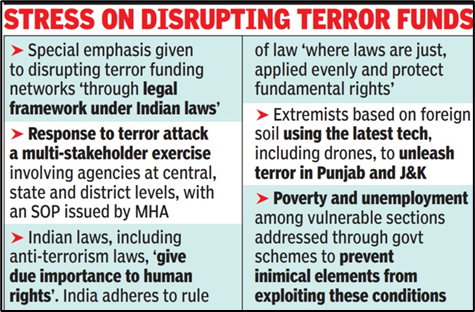
- Core Objective
- Prahaar aims to:
- Criminalise all terrorist acts.
- Starve terrorists, their financiers and supporters of funding, weapons, safe havens and cyber resources.
- Strengthen coordinated action among central and state agencies.
- Prahaar aims to:
- Guiding Principles
- Zero Tolerance: No justification for terrorism under any circumstances.
- Victim-Centric Approach: India stands firmly with victims of terror.
- No Religious Attribution: Terrorism is not associated with any religion, ethnicity, or civilisation.
- Concern Over State Sponsorship: Notes that some countries in the region have used terrorism as an instrument of state policy.
- Seven Key Pillars of Prahaar: Each letter of the acronym represents a strategic pillar:
- Prevention
- Intelligence-led, proactive measures to stop attacks before they occur.
- Continuous disruption of overground worker networks and cyber activities.
- Responses
- Swift, proportionate, and graded counter-terror responses.
- Uniform anti-terror structures and standard operating procedures across levels of governance.
- Aggregating Internal Capacities
- Whole-of-government approach.
- Modernisation of law enforcement agencies (LEAs) with advanced tools, technology, and weaponry.
- Enhanced coordination in intelligence collection and investigation.
- Human Rights and Rule of Law
- Safeguarding due process with multiple levels of redressal and appeal.
- Legal reforms in the counter-terror framework as required.
- Attenuating Enabling Conditions
- Graded police response to radicalisation.
- Legal action based on degree of radicalisation.
- Addressing socio-economic vulnerabilities of youth through education, engagement and de-radicalisation programmes.
- Aligning International Efforts
- Strengthening global cooperation.
- Use of treaties, extradition and deportation under UN norms.
- Collaboration to counter misuse of ICT by terrorists.
- Recovery and Resilience
- Whole-of-society approach to rebuilding and strengthening community resilience after terror incidents.
- Prevention
- Key Threat Perceptions
- Cross-Border and State-Sponsored Terror
- India has faced cross-border sponsored terrorism, including jihadist outfits and their frontal organisations.
- Global terror groups like Al-Qaeda and ISIS have attempted to incite violence through sleeper cells.
- Terror handlers abroad have used drones and advanced technologies to facilitate attacks, especially in Punjab and Jammu & Kashmir.
- Terror groups increasingly collaborate with criminal networks for logistics and recruitment.
- Technology-Driven Terrorism
- Use of drones in Punjab and J&K.
- Exploitation of encryption, dark web and cryptocurrencies for anonymity.
- Use of social media and encrypted messaging apps for propaganda, recruitment, and funding.
- Risks related to CBRNED materials (chemical, biological, radiological, nuclear, explosive, digital).
- Threats from misuse of drones, robotics, and cyberattacks by state and non-state actors.
- Organised Crime Nexus
- Terror groups leveraging criminal networks for logistics and recruitment.
- Collaboration between foreign-based and local outfits for transnational attacks.
- Cross-Border and State-Sponsored Terror
- Counter-Measures and De-Radicalisation
- Proactive disruption of online terror propaganda and recruitment networks.
- Strengthening intelligence and counter-terror operations.
- Community-based reintegration efforts involving doctors, psychologists, lawyers, NGOs, and religious leaders to prevent radicalisation and rehabilitate affected individuals.
- Strategic Way Forward
- Greater collaboration among intelligence and security agencies.
- Continuous capacity-building at the state level.
- Investment in technology and partnerships with private enterprises.
- Uniform structures and standard procedures across central, state and district levels.
Conclusion
Prahaar institutionalises India’s counter-terror strategy as a doctrine rooted in proactive intelligence, coordinated governance, technological preparedness, legal safeguards and international cooperation, aimed at comprehensively dismantling terror networks and strengthening national security.
Mains Article
24 Feb 2026
Context:
- India hosted the India AI Impact Summit 2026, the first global AI summit organised by a Global South country, signalling India’s ambition to shape the future of Artificial Intelligence (AI) governance, infrastructure, and innovation.
- The summit brought together over 20 heads of state, 60 ministers, and over 500 AI leaders from over 100 countries, marking a major multilateral moment for AI policy.
Civilisational Inspiration:
- Drawing inspiration from India’s civilisational traditions of structured knowledge — from Panini’s grammar to Nalanda’s institutional scholarship — the summit emphasised the importance of structured, inclusive and sovereign AI systems.
- India presented an alternative vision to the technology-dominated models of advanced economies.
India’s Vision for AI Governance:
- The MANAV framework: The Indian Prime Minister outlined the MANAV vision as a guiding framework for AI governance -
- M - Moral and Ethical System
- A - Accountable Governance
- N - National Sovereignty
- A - Accessible and Inclusive
- V - Valid and Legitimate
- Key principles of the vision: Ethical guardrails for responsible AI development, data sovereignty to prevent data exploitation, inclusive access ensuring benefits reach all citizens, democratic oversight, etc.
- The approach emphasises “AI with human control”, combining innovation with regulatory oversight.
Delhi Declaration - Global South AI Blueprint:
- The summit adopted the Delhi Declaration, considered the first major AI governance framework emerging from the Global South.
- Key features:
- Development-oriented AI governance: Focus on development priorities rather than purely commercial interests. Flexible techno-legal regulatory approach. Avoidance of rigid compliance regimes.
- Three-pillar framework:
- People – Inclusive AI access
- Planet – Sustainable technology use
- Progress – Economic growth and innovation
- Global initiatives proposed:
- Population-scale AI solutions: BharatGen supporting 22 Indian languages.
- Global compute bank: Modelled on subsidised GPU access in India (~₹65/hour).
- Data sovereignty: Preventing AI extractivism (use of developing-country data to train proprietary models).
India’s Digital Public Infrastructure (DPI) as Foundation:
- India’s AI strategy builds on its successful DPI ecosystem.
- Key achievements:
- UPI processed 228 billion transactions in 2025 (~$3.4 trillion).
- JAM Trinity enabled welfare savings of ₹3.48 lakh crore since 2015.
- Integrated architecture: Digital identity, payments, welfare delivery.
- This infrastructure provides a base for population-scale AI deployment.
AI Infrastructure Expansion:
- Existing gap: Though India generates around 20% of global data, it hosts only about 3% of global data centre capacity. Bridging this gap is central to India’s AI strategy.
- Major investment announcements:
- Global technology companies:
- Microsoft: $50 billion Global South plan (including $17.5 billion for India).
- Google: $15 billion America–India Connect initiative.
- Amazon Web Services: $8.3 billion investment in Maharashtra.
- Indian industry:
- Adani Group: $100 billion renewable-powered AI data centres by 2035.
- Yotta Data Services: Over $2 billion AI computing hub using advanced chips.
- L&T–Nvidia partnership: For gigawatt-scale AI factory.
- National AI infrastructure: The IndiaAI Mission’s national compute cluster has crossed 38,000 GPUs and is scaling to 58,000, available to startups at roughly one-third of global cost.
- Investment target: $200 billion AI infrastructure investment in next two years.
- Global technology companies:
Policy Support and Budgetary Measures:
- The Union Budget 2026–27 supports AI growth through key measures like -
- Tax holiday until 2047 for foreign companies using Indian data centres.
- $1.1 billion VC fund for AI and advanced manufacturing startups.
- National Critical Mineral Mission: Secures the lithium, cobalt, and rare earths that AI and semiconductor manufacturing depend on.
Democratisation of AI:
- India emphasised AI for social transformation, not only industrial competitiveness.
- Human capital initiatives:
- 2.5 lakh students pledged responsible AI innovation.
- 30 Data and AI Labs operational in Tier-2 and Tier-3 cities (Target: 570 AI labs nationwide).
- Public AI infrastructure: AIKosh platform offers over 7,500 datasets and 273 models as shared public infrastructure.
- Education expansion: IITs increased from 16 in 2014 to 23 today.
Sovereign AI Capability:
- India is transitioning from an AI consumer to an AI producer.
- New sovereign AI models: Sarvam AI LLM, BharatGen Param2.
- India is now among countries building indigenous Large Language Models (LLMs).
Strategic Partnerships and Global Role:
- Co-building capacity: India is shifting from technology licensing to technology co-development.
- Key partnerships:
- Tata–OpenAI: Beginning with 100 MW of AI-ready data centre capacity under the Stargate initiative and scaling to one gigawatt, signals that Indian industry is moving to the supply side of global intelligence.
- Pax Silica Declaration: Places India in the US-led coalition, securing supply chains for AI, semiconductors, and critical minerals.
- India–US AI Opportunity Partnership: Commits both nations to pro-innovation approaches on critical technologies.
- India–France Year of Innovation 2026: Organised around joint skilling and measurable outcomes.
Key Challenges and Way Forward:
- Infrastructure deficit: Limited data centre capacity relative to data generation.
- Expand DPI 2.0 - AI integrated with DPI platforms.
- Technological dependence: Reliance on foreign chips and advanced AI hardware.
- Strengthen sovereign AI ecosystem - Indigenous chips and models, domestic cloud infrastructure.
- Skill gaps: Shortage of AI researchers and advanced engineers.
- Human capital development - AI education and research funding, skilling programmes in Tier-2 and Tier-3 cities.
- Regulatory complexity: Balancing innovation and ethical safeguards.
- Ethical and democratic governance - Transparent AI regulation, algorithmic accountability.
- Data governance issues: Implementing data sovereignty without restricting innovation.
- Global South leadership - Build coalitions for equitable AI governance, promote development-oriented AI models.
Conclusion:
- The India AI Impact Summit 2026 marks a turning point in the global AI landscape, positioning India as a norm-setter rather than a rule-taker.
- By combining data sovereignty, DPI, sovereign AI models, and global partnerships, India is attempting to build a structured and inclusive AI ecosystem.
- If executed effectively, this approach could allow India not only to benefit from the AI revolution but also to shape a more equitable global technological order.
Mains Article
24 Feb 2026
Why in the News?
- The Independence of the Election Commission has come under debate following allegations of irregularities in electoral roll revisions and a proposed motion to remove the Chief Election Commissioner (CEC).
What’s in Today’s Article?
- Elections (Importance of Free & Fair Elections, Election Commission, Appointments, Safeguards, Concerns, etc.)
Importance of Free and Fair Elections
- Free and fair elections form part of the Basic Structure of the Constitution, as recognised by the Supreme Court in Indira Gandhi vs. Raj Narain (1975).
- Adult franchise under Article 326 guarantees the right to vote to every citizen above 18 years of age, subject to reasonable restrictions.
- Recent controversies have revolved around alleged “vote theft” and manipulation of electoral rolls during the Special Intensive Revision (SIR) exercise.
- It has been claimed that lakhs of names were deleted from voter lists in certain States, raising concerns about procedural fairness and the sanctity of electoral democracy.
- Any perceived dilution in the electoral process directly impacts public trust in democratic institutions.
Constitutional Status of the Election Commission
- Article 324 of the Constitution provides for a permanent Election Commission of India (ECI) with powers of superintendence, direction, and control over elections to Parliament, State Legislatures, and the offices of President and Vice-President.
- This constitutional status ensures:
- Institutional permanence
- Autonomy from routine executive interference
- Wide discretionary powers in conducting elections
- The Election Commission may consist of a Chief Election Commissioner and other Election Commissioners. Since 1993, it has functioned as a multi-member body, a structure upheld by the Supreme Court in T. N. Seshan vs. Union of India (1995).
- The CEC acts as the Chairperson of the Commission, and decisions are generally taken collectively.
Appointment of the Election Commissioners
- The appointment process became controversial after the enactment of the Chief Election Commissioner and Other Election Commissioners (Appointment, Conditions of Office and Terms of Office) Act, 2023.
- Under the 2023 Act:
- The CEC and Election Commissioners are appointed by the President.
- A Selection Committee comprising the Prime Minister, a Union Minister, and the Leader of the Opposition recommends names.
- Critics argue that the exclusion of the Chief Justice of India from the Selection Committee weakens institutional independence.
- This change followed the Supreme Court’s 2023 judgment in Anoop Baranwal vs. Union of India, which had temporarily mandated the inclusion of the CJI in the selection panel until Parliament enacted a law.
- The validity of the 2023 Act is currently under judicial scrutiny.
Safeguards for Independence
- The Constitution incorporates strong safeguards to protect the Election Commission from executive pressure.
- Removal of the CEC
- Article 324(5) provides that the CEC can be removed only in the same manner and on the same grounds as a Supreme Court judge under Article 124(4). The grounds are:
- Proved misbehaviour, Incapacity
- The removal process is rigorous and quasi-judicial:
- Article 324(5) provides that the CEC can be removed only in the same manner and on the same grounds as a Supreme Court judge under Article 124(4). The grounds are:
- A motion must be signed by at least 100 Lok Sabha members or 50 Rajya Sabha members.
- The Speaker or Chairman may admit the motion.
- A three-member inquiry committee is constituted, comprising:
- A Supreme Court judge
- A Chief Justice of a High Court
- A distinguished jurist
- The CEC is given the opportunity to defend themselves, ensuring adherence to principles of natural justice.
- Both Houses of Parliament must pass the motion by a special majority.
- Removal of Other Election Commissioners
- Other Election Commissioners can be removed by the President on the recommendation of the CEC. However, the Supreme Court in Vineet Narain vs. Union of India (1997) clarified that such advice should not be arbitrary.
- These mechanisms create a balance between executive oversight and institutional independence.
Special Intensive Revision and Electoral Concerns
- The recent controversy relates to the SIR of electoral rolls. Allegations include:
- Large-scale deletion of names from voter lists
- Targeting of specific demographic groups
- Rushed revision processes
- Since electoral rolls form the foundation of democratic participation, any irregularity in revision exercises can undermine public confidence.
- Challenges to such revisions have reached the Supreme Court.
- The issue highlights the delicate balance between administrative efficiency and constitutional guarantees of universal adult suffrage.
Mains Article
24 Feb 2026
Context
- At India Energy Week (IEW) 2026, investment opportunities worth nearly $500 billion were announced in the energy sector, reflecting a transition from energy security to energy independence.
- The long-term success of this shift depends on affordable clean fuels, particularly green hydrogen and its derivative green ammonia.
- Owing to its practicality and scalability, green ammonia is emerging as a central component of India’s clean-energy pathway and a potential influence on global energy markets.
Understanding Green Ammonia
- What is Green Ammonia?
- Green ammonia is produced by combining nitrogen with hydrogen generated using renewable electricity.
- Unlike grey ammonia, which depends on fossil fuels, it is largely carbon-free and aligns with decarbonisation goals.
- Why It Matters and Its Application
- Hydrogen faces challenges of storage and transport. Green ammonia resolves these constraints because it can be liquefied, stored, and shipped using existing infrastructure.
- It therefore acts as a practical carrier of hydrogen energy. Green ammonia has multiple uses:
- Fertiliser production
- Marine fuel for shipping
- Power generation
- Industrial processes
- Its versatility enables large-scale adoption of clean fuel systems.
Creating a Market: The Role of Procurement Mechanisms
- Energy transitions require functioning markets. Governments have introduced aggregated procurement systems to guarantee demand and reduce investor uncertainty.
- Major initiatives include the European Union’s H2Global programme, South Korea’s Clean Hydrogen Portfolio Standard, and India’s SIGHT (Strategic Interventions for Green Hydrogen Transition) programme under the National Green Hydrogen Mission.
- These mechanisms encourage private participation by ensuring predictable demand and revenue streams.
India’s Green Ammonia Auction Model
- The SECI Tender
- The Solar Energy Corporation of India (SECI) issued a tender in 2024 to procure 724,000 tonnes of green ammonia annually for 13 fertiliser plants.
- Successful bidders received 10-year offtake agreements and initial production subsidies, creating strong investment certainty.
- Participation and Outcomes
- Fifteen companies participated and seven secured thirteen contracts, including a large allocation of 370,000 tonnes annually to a single bidder.
- Revisions to the tender addressed risk allocation, payment security, and pricing clarity, producing a balanced framework acceptable to both producers and buyers.
Economic Viability and Price Competitiveness
- Price Discovery
- Prices ranged from ₹49.75–₹64.74 per kg (about $572–$744 per tonne). Conventional grey ammonia costs roughly $515 per tonne.
- The gap narrowed significantly due to subsidies and long-term contracts, improving commercial feasibility.
- Global Significance
- Auction prices were about 40–50% lower than some international benchmarks, establishing strong price competitiveness and demonstrating the economic practicality of clean fuels.
Logistics, Infrastructure, and Strategic Benefits
- Delivery and Transportation
- Pre-identified delivery points were located near coastal fertiliser plants, enabling efficient shipping logistics and reduced transport costs.
- Economic and Strategic Impact
- The contracted supply could replace nearly 30% of imports, lowering exposure to gas price volatility, currency fluctuations, and geopolitical risks.
- In regions with higher production costs, green ammonia becomes particularly attractive for scaling.
India’s Global Leadership Potential
- India combines low renewable costs, a large domestic fertiliser market, effective contract design, and targeted incentives.
- Many countries seeking clean fuels for industry, power generation, and transport may rely on imports, positioning India as a major exporter and potential architect of a new clean-fuel trade network.
Challenges and Policy Requirements
- Responsibilities of Developers
- Project developers must ensure technical due diligence, integrate hybrid renewable systems with storage, and maintain transparent monitoring for long-term reliability.
- Responsibilities of Policymakers
- Authorities need stable regulatory frameworks, reliable grid access, clear energy banking rules, strengthened safety standards, and internationally aligned certification systems.
- Financial Support
- Expansion requires blended finance, extended contracts, and risk-mitigation instruments to improve project bankability and attract private capital.
Conclusion
- India’s green ammonia initiative demonstrates that environmental sustainability and economic growth can progress together.
- By combining incentives, assured demand, and infrastructure planning, clean fuels are approaching commercial viability.
- Continued regulatory stability and financial support can help achieve energy independence while fostering a global clean-fuel market, positioning India as a significant leader in the twenty-first-century energy economy.
Mains Article
24 Feb 2026
Context
- The deaths of three adolescent girls in Ghaziabad reveal a deeper structural problem rather than an isolated tragedy.
- India is confronting a growing crisis in child mental health and adolescent wellbeing, shaped by early psychological vulnerability, social stigma, academic pressure, and an increasingly unregulated digital environment.
- This convergence has created a public health emergency insufficiently addressed by families, schools, healthcare systems, and policy frameworks.
Early Vulnerability and Misunderstanding of Childhood Mental Health
- Mental illness is often perceived as an adult issue, yet emotional and behavioural disorders appear in early childhood, sometimes as early as four or five years.
- Anxiety, depression, and behavioural disorders emerge during critical developmental stages.
- Early trauma, neglect, and chronic stress interfere with emotional and cognitive growth, often resurfacing with greater intensity during adolescence.
- Childhood experiences accumulate rather than disappear. When early distress remains unrecognised, it later manifests in more severe psychological difficulties.
- Disorders have also become more complex. Increasingly, children experience comorbidity: ADHD accompanied by anxiety, depression linked with compulsive screen use, and learning disorders associated with emotional distress.
- Early warning signs, withdrawal, impulsivity, or sudden behavioural change, are frequently dismissed as misbehaviour, allowing long-term emotional harm to develop.
The Structural Gap: Data, Resources, and Access to Care
- Survey data suggests that 7–10% of Indian adolescents have diagnosable mental health conditions, while 5–7% of school-aged children show symptoms of ADHD.
- Yet institutional capacity remains inadequate. India has fewer than 10,000 psychiatrists for over 1.4 billion people, and only a small proportion specialise in child psychiatry.
- The shortage of clinical psychologists, child specialists, and psychiatric social workers forces families to navigate fragmented care systems alone.
- This imbalance between demand and infrastructure leads to delayed diagnosis, untreated distress, and crisis-driven intervention.
- The issue therefore represents a wider public health failure rather than merely a clinical challenge.
The Digital Environment as an Intensifying Factor
- The expansion of smartphones and affordable internet access has transformed childhood.
- Hundreds of millions of children now interact daily with connected devices, a trend accelerated during the COVID-19 pandemic.
- Education, communication, and entertainment occur on the same screen, blurring behavioural boundaries.
- Excessive exposure does not directly cause neurodevelopmental disorders, but it intensifies vulnerabilities.
- Internet addiction, marked by sleep disruption, irritability, and social withdrawal, has become common.
- Prolonged screen exposure weakens attention, emotional regulation, and sleep patterns while displacing essential human interaction during periods of neuroplasticity.
- Reduced real-world engagement undermines emotional development and delays recognition of underlying problems.
Families, Schools, and Social Institutions
- Families function as the first protective layer. Trauma-informed parenting, attentive listening, and early help-seeking significantly improve outcomes.
- Parent and peer support groups reduce isolation and encourage resilience.
- Schools, however, remain a major weakness. Educational systems prioritise academic performance, examinations, and rankings over emotional wellbeing.
- Without emotional regulation and stress management, academic achievement becomes fragile.
- Teachers often lack training to identify warning signs, and healthcare consultations focus mainly on physical growth rather than psychological health.
Policy and Social Response
- Recent policy discussions acknowledge rising youth mental health concerns, and some regions are considering limits on adolescent social media exposure.
- Effective action requires prevention, education, and support rather than punishment.
- Key measures include school-based screening, teacher training, stronger referral networks, community counselling, and expansion of tele-mental health
- Clear digital-use guidelines and accessible care for low-income families are essential. Cultural barriers remain significant; fear of labelling discourages families from seeking help.
- Normalising conversations about mental wellbeing is therefore a national priority.
Reframing Childhood: A Cultural Argument
- Modern childhood has become intensely competitive. Success is increasingly measured by grades rather than wellbeing.
- Healthy development requires resilience, emotional security, and social connection alongside achievement.
- Neglecting psychological health produces long-term social and economic consequences, including reduced productivity and strained relationships.
Conclusion
- The Ghaziabad incident underscores interconnected causes: early vulnerability, institutional neglect, inadequate resources, digital overexposure, and social pressure.
- Families, schools, healthcare providers, and policymakers share responsibility. Early detection, supportive parenting, school reform, responsible technology use, and stigma reduction are essential.
- Protecting childhood wellbeing is not peripheral; it is central to national development and long-term societal stability.