March 27, 2026
Mains Article
27 Mar 2026
Why in news?
A U.S. jury in Los Angeles found Meta and YouTube guilty of designing addictive platforms that harmed a young user.
The companies were deemed negligent and accused of malice and fraud, with $6 million in damages awarded—Meta liable for 70% and YouTube 30%.
What’s in Today’s Article?
- Background: Landmark Case Links Social Media Design to Youth Harm
- Overcoming Section 230: The Legal Shift in Social Media Liability
- Parallel Verdict Highlights Platform Safety Concerns
- India’s regulatory framework for children on the internet
Background: Landmark Case Links Social Media Design to Youth Harm
- The case highlights allegations that Meta (Facebook, Instagram) and YouTube intentionally designed addictive platforms that harmed young users.
- A 20-year-old plaintiff argued that early exposure led to anxiety, depression, and body dysmorphia.
- The lawsuit treats social media as a product, comparing its design to “digital casinos” that exploit dopamine-driven engagement.
Overcoming Section 230: The Legal Shift in Social Media Liability
- Past lawsuits against social media companies often failed due to Section 230 of the Communications Decency Act, which protects platforms from liability for user-generated content.
- Plaintiffs bypassed Section 230 by focusing on product design, arguing that harm arose from platform architecture—such as feeds and engagement mechanisms—rather than specific content.
- The jury examined whether harm stemmed from platform design (not third-party content) and whether companies met negligence criteria: duty of care, breach, causation, and harm.
- Despite arguments about external factors, the jury applied the “substantial factor” test and concluded that platform design significantly contributed to the harm.
- The jury found evidence of conscious disregard for user safety, supported by internal research showing companies were aware of risks but continued harmful design practices.
Parallel Verdict Highlights Platform Safety Concerns
- A New Mexico jury found Meta liable under consumer protection law for misleading users about platform safety, awarding $375 million in damages.
- The case focused on decisions like expanding end-to-end encryption despite internal warnings about child exploitation risks.
- Together with the Los Angeles verdict, it signals a broader shift toward holding platforms accountable for design choices and safety practices, not just user content.
India’s regulatory framework for children on the internet
- Information Technology Act, 2000
- Prohibits harmful and explicit content involving children.
- Mandates quick removal (within 2–3 hours) of unlawful content.
- Requires reporting offences under relevant laws like POCSO.
- Digital Personal Data Protection Act, 2023
- Requires verifiable parental consent for processing children’s data.
- Prohibits tracking, behavioural monitoring, and targeted advertising directed at children.
- Information Technology (Reasonable Security Practices and Procedures and Sensitive Personal Data or Information) Rules, 2011, (SPDI Rules)
- Ensure data is collected for specific purposes with consent.
- Restrict disclosure of sensitive personal data.
- Awareness and Capacity Building
- CERT-In Initiatives - Provides safety advisories, awareness campaigns, and cybersecurity guidance.
- Information Security Education and Awareness (ISEA) - Conducted thousands of workshops covering lakhs of participants. Trained teachers, police personnel, and volunteers as cybersecurity trainers.
- Technical and Enforcement Measures
- Blocking of child sexual abuse material (CSAM) through global databases.
- Collaboration with international agencies like NCMEC (USA).
- Promotion of parental control filters and cyber safety awareness.
- Overall Significance
- India has adopted a multi-layered approach combining legal provisions, regulatory frameworks, awareness programmes, and institutional mechanisms to mitigate risks from AI and protect children in the digital ecosystem.
Mains Article
27 Mar 2026
Why in news?
The RBI has stated that India’s forex reserves remain adequate to cushion external shocks, even as heavy foreign investor outflows ($12.1 billion in March) have weakened the rupee to record lows.
Although reserves stand at a robust $710 billion—close to the recent peak of $728 billion—the headline figure needs closer examination to assess true strength.
What’s in Today’s Article?
- Components of India’s Forex Reserves
- Dual Strategy for Defending the Rupee
- RBI’s Forex Reserves: Adjusted Reality Raises Concerns
- RBI’s Dilemma: Defend the Rupee or Preserve Forex Reserves
Components of India’s Forex Reserves
- India’s forex reserves comprise four elements:
- Foreign Currency (FX) Assets
- Gold Holdings
- Special Drawing Rights (SDRs)
- Reserve Tranche Position with the IMF
- Minor Components: Limited Immediate Use
- Special Drawing Rights (SDRs)
- Valued at $18.7 billion
- Based on a basket of global currencies
- Serve as a buffer that can be exchanged during crises
- IMF Reserve Tranche Position
- Worth $4.8 billion
- Functions as an emergency credit line with the IMF
- Special Drawing Rights (SDRs)
- Major Components: Real Strength of Reserves
- Foreign Currency (FX) Assets
- Valued at $556 billion
- Primary tool for RBI to manage currency volatility
- Most liquid and usable component
- Gold Holdings
- Valued at $131 billion
- Acts as a long-term store of value
- Not easily deployable for routine currency defence
- While total reserves appear large, FX assets are the most relevant measure of the RBI’s ability to defend the rupee in the short term, though even this requires further adjustments.
- Foreign Currency (FX) Assets
Dual Strategy for Defending the Rupee
- The RBI can stop the rupee from falling in two ways.
- The RBI uses a balanced approach, combining spot and forward interventions to stabilise the rupee while managing liquidity and interest rate pressures in the domestic economy.
- Spot Market Intervention
- The RBI sells foreign exchange (FX) in the spot market, immediately reducing forex reserves and supporting the rupee.
- Impact
- Strengthens or stabilises the rupee
- Reduces rupee liquidity in the system
- Leads to higher domestic interest rates
- Forward Market Intervention
- The RBI sells FX in the forward market, agreeing to deliver dollars at a future date rather than immediately.
- Impact
- Helps defend the rupee without immediate reserve depletion
- Avoids tightening of rupee liquidity
- Prevents upward pressure on interest rates
RBI’s Forex Reserves: Adjusted Reality Raises Concerns
- Although headline FX assets appear strong, RBI’s net forward sales of $68 billion (as of January) reduce effective reserves to below $500 billion.
- With continued rupee pressure, this gap may have widened further.
- Analysts warn that reserve adequacy—measured by import cover—is nearing 2013 BoP stress levels, raising concerns about external vulnerability.
RBI’s Dilemma: Defend the Rupee or Preserve Forex Reserves
- Despite selling $94 billion in FX since October 2024, the rupee has weakened sharply, highlighting limits of intervention amid global pressures and capital outflows.
- Analysts warn the rupee could fall to 97–98 if conditions persist.
- With rising oil prices and investor exits increasing the import bill, economists suggest the RBI may need to allow a controlled depreciation to conserve reserves during a prolonged crisis.
Mains Article
27 Mar 2026
Why in the News?
- The 14th Ministerial Conference of the World Trade Organisation has begun amid debates on global trade reforms and India’s policy stance.
What’s in Today’s Article?
- WTO (Objectives, Key Principles, Mechanism, Significance, etc.)
- News Summary (Crisis of Relevance, India’s Trade Strategy, etc.)
World Trade Organization
- The World Trade Organisation (WTO) is a global international body established in 1995 to regulate and facilitate international trade among nations.
- Objectives
- Promote free and fair global trade.
- Ensure predictability and transparency in trade rules.
- Provide a platform for negotiation and dispute settlement.
- Support development through trade integration.
- Key Principles
- Most-Favoured Nation (MFN): Equal treatment to all member countries in trade.
- National Treatment: Imported goods should be treated equally with domestic goods.
- Consensus-based decision-making: Decisions are typically taken with agreement from all of the members.
- Institutional Mechanisms
- Ministerial Conference: The highest decision-making body, held every two years.
- Dispute Settlement Body: Resolves trade disputes among member countries.
- Trade Policy Review Mechanism: Monitors trade policies of member countries.
- Significance
- The WTO plays a crucial role in maintaining a stable global trade system.
- However, in recent years, it has faced challenges such as weakening dispute settlement mechanisms and rising protectionism.
News Summary
- The ongoing WTO Ministerial Conference (MC14) takes place in a context of a changing global trade order and growing tensions among major economies.
- Crisis of Relevance
- The WTO is facing a crisis of relevance due to disruptions in global trade rules.
- The dispute settlement mechanism has become ineffective because of the blocking of judge appointments by the United States.
- Push for WTO Reforms
- The United States is advocating significant reforms, including reconsideration of the MFN principle.
- There is also a push to incorporate plurilateral agreements, which involve a subset of countries instead of all members.
- This represents a shift away from the WTO’s traditional consensus-based approach.
- E-commerce Moratorium
- One of the key issues is the continuation of the moratorium on customs duties on electronic transmissions. It has been in place since 1998.
- Developed countries support its continuation.
- India, along with countries like Indonesia and South Africa, opposes it.
- India argues that:
- It may lead to significant revenue loss.
- It restricts policy space in the digital economy.
- Developing countries lack the technological capacity to benefit equally.
- Investment Facilitation Agreement
- Another major issue is the China-backed Investment Facilitation for Development (IFD) Agreement.
- Supported by over 120 countries.
- Aims to improve the flow of foreign direct investment.
- India opposes this agreement because:
- It is being introduced through a plurilateral route.
- It undermines the multilateral and consensus-based structure of the WTO.
- It may have strategic implications linked to global investment networks.
- Public Stockholding for Food Security
- India continues to push for a permanent solution on public stockholding.
- WTO rules limit agricultural subsidies to 10% of production value.
- India seeks flexibility to support farmers and ensure food security.
- This is crucial because:
- India supports millions of small farmers through MSP.
- Around 80 crore people receive free food grains under welfare schemes.
- Fisheries Subsidies and Livelihood Concerns
- India advocates a balanced approach to fisheries subsidies.
- It supports sustainability in fishing practices.
- It emphasises the protection of small fishers’ livelihoods.
- It calls for greater responsibility from developed nations engaged in distant water fishing.
- India’s Broader Trade Strategy
- India’s approach to the WTO is guided by the need to preserve policy space.
- India has a relatively low share in global trade but high growth potential.
- Past experiences, such as the Information Technology Agreement (ITA-1), influence its cautious approach.
- India aims to ensure that:
- Development concerns remain central to WTO reforms.
- Trade rules do not constrain domestic policy flexibility.
- Emerging sectors like digital trade are regulated fairly.
Mains Article
27 Mar 2026
Context:
- The ongoing geopolitical turbulence in West Asia highlights a structural reality for India: energy insecurity is systemic, not episodic.
- With over 85% dependence on crude oil imports, India remains highly vulnerable to supply disruptions, price shocks, and regional conflicts—leading to inflationary pressures, fiscal strain, and current account deficits.
- However, this crisis also presents a strategic opportunity to transform vulnerability into long-term energy resilience and leadership.
Structural Challenge - Import Dependence and Vulnerability:
- Heavy reliance on imported fossil fuels exposes India to geopolitical risks, volatile oil prices, and macroeconomic instability.
- Energy security is thus directly linked to economic stability, strategic autonomy, and climate commitments (NDCs).
Scaling Renewable Energy - From Incrementalism to Transformation:
- Need for ambition reset:
- India’s existing target of 500 GW of RE by 2030 was bold when announced, but it's no longer sufficient today. A revised target of 1,500 GW by 2030 is both necessary and achievable.
- For example, China added almost 1,600 GW in clean energy (solar and wind) in 2025, whereas India added a mere 49 GW.
- Policy imperatives:
- Strengthening procurement mechanisms: Central agencies must aggregate and contract at least 200 GW+ annually, complemented by aggressive state-level procurement.
- Strengthening: Renewable Purchase Obligations (RPOs), and Renewable Consumption Obligations (RCOs).
Grid Infrastructure and Storage - The Missing Link:
- Transmission bottlenecks:
- Renewables-rich states: Gujarat, Rajasthan, Karnataka, and Tamil Nadu.
- Last year, over 50GW of energy capacity remained stranded due to a lack of evacuation and over 35GW is likely to be curtailed this year.
- As storage is equally critical, grid infrastructure must be treated as a national priority.
- Key reforms:
- Develop high-capacity transmission corridors that are seamlessly integrated with storage systems.
- Expand Renewable Energy Management Centres (REMCs).
- Integrate Battery Energy Storage Systems (BESS) and Pumped Hydro Storage
- Make storage mandatory in RE tenders.
- Reduce GST on storage systems.
Household Energy Transition - From LPG to Electrification:
- Issues with LPG: Significant import dependence, which increased further with the success of schemes like PM Ujjwala Yojana.
- Suggestions:
- Promote electric induction cooking.
- Replicate UJALA model (demand aggregation for affordability).
- Use Ujjwala database for targeted distribution.
Transport Electrification as Economic Strategy:
- Clear and time-bound roadmap: Full electrification of new two-wheelers and three-wheelers by 2030, buses in the near term, and cars and trucks by 2035.
- Challenges: Weak battery ecosystem, and underperformance of PLI for Advanced Chemistry Cells.
- Solutions: Restructure PLI scheme, expand charging infrastructure, and create viable business models and standards.
Nuclear Energy - Backbone of Grid Stability:
- Strategic role: As nuclear power provides the firm, non-intermittent supply that is essential for grid stability, it must be scaled as a long-term backbone of India’s energy mix.
- Targets and innovations: India’s ambition to reach 100 GW of nuclear capacity by 2047 is strategic and necessary. Small modular reactors offer a scalable pathway.
- Policy priorities: Enable private sector participation, strengthen global partnerships, and streamline regulatory processes.
Critical Minerals - Securing the Supply Chain:
- Core issues: Overdependence on concentrated global supply chains, lack of domestic processing and refining capacity.
- Strategic measures: Develop end-to-end domestic capabilities; secure assured offtake agreements, price support mechanisms, deepen partnerships with resource-rich countries, and invest in human capital (battery tech, mineral processing).
Clean Energy Manufacturing Hub - India’s Next Growth Engine:
- Key sectors: Solar modules, batteries, electrolysers, grid technologies and green hydrogen represent the next wave of global manufacturing.
- Policy direction: Align PLI schemes across sectors, reduce logistics costs, and boost export competitiveness. Leverage domestic demand, policy incentives, and scale advantage.
Financing the Energy Transition:
- Challenges: High capital requirements, risk perception in emerging sectors.
- Best practice:
- India's renewable sector has attracted private capital from across the world, thanks to predictable policies and actions through the Solar Energy Corporation of India (SECI).
- Similar policy frameworks are necessary across sectors to enable the private sector to attract capital and technology.
- Solutions:
- India must deepen its green finance ecosystem, including green bonds, blended finance structures, and sovereign-backed risk mitigation instruments.
- Strengthen role of domestic financial institutions, Multilateral Development Banks (MDBs), and develop robust carbon markets.
Governance and Execution - Whole-of-Government Approach:
- Execution must be anchored in institutional coordination and accountability.
- India has demonstrated its ability to deliver at scale, whether through digital public infrastructure (DPI), financial inclusion, or RE deployment.
- Therefore, energy transition now requires an integrated action across centre, states, and municipal bodies.
Conclusion:
- The instability in West Asia is both a warning and an opportunity.
- India stands at a critical juncture where it can either remain vulnerable to external shocks or emerge as a global leader in clean energy and energy security.
- By adopting a holistic, ambitious, and execution-driven approach, India can transition from energy dependence to energy sovereignty, shaping not just its own future but also contributing to global energy transformation.
March 26, 2026
Mains Article
26 Mar 2026
Why in the News?
- The Union Cabinet has approved a revamped UDAN Scheme with higher funding and extended subsidy support.
What’s in Today’s Article?
- UDAN Scheme (Objectives, Key Features, Funding Mechanism, Achievements, Challenges, etc.)
- News Summary
UDAN Scheme
- The Ude Desh ka Aam Nagrik (UDAN) scheme was launched in 2017 under the Regional Connectivity Scheme (RCS) to enhance air connectivity to underserved and unserved regions.
- Objectives
- Improve regional connectivity across Tier-2 and Tier-3 cities.
- Make air travel affordable for common citizens.
- Promote balanced regional development.
- Enhance the infrastructure utilisation of unused and underutilised airports.
- Key Features
- Airlines are selected through a competitive bidding mechanism.
- Viability Gap Funding (VGF) is provided to airlines to operate on less profitable routes.
- 50% of seats are offered at a capped fare of around Rs. 2,500 per hour of flight.
- Focus on connecting remote, hilly, and island regions.
- Funding Mechanism
- Initially funded through a Regional Connectivity Scheme levy imposed on flights operating on major routes.
- The levy subsidised airlines operating on regional routes.
- Achievements of the Scheme
- Over 600 routes have been operationalised since launch.
- More than 90 airports, including many previously unused airstrips, have been revived.
- Improved last-mile connectivity in remote areas such as the North-East and hilly regions.
- Challenges
- Low route viability after subsidy withdrawal.
- Limited passenger demand in certain regions.
- Operational challenges such as infrastructure gaps and airline sustainability.
- High discontinuation rate of routes after the subsidy period.
News Summary
- The government has approved a major revamp of the UDAN scheme to address structural issues and improve sustainability.
- Increased Funding and Scope
- The revamped scheme has a total outlay of 28,840 crore, which marks a nearly six-fold increase from the earlier allocation.
- The scheme now goes beyond airport redevelopment to include support for operations and maintenance.
- Extension of Subsidy Period
- Subsidy support for airlines has been extended from three years to five years.
- This aims to improve route viability and reduce premature discontinuation.
- Shift in Funding Source
- Subsidy funding will now come directly from the government exchequer instead of the RCS levy.
- This marks a significant policy shift in financing the scheme.
- Viability Concerns Highlighted
- The revamp was triggered by poor performance under the earlier scheme:
- Over 90% of routes fell into disuse after subsidy withdrawal.
- Only about 7%-10% of routes remained viable beyond the subsidy period, as noted by a CAG report.
- Out of 663 routes launched since 2017, 327 have been discontinued.
- Airport Infrastructure and Expansion
- 100 additional airports will be redeveloped with an outlay of Rs. 12,159 crore.
- Around 441 aerodromes will receive operational and maintenance support.
- This reflects a shift from infrastructure creation to sustained operational support.
- Focus on Last-Mile Connectivity
- Development of 200 helipads to improve connectivity in remote regions.
- Investment in helicopters and small aircraft to strengthen regional aviation networks.
- Support for Aircraft Procurement
- Procurement of HAL Dhruv helicopters for Pawan Hans.
- Procurement of HAL Dornier aircraft for Alliance Air.
- This aims to enhance fleet availability for regional routes.
Mains Article
26 Mar 2026
Why in news?
The government has proposed increasing Lok Sabha seats from 543 to 816 — a 50% rise — based on the 2011 Census (rather than the upcoming Census) to implement the Nari Shakti Vandan Adhiniyam (Women's Reservation Act), 2023.
The proposal, being discussed with various political parties to build consensus, is likely to face significant legal and constitutional hurdles.
What’s in Today’s Article?
- What Is Being Proposed?
- Why the 2011 Census?
- Constitutional Provisions Governing Lok Sabha Seat Allocation
- The Delimitation Freeze: Why Lok Sabha Seats Have Been Unchanged Since 1971
- The Road Ahead: How Delimitation Will Proceed
- Legal Tests: The Constitutional Hurdles Ahead
What Is Being Proposed?
- Lok Sabha seats to be increased from 543 to 816.
- 273 seats to be reserved for women (33% of 816).
- Delimitation to be based on the 2011 Census, not the upcoming Census.
- Existing proportional representation among states to be maintained.
- A similar increase proposed for state Assembly seats.
Why the 2011 Census?
- The Women's Reservation Act, 2023 links the implementation of the quota to delimitation, which in turn requires a fresh Census.
- By using the 2011 Census instead of waiting for a new one, the government aims to fast-track implementation while avoiding the politically sensitive issue of states with higher populations — largely in the north — gaining seats at the expense of southern states that have performed better on population control.
Constitutional Provisions Governing Lok Sabha Seat Allocation
- Article 81 establishes the foundational principle of equal representation in the Lok Sabha through two key clauses:
- Article 81(2)(a) — The ratio between the number of seats allotted to a state and its population must be, as far as practicable, the same for all states.
- Article 81(2)(b) — Each state must be divided into constituencies such that the ratio between the population of each constituency and the number of seats allotted to it is, as far as practicable, uniform throughout the state.
- Article 81 makes a single exception — very small states with a population not exceeding 6 million are allowed disproportionate representation to ensure they still receive adequate representation in the Lower House.
- Article 82 mandates that upon the completion of each Census, both:
- The allocation of Lok Sabha seats to states, and
- The division of each state into territorial constituencies
The Delimitation Freeze: Why Lok Sabha Seats Have Been Unchanged Since 1971
- The current freeze on delimitation — meaning Lok Sabha seat allocation has remained unchanged since 1971 — is the result of two successive constitutional amendments:
- 1976 Amendment — Froze the definition of "last preceding census" in Articles 81 and 82 to mean the 1971 Census for the purpose of seat allocation among states. This freeze was set for 25 years.
- 2001 Amendment — Extended the freeze further, until the "relevant figures for the first census taken after the year 2026 have been published". The freeze will thus automatically expire once the current Census figures are released.
- Why Was the Freeze Introduced?
- The core reason was the fear of southern states losing political representation:
- Southern states had stabilised their populations through effective family planning.
- Several northern states, however, were experiencing rapid population growth.
- Under a strictly population-based delimitation, southern states would have seen their relative share of Lok Sabha seats decline — effectively penalising them for their success in controlling population growth
- The freeze was thus a political compromise to ensure that states were not disadvantaged for performing better on demographic indicators.
- The core reason was the fear of southern states losing political representation:
The Road Ahead: How Delimitation Will Proceed?
- If the government chooses not to extend the freeze, the next step would be Parliament passing a new Delimitation Act under Article 82.
- This is the established constitutional process:
- Census conducted → figures published
- Parliament passes a Delimitation Act
- Central Government constitutes a Delimitation Commission
- The Commission demarcates boundaries of Parliamentary constituencies as per the Act
- The Last Delimitation Exercise
- As per the Election Commission, the most recent delimitation of constituencies was conducted on the basis of 2001 Census figures under the Delimitation Act, 2002.
- This was an intra-state delimitation — redrawing constituency boundaries within states — and is distinct from the inter-state seat allocation, which has remained frozen since 1976.
Legal Tests: The Constitutional Hurdles Ahead
- The Core Constraint: Article 81
- Any delimitation exercise using the 2011 Census must comply with Article 81's "one person, one vote, one value" principle — ensuring each constituency has roughly equal population.
- Unless Article 81 itself is amended, the Delimitation Commission cannot arbitrarily increase seats by 50% per state without being bound by this principle.
- Two Possible Legal Routes
- Route 1: Amend the Nari Shakti Vandan Adhiniyam
- If women's reservation is delinked from the next Census and delimitation by amending the Act itself, there would be no need for a Delimitation Commission — and reservation would automatically come into force.
- This is the simpler path.
- Route 2: Amend Articles 81 and 82
- If the government proceeds with delimitation using 2011 data, it would need to amend Articles 81 and 82 — opening the door to judicial challenge on multiple grounds.
- Route 1: Amend the Nari Shakti Vandan Adhiniyam
- Constitutional Challenges
- Violation of Right to Equality — Amending Article 81(2)(a) to do away with the "one person, one vote" principle could be challenged as violating Article 14 (Right to Equality) and thereby the Basic Structure of the Constitution.
- Article 14's Reasonable Classification Test — Even invoking positive discrimination under Article 14 would require proving that southern states need special protection based on backwardness — a standard India's legal system currently does not recognise for states with better development indicators.
- Delimitation Commission's Judicial Reviewability — Any constitutional violations by the Commission can be challenged in court.
- A Possible Way Out: The "Compensatory Principle"
- Experts suggests that since constitutional amendments are inevitable, Parliament could devise a "compensatory principle" to address the concerns of southern states — potentially offering them safeguards against losing relative representation.
Mains Article
26 Mar 2026
Why in news?
The WTO’s 14th Ministerial Conference (MC14) will be held from March 26–29 in Yaoundé, Cameroon.
As the organisation’s highest decision-making body, it meets roughly every two years and has the authority to take decisions on WTO rules and set the future direction of global trade negotiations.
What’s in Today’s Article?
- MC14: A Multilateral Meeting in a Unilateral World
- Why Trade Multilateralism Is in Crisis?
- Key Issues at MC14
- What Should India Do at MC14?
MC14: A Multilateral Meeting in a Unilateral World
- The MC14 is taking place against a deeply troubled backdrop for global trade.
- Rising US-China geopolitical rivalry, ongoing global conflicts, and the increasing securitisation of trade relations have collectively weakened the foundations of multilateral cooperation.
- Most significantly, trade multilateralism is in retreat as unilateralism surges. The US has launched a sweeping assault on the WTO-based trading order by weaponising tariffs — imposing them arbitrarily in ways that violate two cardinal WTO principles:
- The Most Favoured Nation (MFN) Rule — which prohibits discriminatory treatment between trading partners.
- Bound Rate Obligations — which prevent countries from imposing tariffs beyond mutually agreed ceilings.
- Beyond tariffs, the US has also begun negotiating one-sided bilateral trade agreements through tariff coercion — pressuring countries into deals on American terms, further bypassing the multilateral framework that the WTO was built to uphold.
Why Trade Multilateralism Is in Crisis?
- The roots of the crisis lie in Washington's growing belief that the WTO — which the US itself was instrumental in creating in 1995 — has not served American interests.
- Two developments have driven this disillusionment:
- China's Rise — China's meteoric economic growth over the past two decades has significantly narrowed the power gap between Washington and Beijing.
- Failed Expectations — The US had hoped that China's WTO accession (which it facilitated) would discipline Beijing's state-led industrial policies. It did not.
- The US Response: Dismantling the WTO from Within
- Rather than reforming the WTO, the US chose to weaken it:
- It paralysed the WTO's Appellate Body — the organisation's highest judicial arm — by relentlessly blocking the appointment of its members.
- Without a functioning Appellate Body, the WTO's dispute settlement system — its most powerful enforcement tool — has been rendered ineffective.
- This gives the US the freedom to act outside WTO legal constraints and confront China on its own terms
- Rather than reforming the WTO, the US chose to weaken it:
- The WTO's Internal Weakness: Consensus Paralysis
- Beyond US actions, the WTO suffers from a structural weakness — its consensus-based decision-making makes drafting new trade rules extremely slow.
- In over three decades, the WTO has produced only two new agreements:
- Trade Facilitation Agreement
- Agreement on Fisheries Subsidies
- This sluggishness has pushed countries to seek trade rule-making through Free Trade Agreements (FTAs) — bypassing the multilateral framework altogether.
Key Issues at MC14
1. Plurilateral Agreements: A Way Forward or a Pandora's Box
- A central debate at MC14 is whether plurilateral agreements — deals between fewer than all WTO members — should be incorporated into the WTO rulebook (Annex 4).
- Two key agreements are in focus:
- Investment Facilitation for Development — endorsed by 120+ countries
- Agreement on Electronic Commerce
- While inclusion in Annex 4 requires consensus among all members, many countries see plurilateral agreements as the best way to reinvigorate the WTO's stalled legislative function.
- India, however, warns that opening this door could fragment the system — a logjam MC14 must resolve.
2. The E-Commerce Moratorium
- First agreed in 1998 and renewed every two years, this moratorium prevents WTO members from imposing tariffs on electronic transmissions. It is set to expire on March 31. Developed countries want it made permanent.
- Developing countries like India are reluctant — as digital trade has surged, continuing the moratorium could mean significant revenue losses.
3. Special and Differential Treatment (SDT)
- SDT recognises that not all WTO members are on equal footing and grants special rights to developing countries and LDCs.
- The US wants to weaken SDT by excluding larger developing economies — China, India, Brazil, and Indonesia — from its benefits. Developing countries must strongly resist this move.
4. Restoring the Appellate Body
- With the WTO's dispute settlement system paralysed by the US blocking Appellate Body appointments, MC14 must unequivocally demand its restoration to put the WTO's judicial function back on track.
5. Defending Foundational WTO Principles
- The US is expected to use MC14 to challenge core WTO principles, particularly the MFN (Most Favoured Nation) rule.
- Developing countries that benefit from these principles must mount a strong, united opposition.
What Should India Do at MC14?
- India, a long-standing advocate of trade multilateralism, must now lead by example.
- It should use MC14 to champion multilateralism, forge alliances with developing countries, and reclaim its role as the normative leader of the Global South.
- To do this effectively, India must be willing to revisit entrenched positions — including its opposition to plurilateral agreements — and explore innovative solutions like electing Appellate Body members through voting.
- A failed MC14 would hand a victory to American unilateralism and its coercion-based trade order — an outcome deeply damaging to the developing world.
Mains Article
26 Mar 2026
Why in News?
- India has unveiled its updated Nationally Determined Contributions (NDCs) for 2035 under the United Nations Framework Convention on Climate Change (UNFCCC), in line with its obligations under the Paris Agreement.
- These targets reflect a progression over earlier commitments and aim to reconcile climate ambition with developmental priorities and energy security.
What’s in Today’s Article?
- Key Highlights of India’s 2035 NDC Targets
- Understanding NDCs and Climate Governance
- Significance of India’s Climate Strategy
- Main Pillars of India’s Climate Strategy
- Challenges and Concerns
- Way Forward
- Conclusion
Key Highlights of India’s 2035 NDC Targets:
- Expansion of non-fossil energy capacity:
- Target: 60% of installed electricity capacity from non-fossil sources by 2035.
- Current status: India already achieved about 52% (2025). Target was to achieve 50% by 2030.
- Sources include: Solar, wind, hydro, biomass, nuclear.
- Indication: Early achievement of 2030 target (50%), showcasing rapid renewable expansion.
- Reduction in emissions intensity:
- Target: 47% reduction in emissions intensity of GDP (from 2005 levels) by 2035.
- Current progress: 36% reduction achieved (2005–2020) and the 2030 target is 45% reduction.
- This reflects continued emphasis on energy efficiency and low-carbon growth.
- Enhancement of carbon sink:
- Target: 3.5–4 billion tonnes CO₂ equivalent carbon sink.
- Current progress: About 2.3 billion tonnes achieved by 2021 (2.5–3 bn tonnes to be achieved by 2030).
- Focus on afforestation, reforestation, and ecosystem restoration.
Understanding NDCs and Climate Governance:
- What are NDCs? These are voluntary climate action plans under the Paris framework, updated every 5 years with increasing ambition, reflecting national circumstances and capabilities.
- India’s NDC evolution: Demonstrates incremental progression principle.
- 2015: First NDC (targeting 2025)
- 2022: Updated NDC (targets for 2030)
- 2026: Third NDC (targets for 2035)
- Global stocktake (GST) influence: Based on findings of the Global Stocktake (GST) (initiated 2021), it was held that the world is not on track for the 1.5°C goal.
- India’s targets: These are shaped by equity and CBDR-RC principle (Common But Differentiated Responsibilities), developmental needs and energy security. India is on track or ahead in several parameters.
Significance of India’s Climate Strategy:
- Leadership of Global South: India positioned as a climate leader among developing countries. This signals commitment despite the historical responsibility of developed nations.
- Balancing growth with sustainability: Focus on energy access, industrial growth, and climate mitigation, and reflecting “climate justice” approach.
- Strategic autonomy in climate policy: NDCs are self-determined, not externally imposed, aligning with domestic priorities like energy security and affordable power.
Main Pillars of India’s Climate Strategy:
- India’s NDC is operationalized through the National Action Plan on Climate Change (NAPCC) and its nine national missions, as well as the State Action Plans on Climate Change (SAPCC).
- India’s climate action is being implemented at local level through various schemes and programme such as:
- Jal Jeevan Mission,
- National Mission on Sustainable Agriculture, Sustainable Habitat,
- MISHTI (Mangrove Initiative for Shoreline Habitats & Tangible Incomes),
- National Disaster Management Plan,
- Soil Health Card and
- Pradhan Mantri Krishi Sinchayee Yojana (PMKSY), etc.
- People-centric approach:
- India’s climate efforts are centered around the principle of “Lifestyle for Environment (LiFE),” which is transforming sustainable living into a mass movement.
- The initiatives like ‘Ek Ped Maa Ke Nam’ transformed tree plantation into a people-driven climate action.
Challenges and Concerns:
- Modest ambition: Critics argue that targets do not match India’s current progress. For example, 60% non-fossil capacity is seen as under-ambitious.
- Gap between capacity and generation: Though 52% capacity is non-fossil, only ~25% actual generation due to intermittency of renewables.
- Land and infrastructure constraints: Renewable expansion faces land acquisition issues, and transmission bottlenecks.
- Forest cover limitations: Current forest and tree cover (~24.6%) is lower than the target of 33% (National Forest Policy).
- Global inequities: Developed countries allegedly rolling back climate commitments, and imposing unilateral trade measures (e.g., carbon border taxes).
Way Forward:
- Enhancing renewable energy ecosystem: Invest in grid infrastructure, energy storage technologies, and green hydrogen.
- Bridging capacity-generation gap: Improve efficiency and reliability of renewables. Promote hybrid systems (solar + wind + storage).
- Strengthening carbon sink: Expand agroforestry, urban forestry, and community-led conservation.
- Climate finance mobilisation: Push for international climate finance, technology transfer, and leverage initiatives like green bonds.
- Policy and institutional reforms: Streamline approvals for renewable projects. Strengthen climate governance frameworks.
Conclusion:
- India’s updated 2035 NDCs reflect a measured yet pragmatic escalation in climate ambition, rooted in equity and developmental realities.
- While the country is on track to meet or exceed several existing targets, concerns remain about the adequacy of ambition in the face of the global climate crisis.
- Going forward, India’s role will be crucial in shaping a just, inclusive, and sustainable global climate order, particularly as a voice of the Global South.
Mains Article
26 Mar 2026
Context
- The global shift from fossil fuels to renewable energy is shaped by tensions between energy security, economic stability, and climate responsibility.
- Simon Stiell warned that fossil fuel reliance erodes national sovereignty, especially during geopolitical crises.
- At the same time, voices like Greta Thunberg reflect impatience with the slow pace of transition.
- However, the pathway forward is not binary; it involves managing trade-offs between development needs, strategic autonomy, and sustainability.
Fossil Fuel Dependence and Strategic Vulnerability
- Fossil fuels remain central to industrial economies but create geopolitical vulnerability. Disruptions in key chokepoints like the Strait of Hormuz demonstrate how energy supply can be weaponised.
- For India, which depends heavily on imported crude, such disruptions trigger economic shocks, inflation, and risks to industrial continuity.
- Yet, an abrupt exit from fossil fuels is equally dangerous. Developing nations rely on coal, oil, and gas to sustain growth and employment.
- Without a structured transition or energy infrastructure, abandoning these resources could lead to industrial collapse and weakened economic resilience.
- Thus, fossil fuels are both a liability and a necessity.
Renewables: Independence or New Dependency?
- Renewable energy promises long-term stability because solar and wind power cannot be physically embargoed once systems are installed.
- This creates a sense of energy independence absent in fossil fuel systems.
- However, renewables depend on critical minerals such as lithium, cobalt, and rare earth elements.
- Their supply chains are highly concentrated. The Democratic Republic of the Congo dominates cobalt extraction, Australia leads in lithium production, while China controls much of global processing.
- This concentration introduces supply chain risk and strategic dependence. A disruption in mineral flows or manufacturing, whether due to conflict or trade restrictions, could stall renewable deployment.
- In this sense, the transition replaces oil dependency with mineral dependency, shifting rather than eliminating geopolitical risk.
The Role of Crisis in Accelerating Transition
- Geopolitical crises often accelerate the energy transition. Rising fossil fuel prices make renewables more attractive despite high capital costs.
- When oil prices surge, the payback period for renewable projects shrinks, encouraging governments to prioritise energy diversification.
- In contrast, when fossil fuels are cheap, governments tend to favour fiscal prudence over long-term transformation.
- Stable oil markets reduce urgency, slowing investments in clean energy. For India, disruptions in oil supply may force a faster transition, driven by necessity rather than planning.
- Such crisis-driven shifts can strengthen energy sovereignty, but they may also lead to rushed decisions without addressing underlying structural challenges.
Equity and Historical Responsibility
- The global transition raises questions of climate justice and fairness. Developed nations built their economies using fossil fuels, achieving high levels of industrialisation and strategic reserves.
- Expecting developing countries to rapidly decarbonise without similar opportunities creates an imbalance.
- India must balance its growth ambitions with climate commitments. Affordable and reliable energy remains essential for development.
- A just transition requires technology transfer, financial support, and recognition of differing national circumstances. Without this, the push for renewables risks reinforcing existing inequalities.
Ethics Beyond Economics and Fear
- Framing fossil fuel dependence as a threat to security relies heavily on fear-driven policy.
- While effective in the short term, such narratives often lose impact as nations adapt through alternative strategies.
- A durable transition must be rooted in ethical responsibility. Renewable energy adoption should be driven by the need to address climate change, not just economic or strategic gains.
- This includes acknowledging the environmental and social costs of mineral extraction, such as ecological damage and human rights concerns in mining regions.
- Consistency in ethical standards is crucial. Concerns about mining impacts should persist regardless of fossil fuel prices, ensuring that sustainability is not reduced to convenience.
Conclusion
- The transition to renewable energy involves navigating a complex landscape of geopolitics, economics, and ethics.
- Fossil fuels expose nations to external shocks, while renewables introduce new dependencies on minerals and supply chains. Crises can accelerate change, but sustainable progress requires careful planning.
- For countries like India, the goal is a balanced pathway that preserves economic stability while advancing energy transition.
- Ultimately, the strongest foundation for this shift lies not in fear or opportunity, but in a shared commitment to protecting the planet and ensuring a more equitable future.
Mains Article
26 Mar 2026
Context
- The Transgender Persons (Protection of Rights) Amendment Bill, 2026 introduces significant changes to India’s legal framework governing gender identity and the rights of marginalised communities.
- While the government presents the amendments as corrective measures addressing the ambiguities of the 2019 Act, a closer examination reveals that the Bill may deepen structural inequalities rather than resolve them.
- By narrowing definitions, reinforcing problematic classifications, and overlooking key socio-legal realities, the legislation raises serious concerns regarding inclusivity, scientific accuracy, and human rights.
Redefining Identity: Restriction and Exclusion
- One of the most contentious aspects of the Amendment Bill is its narrowed definition of a transgender person.
- By limiting recognition to specific socio-cultural identities such as hijra, kinner, and aravani, as well as biologically defined intersex variations, the Bill excludes individuals with fluid or non-heteronormative gender identities.
- This restrictive approach not only erases the diversity within gender identities but also undermines the lived realities of those who do not fit into rigid cultural or biological categories.
- Furthermore, the removal of the right to self-perceived gender identity, previously recognized under the 2019 Act, marks a regressive shift.
Conceptual Confusion: Sex vs Gender
- A central flaw in the Bill lies in its conflation of sex identity and gender identity.
- By categorising male and female as gender identities rather than biological sex markers, the legislation demonstrates a lack of conceptual clarity.
- This confusion extends further in its treatment of intersex persons, who are biologically diverse, as part of the transgender category, which is primarily a social and psychological identity.
- It erases the distinct medical, legal, and social needs of intersex individuals, thereby limiting the scope of protections available to them.
- International bodies such as the United Nations and the World Health Organisation clearly distinguish between these categories, advocating for separate recognition and safeguards.
- The Bill’s divergence from these standards risks weakening India’s alignment with global human rights frameworks.
Structural Invisibilisation and Data Deficit
- The absence of reliable data on transgender and intersex populations further complicates the issue.
- Without accurate demographic and socio-economic data, policy interventions remain superficial and ineffective.
- The continued failure to distinguish between sex and gender in official documentation perpetuates invisibility, leaving millions outside the reach of welfare systems and legal protections.
- Separating these categories in administrative frameworks would not only improve data accuracy but also enable targeted policymaking.
Broader Concerns Surrounding the Amendment Bill
- Medicalisation and Privacy Concerns
- The introduction of a medical board-led certification process signals a shift toward the medicalisation of identity.
- Mandatory reporting of surgeries and increased institutional oversight raise serious concerns about privacy and bodily autonomy.
- A particular concern is the continued neglect of intersex infants, who remain vulnerable to non-consensual normalising surgeries.
- Despite global calls for banning such practices, the Bill does not provide explicit legal safeguards, thereby failing to protect bodily integrity.
- Legal Recognition of Exploitative Structures
- While the Bill introduces stricter penalties for forced exploitation, it paradoxically leaves intact the deeply entrenched hijra jamath-gharana system.
- By targeting external coercion without addressing internal hierarchies, the legislation risks legitimising exploitative practices within these communities.
- These systems often involve economic control, restricted mobility, and lack of access to education, particularly for abandoned gender non-conforming children.
- Absence of Intersectionality and Civil Rights
- It fails to account for how caste, disability, religion, and poverty intersect with gender identity to produce compounded discrimination.
- Without targeted provisions, marginalised subgroups within the transgender community remain excluded from meaningful protection.
- Additionally, issues such as marriage, adoption, inheritance, and succession are central to legal recognition and citizenship.
- Policy Framework and Terminological Limitations
- The continued use of the term transgender as an umbrella category reflects a broader policy limitation.
- The rejection of proposals to adopt a more inclusive framework such as GIESC (Gender Identity/Expression and Sex Characteristics) demonstrates a reluctance to modernize terminology in line with scientific understanding.
- This outdated framework not only limits inclusivity but also reinforces a singular identity narrative, ignoring the diversity of sexual orientations and gender expressions within the community.
Conclusion
- The Transgender Persons (Protection of Rights) Amendment Bill, 2026, despite its stated intent to strengthen protections, ultimately reinforces many of the structural flaws present in the 2019 Act.
- By narrowing definitions, conflating distinct identities, and neglecting critical issues such as bodily autonomy, intersectionality, and civil rights, the Bill risks institutionalising exclusion rather than alleviating it.
- A more effective approach would require a scientifically grounded and rights-based framework that clearly distinguishes between sex and gender, ensures robust legal protections for intersex individuals, dismantles exploitative systems, and guarantees full civil rights.
March 25, 2026
Mains Article
25 Mar 2026
Why in news?
- The Supreme Court, in its recent ruling, held that a person who has converted to Christianity cannot continue to claim Scheduled Caste (SC) protections. The court upheld the Andhra Pradesh High Court's order in this regard.
- The ruling sits at the intersection of two conflicting realities:
- Constitutional Design - SC status is a legal-social identity tied to specific religions under the 1950 Order.
- Ground Reality - Caste-based discrimination has been shown to persist even after conversion, particularly among Dalit Christians.
What’s in Today’s Article?
- What the Court Said?
- The Case Behind the Ruling: Pastor Chintada Anand Paul vs The State
- The Legal Framework: Why SC Status Ends Upon Conversion
What the Court Said?
- The SC ruled that other than Hinduism, Sikhism, or Buddhism, a person cannot simultaneously:
- Profess and practice a religion, and
- Claim membership of a Scheduled Caste
- The court described the bar as "absolute" with "no exceptions", stating that the two positions are "mutually exclusive and contrary to the Constitutional scheme."
- The court held that the loss of SC status upon conversion is not gradual — it is instant: "Once the appellant converted to Christianity, the caste status which he earlier enjoyed… stood eclipsed in the eyes of law."
- The Legal Basis
- SC status is defined through the Constitution (Scheduled Castes) Order, 1950, which restricts SC status to Hindus, Sikhs, and Buddhists.
- The court held that claiming SC benefits for statutory purposes while professing another religion is constitutionally impermissible.
- Scheduled Tribes: A Different Standard
- The court clarified an important distinction:
- For Scheduled Tribes, religion is not the determining factor.
- ST identity depends on whether a person continues to be part of the community in terms of customs and social recognition.
- This makes the SC and ST frameworks legally distinct on the question of religious conversion.
- The court clarified an important distinction:
- What Does "Profess" a Religion Mean
- The court gave an important constitutional interpretation of the word "profess" as used in the 1950 Order:
- It is not merely a private belief or personal conviction
- It requires an outward, public manifestation of one's faith
- "The term 'profess' connotes to publicly declare or practice a religion"
- By this standard, the appellant's role as a pastor — leading prayers and organising gatherings — was itself conclusive proof of his religious identity.
- The court gave an important constitutional interpretation of the word "profess" as used in the 1950 Order:
The Case Behind the Ruling: Pastor Chintada Anand Paul vs The State
- In 2021, Pastor Chintada Anand Paul of Pittalavanipalem village, Andhra Pradesh, filed a complaint alleging: Repeated abuse using caste slurs; Death etc.
- A case was registered under the SC/ST (Prevention of Atrocities) Act, along with IPC provisions of wrongful restraint, criminal intimidation, and hurt.
- The accused approached the Andhra Pradesh High Court to quash the proceedings, arguing a single key point:
- The complainant had converted to Christianity years ago and was functioning as a pastor.
- Therefore, he could not claim SC status and could not invoke the SC/ST Act.
- The central legal question was: does this protection travel with a person after they voluntarily leave their community through religious conversion?
- The Andhra Pradesh HC Ruling (April 2025)
- The AP High Court ruled in favour of the accused, holding that:
- The "caste system is alien to Christianity".
- The SC/ST Act is "protective legislation" meant exclusively for members of the SC/ST community.
- A converted Christian falls outside the definition of SC and cannot invoke the Act.
- The AP High Court ruled in favour of the accused, holding that:
The Legal Framework: Why SC Status Ends Upon Conversion
- The court's reasoning is rooted in a clear chain of constitutional and statutory provisions that tie Scheduled Caste identity directly to the religion a person professes.
- The Constitution (Scheduled Castes) Order, 1950
- Issued under Article 341 of the Constitution, this is the foundational document defining who qualifies as a Scheduled Caste. Its Paragraph 3 explicitly states:
- "No person who professes a religion different from the Hindu, the Sikh or the Buddhist religion shall be deemed to be a member of a Scheduled Caste."
- This makes conversion to Christianity (or any other religion outside these three) a legal cut-off point — the moment at which SC status ceases to exist in the eyes of the law.
- Issued under Article 341 of the Constitution, this is the foundational document defining who qualifies as a Scheduled Caste. Its Paragraph 3 explicitly states:
- How the Constitution Reinforces This?
- Article 366(24) defines Scheduled Castes as those groups notified by the President under Article 341
- Articles 341 and 366(24) work in tandem, creating a self-reinforcing framework that limits SC status to members of Hindu, Sikh, or Buddhist faiths
- The SC/ST Act Follows the Same Definition
- The SC/ST (Prevention of Atrocities) Act adopts the same definitions as the constitutional provisions above.
- This means that the religious bar on SC status automatically extends to the protections and remedies available under the Act.
- The entire framework leads to one conclusion — SC legal identity is inseparable from religious identity.
- Once a person's social membership to the SC community ends through conversion, the legal protections tied to that membership end as well.
Mains Article
25 Mar 2026
Why in news?
Recently, CJI Surya Kant recused himself from hearing petitions challenging the Chief Election Commissioner and Other Election Commissioners (Appointment, Conditions of Service and Term of Office) Act, 2023 — legislation that replaced the CJI with a Union Minister on the panel for appointing Election Commissioners, thereby superseding the Supreme Court's own 2023 interim arrangement.
Citing potential conflict of interest, the CJI directed that the case (Dr. Jaya Thakur v. Union of India, 2024) be listed before a bench comprising judges not in the line of succession to the office of CJI.
Notably, this is the second consecutive recusal — CJI Sanjiv Khanna had similarly stepped away from the same case in 2024. While the administrative direction is clear, the CJI's oral remarks have raised questions that are likely to outlast the constitution of the new bench.
What’s in Today’s Article?
- The Doctrine of Recusal: Foundations and Framework
- The NJAC Precedent: When Recusal Was Refused
- The Present Case: Was CJI's Recusal Justified?
- The Problematic Direction: Binding Future Judges
- The Case for Codifying Judicial Recusal in India
- The Way Forward
The Doctrine of Recusal: Foundations and Framework
- Recusal is rooted in one of the oldest maxims of natural justice: Nemo judex in causa sua — "No one shall be a judge in their own cause"
- This principle ensures that justice is not only done but is seen to be done, free from bias or conflict of interest.
- Evolution of the Standard in India
- Indian courts have progressively refined the recusal standard through key judgments:
- Manak Lal v. Dr. Prem Chand (1957) - Strict automatic disqualification for pecuniary (financial) interest.
- Ranjit Thakur v. Union of India (1987) - Shifted to reasonable apprehension of bias — not merely a remote possibility — as the threshold for recusal.
- The evolution reflects a move from a rigid, interest-based test to a more perception-based standard — what a reasonable person would think about the judge's impartiality.
- Indian courts have progressively refined the recusal standard through key judgments:
- Who Decides: The Judge's Own Conscience
- A critical feature of India's recusal framework is that:
- The decision to recuse rests solely on the judge's own conscience
- No party can compel a judge to recuse
- No statute in India codifies the standards or procedure for recusal
- A critical feature of India's recusal framework is that:
The NJAC Precedent: When Recusal Was Refused
- In Supreme Court Advocates-on-Record Association v. Union of India (2015), a five-judge Constitution Bench was hearing a challenge to the National Judicial Appointments Commission (NJAC) Act, 2014.
- The legislation sought to replace the Collegium system for judicial appointments.
- Recusal was sought against Justice J.S. Khehar on the ground that he would eventually become CJI and therefore had an institutional stake in whether the Collegium or NJAC governed future appointments.
- Justice Khehar refused, on two grounds:
- Universal conflict — The conflict infected every judge on the bench, since all would either benefit from the Collegium (if petitioners succeeded) or be subject to the NJAC (if they failed).
- Doctrine of Necessity — When the only available forum itself faces a disqualifying conflict, institutional obligation must override the conflict
- Justice Kurian Joseph added an important dimension — that a judge who chooses to recuse has a constitutional duty of transparency.
- Stating reasons for withdrawal, he held, is itself part of the oath of office taken under the Third Schedule of the Constitution.
The Present Case: Was CJI's Recusal Justified?
- The logic that compelled Justice Khehar to stay on in the NJAC case applies equally to the current CEC law challenge:
- Under the seniority convention established by the Second Judges Case, every sitting Supreme Court judge is a potential future CJI.
- Therefore, the same conflict of interest that moved CJI Surya Kant to recuse afflicts every judge of the court simultaneously.
- If the conflict is universal — touching every judge equally — then the doctrine of necessity compels the court to hear the case regardless, because:
- No alternative court of equivalent jurisdiction exists;
- The conflict should be openly acknowledged, as the NJAC bench did, rather than used as grounds for stepping away.
- Viewed through the NJAC precedent, CJI Surya Kant's recusal represents a departure from a principle the court itself laid down a decade ago — that universal institutional conflict is not a valid ground for individual recusal; it is precisely the situation where the doctrine of necessity must apply.
The Problematic Direction: Binding Future Judges
- Beyond the recusal itself, the CJI's oral direction — that the replacement bench must exclude judges in line to become CJI — raises a deeper constitutional problem.
- Recusal is an act of individual judicial conscience; it cannot be mandated in advance by a predecessor for judges who have not yet considered the question themselves.
- A further incongruity arises: if CJI Surya Kant recused himself due to conflict of interest, how can he — as Master of the Roster — decide which judges hear the case?
- The order authorises him to earmark the bench, even after stepping away.
The Case for Codifying Judicial Recusal in India
- India currently has:
- No statute governing judicial recusal
- No binding code of conduct enforceable against Supreme Court judges
- No mechanism to review a recusal decision once made
- Recusal remains entirely a matter of individual judicial conscience — with no external check or objective standard.
- The US model — under Section 455, Title 28 of the United States Code — provides a codified, objective standard for judicial disqualification.
- Why the CEC Case Makes It Urgent?
- The current dispute — where two successive Chief Justices have recused from the same case — exposes the institutional cost of this vacuum.
- A question as consequential as who appoints the guardians of India's elections is being left to a bench constituted by informal direction rather than principled rule.
- The deficit, as the article notes, is institutional as much as it is individual.
The Way Forward
- India's constitutional framework benefits from judges who exercise recusal with care and conscience.
- But a robust democracy demands more — a framework that transforms judicial discretion into enforceable obligation, bringing transparency, consistency, and accountability to one of the judiciary's most sensitive decisions.
Mains Article
25 Mar 2026
Why in the News?
- The Supreme Court has upheld permanent commission and pensionary benefits for women officers in the Armed Forces, highlighting systemic gender bias.
What’s in Today’s Article?
- Women in Armed Forces (Key Features of SSC, Permanent Commission & Significance)
- News Summary (Supreme Court’s Ruling, Broader Implications, etc.)
Women in the Armed Forces
- Women have been inducted into the Indian Armed Forces primarily through the Short Service Commission (SSC) route.
- Key Features of SSC
- Officers serve for a limited tenure (generally 10-14 years).
- Permanent Commission (PC) allows a full career with pension benefits.
- Historically, women officers had limited access to PC compared to men.
- Issues Faced by Women Officers
- Limited career progression opportunities.
- Lack of access to command roles and training courses.
- Institutional bias in performance evaluation and promotions.
Permanent Commission and Its Significance
- PC is critical for:
- Long-term career stability in the Armed Forces.
- Eligibility for promotions and leadership roles.
- Pension and post-retirement benefits.
- Denial of PC effectively restricted women officers to short-term service, creating structural inequality.
News Summary
- The Supreme Court delivered a landmark judgment addressing discrimination faced by women Short Service Commission Officers (SSCWOs).
- Recognition of Systemic Bias
- The Court observed that a long-held presumption that women lacked long-term career prospects led to an uneven playing field.
- This assumption adversely affected their chances of obtaining permanent commission.
- Flaws in the Evaluation System
- The Court found that the Annual Confidential Reports (ACRs) of women officers were graded casually.
- Women were often assigned average or lower scores.
- Higher grades were informally reserved for male officers eligible for PC.
- This resulted in a structural disadvantage when women were later evaluated for permanent commission.
- Unequal Opportunity Structure
- The Court noted that women officers were not encouraged for career-enhancing courses.
- They were denied key appointments.
- They had weaker service profiles due to systemic neglect.
- This reflected an “unequal opportunity structure” within the Armed Forces.
Key Directions of the Supreme Court
- Grant of Permanent Commission
- Women officers who met eligibility criteria are entitled to Permanent Commission.
- The Court held that inclusion in the consideration zone is a constitutional obligation, not discretion.
- Pensionary Benefits
- Women officers denied PC but released from service will be deemed to have completed 20 years of service.
- They will receive a pension and consequential benefits.
- No Vacancy Cap Barrier
- The Court rejected the argument of limited vacancies.
- It held that vacancy caps cannot override the need for equality.
- Relief Across Forces
- The judgment extends relief to all three branches of the Indian Armed Forces.
- This ensures uniform application across all branches.
Constitutional and Legal Principles
The judgment reinforces key constitutional values:
- Equality Before Law
- Article 14 ensures equality before the law.
- Gender-based discrimination in career progression violates this principle.
- Equal Opportunity in Public Employment
- Article 16 guarantees equal opportunity in public employment.
- Denial of PC to women was found inconsistent with this provision.
- Substantive Equality
- The Court emphasised that formal equality is insufficient.
- Structural disadvantages must be addressed to ensure real equality.
Broader Implications
- Institutional Reform
- The Armed Forces will need to:
- Reform evaluation systems like ACRs.
- Ensure fair access to training and promotions.
- Gender Inclusion
- The judgment strengthens the case for:
- Greater inclusion of women in defence services.
- Expansion of roles beyond traditional limitations.
- Precedential Value
- The ruling builds upon earlier judgments and sets a precedent for addressing systemic discrimination in institutions.
Mains Article
25 Mar 2026
Context:
- According to Cesare Beccaria’s principle, the certainty and swiftness of punishment are more effective than severity.
- In the Indian context, mounting judicial pendency and delayed justice highlight the urgent need for systemic reforms, with plea bargaining emerging as a potential solution.
India’s Judicial Backlog - A Structural Crisis:
- Over 5 crore pending cases in Indian courts, with about 4.76 crore cases pending in district and subordinate courts, 63 lakh in High Courts, and 92,000 in the Supreme Court of India.
- The 80% backlog concentrated at district level impacts common citizens directly.
- Pandemic exacerbated delays despite reforms like e-Courts Project, Fast-track courts, and Lok Adalats.
- Hence, the issue is structural, not merely administrative.
Consequences of Delayed Justice:
- Human costs:
- For victims, long legal battles can mean a second trauma.
- For pre-trial detainees, delayed trials mean years of imprisonment before they are found guilty or acquitted.
- For individuals involved in civil disputes, such as property or divorce cases, protracted legal battles can result in substantial financial and emotional losses.
- Economic costs:
- A slow justice system makes it harder to enforce contracts, raises the cost of doing business and dissipates investor confidence.
- It sends the wrong signal to the investors about the country’s investment climate.
- Institutional legitimacy: For example, delayed justice weakens public trust, and leads to a crisis of legitimacy in the legal system.
Plea Bargaining - Concept and Evolution:
- Introduction:
- Plea bargaining is a relatively new concept in India’s formal criminal justice system.
- The 2005 amendment to the Code of Criminal Procedure formally introduced plea bargaining into the Indian criminal justice system.
- Meaning: It allows the accused to take responsibility for the crime on their own terms, usually by agreeing to a deal that includes lower charges or a lighter sentence.
- Significance: When practised in a way that is fair and legal, this can serve the interests of both the state and the accused by allowing the case to proceed more quickly and efficiently.
- Global practice:
- Experiences from the US, England, Canada and Australia, show that negotiated dispute resolution mechanisms are some of the best ways to deal with large volumes of cases.
- In fact, over 90% of criminal cases in the US are settled through plea deals instead of full trials.
Status of Plea Bargaining in India:
- Underutilised tool: Used in less than 1% of cases even after two decades.
- Key barriers:
- Procedural hesitation
- Lack of incentives for lawyers
- Limited awareness among prosecutors, defence lawyers, and litigants
- Institutional inertia
Why Plea Bargaining Matters?
- Managing case burden: Neither a judiciary capable of withstanding greater workloads nor improved infrastructure alone will be sufficient to have any effect.
- Reducing uncertainty: The outcome of a trial can be highly uncertain, costly, and time-consuming. Plea-bargaining presents an alternative to both parties to arrive at a mutual agreement.
- Efficient resource allocation: Negotiated settlements allow police, prosecutors and courts to devote their time and resources to complicated and serious crimes.
- Victim-centric justice: Victims would prefer that cases be resolved quickly with the confession of the guilty.
- Systemic efficiency: Effective plea bargaining makes the justice system work better as a whole.
Challenges in Implementation and Way Forward:
- Risk of coercion or extortion:
- National mission for negotiated justice - A “Sahmati Samadhan Nyaya Mission” to promote plea bargaining and pre-trial settlements.
- Safeguards and oversight - Prevent coercion, ensure transparency and voluntariness.
- Judicial role - Courts to actively encourage early settlement mechanisms.
- Perception of compromised justice: Awareness and legal literacy - Educate litigants on benefits of plea bargaining.
- Lack of standardised procedures: National protocol - As suggested by Attorney General R. Venkataramani, to standardise guidelines for uniform implementation.
- Weak institutional capacity and training: Institutional reforms - Training prosecutors in fair negotiation, and ensuring institutional readiness.
- Misaligned incentives for legal professionals: Incentive alignment - Reform fee structures for lawyers to encourage settlements.
Conclusion:
- India’s justice system faces a structural crisis of delay and pendency, undermining both individual rights and economic growth.
- Revitalising plea bargaining offers a pragmatic pathway to timely, certain, and efficient justice.
- As envisioned centuries ago by Beccaria, a justice system must prioritise certainty and speed over severity.
- With proper safeguards and institutional support, plea bargaining can transform India’s legal landscape and restore faith in the rule of law.
Mains Article
25 Mar 2026
Context
- The Transparency International’s Corruption Perceptions Index (CPI) 2025 presents a troubling global picture: corruption is intensifying, weakening democratic accountability, eroding public institutions, and narrowing civic freedoms.
- The global average score has declined to 42, with most countries below 50 and only a few maintaining high standards of transparency and institutional integrity.
- This reflects a systemic decline in governance quality worldwide.
Global Decline and Its Implications
- The global trend reveals a strong link between weakening oversight mechanisms and rising corruption.
- Countries with reduced civil liberties and compromised institutional independence tend to experience worsening governance outcomes.
- The shrinking number of high-performing nations underscores a regression in accountability frameworks and regulatory standards.
- Corruption is increasingly embedded within governance systems, affecting both developed and developing economies.
India’s Position: Growth Without Governance Gains
- India, with a CPI score of 39 and rank of 91, remains in the lower half globally.
- Despite significant economic growth, its score has stagnated over a decade, indicating limited progress in governance reform.
- While India performs better than some neighbours, it lags behind countries that have strengthened institutional capacity, policy consistency, and regulatory predictability.
- This divergence highlights a mismatch between economic expansion and improvements in public sector accountability.
- Sustained growth without parallel institutional strengthening risks undermining long-term development goals.
Why Corruption Perceptions Matter and Economic Costs of Corruption
- Why Corruption Perceptions Matter?
- The CPI reflects perceived levels of public sector integrity, drawing from multiple indicators such as judicial effectiveness, public procurement, and regulatory enforcement.
- A low score signals concerns about transparency deficits and weak accountability systems.
- These perceptions influence investment climate, sovereign risk, and capital allocation. Investors prioritize stable environments with strong governance credibility.
- Thus, corruption is not merely an ethical issue but a critical determinant of economic competitiveness.
- Economic Costs of Corruption
- Corruption imposes substantial economic costs by increasing transaction costs, fostering inefficiencies, and encouraging rent-seeking behaviour.
- Globally, it accounts for significant losses in output. In India, estimates suggest direct losses of around 0.5% of GDP, rising to 1–1.5% when indirect effects are included.
- These losses translate into reduced spending on infrastructure development, healthcare systems, education investment, and industrial growth.
- Corruption diverts resources away from productive uses, weakening overall economic efficiency and slowing development.
Structural Challenges: The Compliance Burden
- A major structural issue lies in India’s complex compliance architecture.
- Thousands of legal provisions, many involving criminal liability, create a burdensome regulatory environment.
- Entrepreneurs must navigate extensive compliance obligations, increasing uncertainty and costs.
- This complexity expands discretionary power among officials, raising the likelihood of corruption.
- Instead of ensuring compliance, excessive regulation often fosters informal practices and weakens ease of doing business.
- Simplification of laws and reduction of criminal provisions are essential for improving regulatory transparency.
Encouraging Trends: The Role of Digital Governance
- Despite challenges, India has made progress through digital public infrastructure. Reforms such as direct benefit transfers have reduced leakages in welfare delivery.
- The Reserve Bank of India’s Digital Payments Index shows rising financial digitisation, while the Goods and Services Tax Network has enhanced tax transparency and formalisation.
- Digital systems reduce human discretion, strengthen traceability, and limit opportunities for corruption.
- These initiatives demonstrate how technology-driven governance can improve efficiency and accountability.
Balancing Economic Ambition with Institutional Reform
- India’s ambition to become a $10 trillion economy requires alignment between economic growth and institutional strengthening.
- Without improvements in governance, rapid expansion may create structural imbalances. Corruption undermines fiscal efficiency, weakens regulatory credibility, and erodes social trust.
- Addressing these issues requires sustained reforms focused on judicial efficiency, policy transparency, institutional independence, and administrative simplification.
- Incremental and consistent improvements are more effective than short-term enforcement measures.
Conclusion
- The CPI 2025 serves as a benchmark highlighting the need for stronger governance.
- India’s constitutional framework, democratic institutions, and growing digital capacity provide a solid foundation, however, persistent corruption perceptions indicate gaps in implementation.
- Long-term progress depends on cumulative reforms that enhance accountability, strengthen institutional resilience, and improve governance standards.
- Aligning institutional quality with economic ambition is essential for sustainable and inclusive development.
Mains Article
25 Mar 2026
Context
- India has positioned itself as a global leader in corporate accountability through the Companies Act, 2013, which mandates profit-sharing for social development under Corporate Social Responsibility (CSR).
- This progressive framework was designed to channel corporate resources toward national development goals.
- However, despite its broad vision, environmental sustainability has remained a relatively neglected domain within CSR.
- At a time when India faces severe ecological challenges, such as air pollution, water scarcity, and poor waste management, this imbalance raises serious concerns about the long-term sustainability of growth.
Judicial Intervention and Constitutional Mandate
- A significant shift in the discourse on CSR has emerged through recent Supreme Court observations.
- By invoking Article 51A(g) of the Constitution, the judiciary has reframed environmental responsibility as a constitutional duty rather than discretionary charity.
- This interpretation establishes that the right to conduct business is inherently linked to the obligation to protect and restore the environment.
- The Court’s intervention, particularly in response to the neglect of the Great Indian Bustard’s habitat by energy companies, underscores the urgency of integrating ecological concerns into corporate decision-making.
Skewed CSR Funding Patterns
- An analysis of CSR expenditure over the past seven years reveals a clear imbalance in funding priorities.
- Corporations have overwhelmingly favoured human-centric sectors, with education receiving approximately 38% of funds, healthcare 22%, and rural development 10%.
- In contrast, environmental initiatives account for only 7–9% of CSR spending.
- This disparity indicates that companies often perceive environmental issues as less immediate compared to social needs, resulting in chronic underinvestment in sustainability efforts.
Examples of Positive Environmental Initiatives
- Despite the overall imbalance, certain corporations have demonstrated that impactful environmental action is both achievable and beneficial.
- Large-scale initiatives in afforestation, water conservation, and waste management highlight the potential of CSR to contribute meaningfully to ecological restoration.
- These efforts not only generate measurable environmental benefits but also integrate community livelihoods with conservation.
- However, such examples remain exceptions, as most companies continue to prioritise short-term, highly visible projects over long-term ecological commitments.
Challenges in Environmental Restoration
- One of the key reasons for the neglect of environmental CSR lies in the inherent complexity of restoration projects.
- Unlike social initiatives that yield quick and easily measurable results, ecological restoration requires long-term investment, scientific expertise, and continuous monitoring.
- India’s limited progress toward its Bonn Challenge targets illustrates this challenge, with corporate contributions to land restoration remaining minimal.
- Additionally, corporations often favour initiatives that provide immediate visibility, such as awareness campaigns or rapid plantation techniques like Miyawaki forests.
- While these projects may enhance corporate image, they can sometimes compromise native biodiversity and fail to address deeper ecological issues.
- Structural challenges, including urban bias in project selection, inadequate policies for degraded lands, and weak collaboration with forest departments and experts, further hinder effective restoration.
The Way Forward
- Need for Strategic Reorientation
- The current scenario calls for a fundamental rethinking of CSR strategies, shifting from fragmented efforts to a comprehensive ecosystem recovery approach.
- This transition requires redefining success metrics to include tangible ecological outcomes such as soil health, water retention, and biodiversity regeneration.
- Moving beyond conventional compliance-based auditing, corporations must adopt time-bound restoration goals supported by scientific assessment.
- Collaboration will play a crucial role in this transformation.
- Partnerships between government agencies, academic institutions, conservation organisations, and local communities can help build specialised restoration units guided by ecological expertise.
- Furthermore, innovative financial mechanisms, such as restoration trusts or escrow funds, can ensure sustained funding for long-term projects.
- Towards Ecosystem-Centric Corporate Governance
- To achieve meaningful change, corporate governance in India must evolve from a shareholder-centric model to an ecosystem-centric one.
- Businesses need to recognise the environment as a critical stakeholder, with directors acting as fiduciaries of both financial and natural capital.
- Environmental sustainability should no longer be treated as a peripheral obligation but as an integral component of business strategy.
Conclusion
- India stands at a critical juncture where the integration of ecological priorities into CSR is both necessary and urgent.
- While the country has taken significant steps toward institutionalising corporate responsibility, the environmental dimension requires far greater attention and investment.
- By embracing an ecosystem-centric approach and aligning corporate actions with constitutional and ecological imperatives, India can pave the way for truly sustainable development, where economic progress and environmental preservation go hand in hand.
March 24, 2026
Mains Article
24 Mar 2026
Why in news?
India's Strategic Petroleum Reserves (SPRs), with a total storage capacity of 5.33 million tonnes, are currently holding 3.37 million tonnes of crude oil — just 64% of total capacity, as revealed by Minister of State for Petroleum in a written reply to the Rajya Sabha.
The SPRs are spread across three underground cavern facilities in Andhra Pradesh and Karnataka, managed by the Indian Strategic Petroleum Reserve Limited (ISPRL). At full capacity, they can cover approximately 9.5 days of India's crude oil requirements.
With one-third of storage capacity lying vacant, India's buffer against short-term supply shocks is not at its strongest at a time when it is needed most. The government noted that the reserve figure is dynamic, not static — it fluctuates depending on market conditions, incoming stocks, and actual consumption. So the 64% figure represents a snapshot, not a fixed position.
What’s in Today’s Article?
- About Strategic Petroleum Reserves (SPRs)
- India's Oil Stockpiles: Where We Stand and Why It Matters
About Strategic Petroleum Reserves (SPRs)
- These are dedicated stockpiles of crude oil maintained by countries as a buffer against sudden supply disruptions and price shocks.
- They are distinct from the routine operational reserves held by oil companies.
- Historical Background
- The concept of SPRs was first proposed after the Oil Crisis of 1973, when Arab nations imposed an oil embargo on Western countries.
- Since then, SPRs have been tapped during major global emergencies.
- Countries like the US, China, and Japan maintain massive SPRs, reflecting the strategic importance of energy stockpiling for large oil-importing economies.
- India's SPR Infrastructure: Current Status
- In India, SPRs are managed by ISPRL (Indian Strategic Petroleum Reserve Limited) — a special purpose vehicle and a wholly-owned subsidiary of the Oil Industry Development Board (OIDB).
- India currently has three underground cavern facilities:
- Visakhapatnam (Andhra Pradesh) – 1.33 million tonnes
- Mangaluru (Karnataka) -1.50 million tonnes
- Padur (Karnataka) - 2.50 million tonnes
- Total - 5.33 million tonnes
- At full capacity, these reserves cover approximately 9.5 days of India's crude oil needs.
- Planned Expansion: Future SPR Sites
- In July 2021, the government approved two additional commercial-cum-strategic petroleum reserves with a combined capacity of 6.5 million tonnes:
- Chandikhol, Odisha — 4 million tonnes
- Padur, Karnataka (expansion) — 2.5 million tonnes
- Further proposals exist for reserves at Bikaner (Rajasthan) and Rajkot (Gujarat), which would add another 6 million tonnes to India's total SPR capacity.
- However, decisions on these are yet to be taken.
- In July 2021, the government approved two additional commercial-cum-strategic petroleum reserves with a combined capacity of 6.5 million tonnes:
- Key Gaps and Concerns
- Current reserves cover only ~9.5 days of crude needs — far below the 90-day benchmark recommended for IEA members.
- Reserves are presently at only 64% capacity (3.37 million tonnes out of 5.33 million tonnes).
- Planned expansion projects remain incomplete or undecided, leaving India exposed during prolonged supply disruptions like the current West Asia conflict.
India's Oil Stockpiles: Where We Stand and Why It Matters?
- India is the world's third-largest consumer of crude oil.
- Over 88% of its crude oil requirement is met through imports.
- This high import dependency makes India acutely vulnerable to global supply disruptions.
- The IEA Benchmark: How Does India Compare
- The IEA (International Energy Agency) recommends that countries maintain oil stocks equivalent to at least 90 days of net oil imports.
- This includes both strategic reserves and commercial inventories held by refiners.
- India is an Associate Member of the IEA (not a full member), so it is not legally obligated to meet this benchmark.
- India's current total national storage capacity — including commercial stocks with refiners — stands at 74 days, still short of the 90-day IEA standard.
- Why India Urgently Needs to Expand Its SPRs?
- The ongoing West Asia conflict has effectively closed the Strait of Hormuz, a critical maritime chokepoint.
- Experts argue that expanding dedicated strategic reserves is long overdue, given:
- India's massive and growing consumption levels.
- Its over 88% import dependency.
- The risk of extended supply disruptions from geopolitical conflicts like the current West Asia war.
- The current SPR covers only ~9.5 days of crude needs — a dangerously thin buffer.
- The Commercial Case for Expanding SPRs
- Beyond energy security, there is a strong commercial rationale for building more storage capacity:
- Market leverage — Even limited additional storage would allow ISPRL to release inventory when prices surge and recharge reserves when prices are low, making it a serious player in international oil markets.
- Leasing to foreign refiners — Storage can be leased to West Asian refiners, who benefit from reduced freight costs when supplying to Southeast Asian markets.
- Beyond energy security, there is a strong commercial rationale for building more storage capacity:
- The ADNOC Example
- In July 2021, the government approved the commercialisation of Phase-I SPRs.
- Under this, an agreement was signed between ADNOC (Abu Dhabi National Oil Company, UAE) and ISPRL.
- It allows ADNOC to use 7,50,000 tonnes of capacity at the Mangaluru SPR — a model that can be replicated to generate revenue while keeping reserves available for emergencies.
Mains Article
24 Mar 2026
Why in news?
PM Modi addressed the Lok Sabha during the Budget Session of Parliament, outlining India's position on the escalating West Asia conflict, now in its fourth week.
His statement carried five key diplomatic signals and touched upon energy security, the Indian diaspora, and India's foreign policy approach.
What’s in Today’s Article?
- Key Takeaways From PM Modi’s Lok Sabha Speech on West Asia Conflict
Key Takeaways From PM Modi’s Lok Sabha Speech on West Asia Conflict
- Acknowledging the Crisis: Why Parliament Was Chosen
- PM Modi described the situation in West Asia as "concerning" and noted that the conflict has been ongoing for "more than three weeks".
- Choosing Parliament as the platform to address the crisis is itself significant — it reflects the gravity of the situation and its direct impact on ordinary citizens' lives, including supply chain disruptions affecting everyday goods.
- Economic Impact on India
- PM highlighted that India has extensive trade relations with countries both directly at war and those affected by the war in West Asia and the Gulf region.
- The Strait of Hormuz: A Critical Chokepoint
- The Strait of Hormuz is a narrow but strategically vital waterway through which approximately one-fifth of the world's energy supply passes.
- PM Modi described any closure of the strait as "unacceptable", underlining its importance to India's trade and energy needs.
- Several Indian commercial ships and seafarers are directly affected in this region.
- Energy Security and LPG
- India imports 60% of its LPG requirements, and uncertain supply due to the conflict has prompted the government to prioritise domestic LPG production.
- Government is ensuring smooth supply of petrol and diesel across the country.
- Active monitoring of Gulf shipping routes to ensure safe passage; several stuck ships have since arrived in India.
- India currently holds a Strategic Petroleum Reserve of 53+ lakh metric tonnes.
- Work underway to expand this to 65+ lakh metric tonnes, in addition to reserves held by oil companies.
- Over the past 11 years, India has expanded its energy import sources from 27 to 41 countries, reducing dependence on any single region — a strategy that has proven its value in the current crisis.
- Indians Affected by the Conflict
- The Indian Diaspora in the Gulf
- Approximately one crore (10 million) Indians live and work in Gulf countries.
- They are primarily breadwinners from states like Kerala, Uttar Pradesh, Bihar, and West Bengal.
- Any prolonged conflict threatens their livelihoods, remittances, and safety — making this a deeply personal issue for millions of Indian families.
- Stranded Indian Seafarers
- Around 700 Indian seafarers aboard approximately 22 ships are currently stuck in the Strait of Hormuz.
- Indians make up a significant portion of crew members on commercial ships sailing these waters, amplifying India's stakes in the crisis.
- Evacuation
- More than 3,75,000 Indians have safely returned to India since the war began.
- Approximately 1,000 Indians evacuated from Iran, including over 700 young medical students.
- CBSE has cancelled Class 10 and 12 board exams in Gulf countries and is working to ensure educational continuity.
- Consular Mechanisms Activated
- All Indian missions in affected countries are providing continuous help and issuing regular advisories.
- 24/7 control rooms and emergency helplines established both in India and in affected countries.
- The Indian Diaspora in the Gulf
- India's Diplomatic Position: Dialogue Over Conflict
- PM Modi stated that he has personally spoken twice to all major leaders in the region — including those from Iran, Saudi Arabia, UAE, Qatar, Oman, Kuwait, and Bahrain.
- He reiterated that "dialogue and diplomacy are the only solutions", echoing a position India had also taken during the Russia-Ukraine war.
- India has consistently positioned itself as a voice for peace in the interest of humanity, urging all parties to pursue a swift and peaceful resolution.
- India's Strategic Silence: Reading the Diplomatic Signals
- One of the most notable aspects of PM Modi's statement was what he did not say:
- He made no condemnation of US or Israeli actions in the conflict.
- He also expressed no condolences for the Iranian supreme leader — a silence that has been noted in Tehran.
- This deliberate ambiguity reflects India's pragmatic foreign policy — a careful balancing act to protect its national interests without alienating any of the major players.
- This approach is often described as "strategic autonomy" — India avoids taking sides while actively engaging all parties diplomatically
- One of the most notable aspects of PM Modi's statement was what he did not say:
Mains Article
24 Mar 2026
Why in the News?
- The government is considering implementing the Women’s Reservation Act through delimitation based on the 2011 Census to fast-track its rollout.
What’s in Today’s Article?
- Women’s Reservation Act (Key Features, Significance, Delimitation & Its Role, Issues in Current Framework, etc.)
- News Summary (Delinking Women’s Reservation Act from Census, Implications, etc.)
Women’s Reservation Act
- The Women’s Reservation Act, officially known as the Constitution (106th Amendment) Act, 2023, aims to provide 33% reservation for women in the Lok Sabha and State Legislative Assemblies.
- Key Features
- Reserves one-third of seats for women in Parliament and State Assemblies.
- Includes reservation within the Scheduled Castes (SC) and Scheduled Tribes (ST) quotas.
- Reservation is expected to be implemented after delimitation based on Census data.
- Significance
- The Act is a major step toward enhancing women’s political participation and representation in governance.
- It aims to address historical underrepresentation and promote inclusive policymaking.
Delimitation and Its Role
- Delimitation refers to the process of redrawing the boundaries of electoral constituencies based on population data.
- It is conducted under Article 82 (for Parliament) and Article 170 (for State Assemblies).
- The objective is to ensure equal representation by adjusting seats according to population changes.
- Under the existing framework, delimitation is to be carried out after the first Census conducted post-2026.
- This requirement has delayed the implementation of the Women’s Reservation Act.
Issues with Current Framework
- The linkage between the Census and delimitation has created delays.
- The 2021 Census has been delayed, pushing the timeline further.
- As a result, the implementation of women’s reservation could be postponed beyond 2030.
- This has led to policy discussions on alternative mechanisms to expedite implementation.
News Summary
- The government is exploring a proposal to delink the Women’s Reservation Act from the ongoing Census and delimitation process and implement it earlier.
- Increase in Lok Sabha Seats
- The number of Lok Sabha seats may increase from 543 to 816.
- Out of these, 273 seats could be reserved for women.
- This expansion may involve a 50% increase in seats across states, while maintaining the current proportion of representation.
- Maintaining Federal Balance
- To address concerns of southern states, the proposal suggests:
- Keeping the proportion of seats across states unchanged.
- Avoiding the penalisation of states that have controlled population growth.
- This ensures political balance and reduces regional opposition.
- To address concerns of southern states, the proposal suggests:
- Legislative and Constitutional Changes
- Implementation would require amendments to key provisions, i.e. Article 81 (Lok Sabha composition) and Article 170 (State Assemblies composition).
- These constitutional caps currently limit the number of seats, necessitating amendments.
- Possible Implementation Mechanism
- A lottery system may be used to determine reserved constituencies.
- Every third seat is likely to be reserved for women.
- However, clarity is still awaited on whether the reservation will be rotational.
Implications of the Proposal
- Faster Implementation
- Using 2011 Census data can enable implementation before the 2029 Lok Sabha elections.
- Political Impact
- An increase in seats may alter electoral dynamics.
- Larger states like Uttar Pradesh could see significant seat increases.
- Federal Concerns
- Balancing representation without disadvantaging certain states is a critical challenge.
- Administrative Challenges
- Delimitation and seat expansion require extensive administrative and legal processes.
Mains Article
24 Mar 2026
Why in News?
- The Corporate Laws (Amendment) Bill 2026, introduced by the Union Finance Minister in the Lok Sabha, seeks to amend the Limited Liability Partnership Act, 2008 and the Companies Act, 2013.
- The Bill has been referred to a 31-member Joint Parliamentary Committee (JPC) for detailed scrutiny, reflecting both its significance and the concerns raised by the Opposition.
- The 31 members JPC [21 from Lok Sabha (nominated by Om Birla), and 10 from Rajya Sabha (selected by C. P. Radhakrishnan)], will submit its report by the first week of the Monsoon Session.
What’s in Today’s Article?
- Objectives of the Bill
- Key Provisions of the Bill
- Concerns and Criticisms
- Significance for the Economy
- Challenges and Way Ahead
- Conclusion
Objectives of the Bill:
- Ease of Doing Business: Simplify compliance requirements and reduce regulatory burden.
- Decriminalisation: Shift minor corporate offences from criminal penalties to monetary fines.
- Modernisation: Align India’s corporate regulatory framework with global best practices.
- Governance reforms: Strengthen institutions like National Financial Reporting Authority (NFRA) and Regional Directors (RDs).
Key Provisions of the Bill:
- Decriminalisation of corporate offences: It seeks to convert minor offences into civil violations with monetary penalties, to reduce litigation and improve business sentiment.
- Changes in Corporate Social Responsibility (CSR):
- It increases CSR applicability threshold from ₹5 crore to ₹10 crore profits.
- However, mandatory CSR spending remains at 2% of average net profits (last 3 years).
- Relaxations: Exemption for small companies. Extension of deadline for transferring unspent CSR funds (from 30 to 90 days).
- Corporate governance and compliance reforms:
- Reduced compliance burden for small companies.
- For example, relaxed auditor appointment norms, lower additional fees for filings, and enhanced role of NFRA and RDs.
- Hybrid meetings and digital governance:
- Companies are allowed to hold Annual General Meetings (AGMs)/Extraordinary General Meetings (EGMs) via videoconferencing.
- However, at least one physical AGM is mandatory every three years.
- This reflects post-pandemic digital governance trends.
- Capital structure flexibility: Rationalisation of provisions related to share buybacks. Increased flexibility in capital structuring while retaining safeguards.
- New framework for trust conversion: It enables conversion of specified trusts (registered under SEBI/IFSC) into LLPs. Expands flexibility for financial entities and investment structures.
Concerns and Criticisms:
- Delegation of legislative powers: Critics argue excessive delegation to executive bodies like NFRA. In Hamdard Dawakhana vs Union of India, the apex court held that Parliament should not enact “skeletal legislation”.
- Dilution of parliamentary oversight: Opposition fears reduced role of legislature in rule-making. Concerns over arbitrariness and accountability.
- Weakening of CSR framework: Raising the CSR threshold may exclude many companies, and could dilute social responsibility obligations.
- Governance vs deregulation debate: Decriminalisation may reduce fear of non-compliance. Risk of weakening corporate accountability mechanisms.
Significance for the Economy:
- Positive signals for investors: Reduced compliance burden improves business climate.
- Alignment with global practices: Enhances India’s attractiveness as an investment destination.
- Digital corporate ecosystem: Promotes efficiency through virtual meetings and governance.
Challenges and Way Ahead:
- Striking a balance: Between ease of doing business and corporate accountability.
- Stakeholder consultation - Incorporate industry, civil society, and expert inputs.
- Balanced decriminalisation - Retain strict penalties for serious corporate misconduct.
- Ensuring effective oversight: Despite increased delegation.
- Strengthen parliamentary scrutiny - Ensure JPC thoroughly evaluates delegation clauses.
- Maintaining CSR effectiveness: Amid relaxed norms.
- CSR reforms with safeguards - Monitor impact of increased thresholds on social spending.
- Preventing misuse: Of decriminalisation provisions.
- Robust regulatory framework - Empower NFRA with accountability safeguards.
Conclusion:
- The Corporate Laws (Amendment) Bill 2026 represents a significant step toward modernising India’s corporate regulatory landscape.
- The success of the reform will ultimately depend on maintaining a fine balance between liberalisation and accountability, ensuring that economic growth does not come at the cost of governance standards.
Mains Article
24 Mar 2026
Context
- Tuberculosis (TB) continues to be a major public health challenge in India, not only due to its widespread prevalence but also because of the stigma and social isolation associated with it.
- The experience shared by TB survivor Cedric Fernandes at a 2017 workshop in New Delhi highlights the emotional burden of the disease, particularly the loneliness faced by patients.
- Over time, the emergence of the TB Champion movement has transformed the approach to TB care, shifting it from a purely biomedical model to a more inclusive and community-driven framework.
The Burden of TB and Social Stigma
- India diagnoses and treats millions of TB cases annually, yet the journey from diagnosis to recovery is often fraught with social challenges.
- Stigma and discrimination remain deeply embedded in both urban and rural settings, affecting individuals across gender, age, and socio-economic backgrounds.
- Vulnerable groups, including women, transgender individuals, children, and the elderly, experience compounded disadvantages.
- This stigma discourages people from seeking timely diagnosis and adhering to treatment, thereby worsening health outcomes.
- The persistence of misconceptions about TB further reinforces fear and social exclusion, making it essential to address not only the medical but also the social dimensions of the disease.
Limitations of the Biomedical Approach
- Historically, global TB responses have focused predominantly on clinical interventions such as diagnosis, treatment, and disease control.
- While these measures are indispensable, they often overlook the lived experiences of patients.
- This biomedical approach has been criticised for excluding community participation and undervaluing the emotional and social needs of individuals affected by TB.
- Although India’s National TB Elimination Programme (NTEP) has introduced significant advancements, including AI-enabled screening, active case finding, and improved treatment regimens, these innovations alone are insufficient to achieve complete disease elimination.
- A more holistic approach is required, one that integrates community involvement and patient perspectives.
Emergence of the TB Champion Movement
- The TB Champion movement challenges earlier assumptions that TB survivors would prefer to disengage after completing treatment.
- Contrary to such beliefs, many survivors have stepped forward as advocates, peer supporters, and community leaders.
- TB Champions are individuals who use their lived experiences to support others, raise awareness, and advocate for change.
- Their involvement demonstrates that survivors can play a vital role in strengthening the public health response.
- By sharing their personal stories, they humanise the disease and help reduce fear and stigma within communities.
Role of TB Champions
- Emotional and Psychological Support
- One of the most significant contributions of TB Champions is the emotional support they provide to patients.
- TB treatment can be long and challenging, often leading to anxiety, isolation, and self-stigma.
- Through peer counselling and support groups, TB Champions offer reassurance, motivation, and guidance, helping patients navigate the treatment process.
- Improving Treatment Literacy
- TB Champions also enhance patients’ understanding of the disease and its treatment.
- By explaining symptoms, side effects, and the importance of adherence, they empower individuals to take control of their health.
- This personalised engagement develops confidence and improves treatment outcomes.
- Combating Myths and Promoting Awareness
- TB Champions play a crucial role in dispelling these myths through community outreach and education.
- By conducting meetings and sharing their own recovery stories, they encourage people to seek timely diagnosis and treatment.
- Their grassroots presence enables them to reach the last mile, ensuring that even remote and marginalised communities receive accurate information.
- Expanding Community Impact
- During the COVID-19 pandemic, they emerged as reliable sources of information, promoting appropriate health behaviours within their communities.
- This highlights their broader potential as community health advocates.
- Additionally, the formation of survivor-led networks has strengthened collective action.
- These networks provide a platform for advocacy, mutual support, and engagement with healthcare systems, particularly for socially vulnerable groups.
Challenges and Sustainability
- Despite their success, TB Champion networks face challenges related to sustainability.
- Many of these initiatives depend on external funding, raising concerns about their long-term viability.
- To ensure continued impact, there is a need to develop self-sustaining socio-economic models that can support survivor-led efforts.
- Addressing these challenges is crucial for maintaining the momentum of community-driven TB responses and ensuring that the benefits of these initiatives are not lost.
Conclusion
- The fight against tuberculosis in India requires more than medical interventions; it demands a comprehensive approach that addresses the social and emotional realities of patients.
- The TB Champion movement exemplifies the power of community engagement, demonstrating that survivors can be instrumental in driving change.
- By providing emotional support, improving awareness, and challenging stigma, TB Champions have redefined the role of patients in public health.
- Their contributions highlight the importance of empathy, empowerment, and collective action in achieving the goal of a TB-free India.
Mains Article
24 Mar 2026
Context
- Tuberculosis (TB) remains a major public health challenge, particularly in India. Recent advancements endorsed by the World Health Organisation (WHO) have significantly transformed TB diagnostics.
- The emergence of near point-of-care tests, molecular diagnostics, and AI-enabled tools has improved detection, efficiency, and accessibility.
- However, persistent gaps in implementation, access, and research must be addressed to achieve elimination goals.
Technological Advancements and Their Impact
- The introduction of near point-of-care (NPOC) tests, tongue swabs, and sputum pooling has made TB testing faster and more scalable.
- A major breakthrough is the use of portable chest X-rays (CXR) combined with artificial intelligence (AI) for screening.
- Under the National TB Elimination Programme, mobile vans equipped with these technologies have expanded community-based screening.
- AI enables rapid identification of suspicious lesions, allowing opportunistic screening in both public and private healthcare settings.
- This reduces diagnostic delays and improves early detection; however, effective implementation requires on-the-spot sputum collection, proper referral systems, and strong microplanning to target vulnerable populations, including those in urban slums and tribal areas.
Evolution of Molecular Testing in India
- India’s diagnostic approach has shifted from sputum smear microscopy to advanced nucleic acid amplification tests (NAAT).
- The introduction of CBNAAT and Truenat has enabled rapid detection of TB and drug resistance.
- This shift has strengthened the overall diagnostic accuracy and reduced reliance on less sensitive methods.
- Despite progress, uneven access to molecular testing remains a concern. Strengthening sample collection, transport systems, and laboratory capacity is essential, especially for the elderly, disabled, and populations in remote areas.
- Reducing turnaround time is critical to ensure timely treatment, particularly for drug-resistant TB cases.
- The expansion of decentralised testing through NPOC-NAAT allows testing at primary healthcare levels.
- Additionally, non-sputum samples such as tongue swabs improve access for individuals who cannot produce sputum, including children.
The Need for a Comprehensive Diagnostic Strategy
- No single diagnostic tool can address all challenges. A comprehensive diagnostic toolbox is required, combining AI-enabled imaging and molecular tests.
- Diagnostic network optimisation helps determine the best combination of tools for different settings, ensuring accessibility, affordability, and efficiency.
- Implementation must be guided by evidence-based research. Institutions like the Indian Council of Medical Research play a crucial role in evaluation, validation, and health technology assessment.
- Streamlined procurement systems ensure that only effective and safe tools are scaled up across public and private sectors.
Persistent Gaps and Research Priorities
- First, there is a need for cost-effective biomarkers to identify individuals at high risk of disease progression, improving TB preventive therapy (TPT) uptake.
- Second, asymptomatic TB requires broader screening beyond symptoms, using CXR access and non-invasive diagnostics such as saliva-based tests.
- Third, paediatric TB diagnosis remains difficult due to low bacterial load and inability to produce sputum.
- Alternative approaches like stool-based testing require further research.
- Fourth, extra-pulmonary TB (EP-TB) diagnosis is often delayed, expensive, and inaccessible, leading to misdiagnosis and poor outcomes.
- Emerging solutions like AI-enabled ultrasound combined with molecular tools show promise but need further validation.
- Finally, community engagement is essential. Addressing screening hesitancy and improving awareness through community-led programmes can increase uptake of diagnostics and preventive therapy.
Conclusion
- Strengthening TB diagnostics offers one of the highest returns in public health. Early diagnosis improves treatment outcomes, reduces transmission, and minimises long-term complications.
- It also lowers out-of-pocket expenditure for affected families.
- India’s expanding diagnostic ecosystem, driven by innovation, research, and policy support, provides a strong foundation for TB elimination.
- Achieving this goal requires ensuring equitable access, improving implementation efficiency, advancing research, and fostering community participation.
- A robust, evidence-based diagnostic strategy can accelerate progress toward eliminating TB and improving overall public health.
March 23, 2026
Mains Article
23 Mar 2026
Why in the News?
- Recent analysis highlights that commonly used indicators like insurance penetration and density fail to capture the true level of household financial protection in India.
What’s in Today’s Article?
- Insurance in India (Penetration, Density, Limitations, Factors Distorting Insurance Indicators, Need for Better Management, Policy Implications, etc.)
Insurance Penetration and Density
- Insurance penetration and density are widely used indicators to assess the size and development of the insurance sector.
- Insurance Penetration: Ratio of total insurance premiums to GDP
- Insurance Density: Per capita premium paid (usually in US dollars)
- These indicators are internationally accepted and are useful for cross-country comparisons and tracking industry growth.
- However, their interpretation often leads to misleading conclusions about insurance coverage and financial security.
Limitations of These Indicators
- Focus on Premiums, Not Protection
- Both indicators measure premium collection, not the extent of financial protection provided to households.
- They do not indicate how many people are insured neither do they show whether coverage is sufficient to replace lost income.
- Thus, high premium growth may not necessarily translate into better financial security.
- Misleading Interpretation in Public Discourse
- Insurance penetration is often equated with coverage, which is incorrect.
- It reflects industry revenue relative to GDP.
- Changes in GDP growth can affect penetration without any change in actual coverage.
- Similarly, insurance density does not account for income differences across countries, making international comparisons misleading.
Factors Distorting Insurance Indicators
- Several factors can distort these indicators without reflecting real improvements in protection:
- Economic Growth: Rapid GDP growth can reduce penetration ratios even if insurance uptake increases.
- Product Strategy: Insurers may sell high-premium products, raising penetration without improving coverage.
- Regulatory Changes: Policy changes affecting commissions or product design can temporarily alter premium trends.
- These factors show that fluctuations in these indicators do not necessarily reflect changes in insurance adequacy.
Gap Between Premium and Protection
- A key issue in India’s insurance sector is the mismatch between premiums paid and actual protection received.
- Insurance products are often marketed as savings instruments rather than risk protection tools.
- As a result, premiums may be high, but coverage remains limited.
- Life insurers settled over 10 lakh death claims, paying around 33,000 crore, with an average payout of about Rs. 3.3 lakh per claim.
- While the 97% claim settlement ratio indicates efficiency, the relatively low payout suggests limited financial support for families.
- For most households, such payouts may not provide long-term income replacement.
Rethinking the Concept of Underinsurance
- India is often labelled an “underinsured” country based on low penetration and density figures. However, this diagnosis may be flawed.
- Many households already possess some form of insurance (individual, employer-based, or government schemes).
- The real issue is inadequate coverage, not lack of access.
- Thus, the focus should shift from expanding reach to improving the adequacy of insurance coverage.
Need for Better Measurement
- A more meaningful assessment of insurance should focus on protection rather than premium flows. Key questions to consider include:
- How many households actually have life insurance coverage?
- What is the level of coverage relative to household income?
- Such indicators would provide a clearer picture of financial security and help design better public policies.
- The required data is largely available through regulatory filings, census records, and insurance databases, making such measurement feasible.
Policy Implications
- Improving Financial Protection: Policies should prioritise adequate life cover rather than merely increasing premium volumes.
- Product Reforms: Encouraging pure risk-based products (like term insurance) can enhance protection.
- Better Data Framework: Developing new metrics focused on coverage adequacy can improve policy formulation.
- Public Awareness: Shifting consumer perception from insurance as savings to insurance as protection is essential.
Mains Article
23 Mar 2026
Why in news?
Following the recent escalation of the West Asian conflict, India's economy has begun feeling the strain.
In just two weeks, foreign exchange reserves fell by $19 billion, the rupee weakened by 2.9% to ₹93.72, and stock markets dropped nearly 9%. Foreign investors have pulled out ₹1.03 lakh crore (~$11 billion) from India in March 2026 alone, reigniting concerns about external sector vulnerability.
What’s in Today’s Article?
- Foreign Exchange (Forex) Reserves
- India's Historical Vulnerability: From 1991 to the Present
- Current Concerns and the Road Ahead
Foreign Exchange (Forex) Reserves
- Forex reserves are funds held by a country's central bank in foreign currencies (like the US dollar). They act as a financial buffer during times of economic stress.
- Their key roles include:
- Funding the current account deficit (CAD) — the gap between what India earns and spends in foreign exchange.
- Smoothening rupee volatility by selling dollars when foreign investors pull money out (FPI outflows).
- Strengthening a country's overall macroeconomic credibility.
- Even if the CAD is small (currently ~1% of GDP), funding it becomes difficult when capital outflows are high — making adequate reserves critical.
- Where Do India's Forex Reserves Stand Today?
- As of March 13, 2026, India's forex reserves stood at $709.75 billion (RBI data).
- This is enough to cover over 12 months of imports, which is considered very comfortable.
- India is currently well above the danger zone, but the recent depletion warrants attention.
India's Historical Vulnerability: From 1991 to the Present
- India has faced external sector stress multiple times since independence.
- The most severe was the 1991 Balance of Payments (BoP) Crisis, when reserves fell so low that India could barely cover 2–3 weeks of imports — a near-bankruptcy situation that forced India to pledge gold and seek IMF assistance.
- Steps Taken to Address the 1991BoP Crisis
- Pledged 20 tonnes of gold with the Union Bank of Switzerland to raise $200 million
- Shipped 47 tonnes of gold to the Bank of England to raise $405 million
- Devalued the rupee in two tranches (9% and 10%) within three days — a total fall of ~18.7% against the dollar (₹20–21 → ₹25–26)
- The crisis forced the then government to launch landmark economic reforms — abolition of trade licences, rupee convertibility on current account, opening up to FDI, and capital market liberalisation.
- Since 1991, similar (though less severe) pressures have arisen during:
- Asian Financial Crisis (1997) - Regional currency contagion
- Global Financial Crisis (2008) - Capital flight from emerging markets
- Taper Tantrum (2013) - US Fed signaling rate hikes, FPI outflows
- COVID-19 Pandemic (2020) - Global uncertainty, rupee pressure
- Russia-Ukraine War (2022) - Crude oil shock, current account widening
- West Asian Conflict (2025–26) Ongoing — current episode
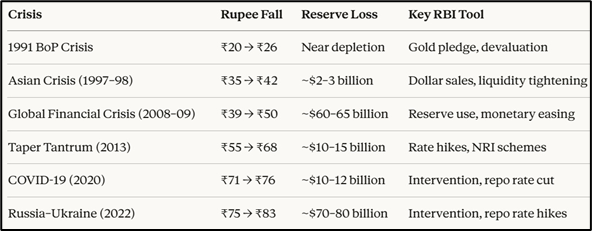
- Each crisis tested India's external sector differently, but the consistent lesson has been the importance of building and maintaining adequate forex reserves as a first line of defence.
Current Concerns and the Road Ahead
- Despite healthy reserve levels, several risks are building up:
- FPI Outflows — Foreign Portfolio Investors (FPIs) are pulling money out of Indian equity and debt markets, increasing demand for foreign currency and putting pressure on the rupee.
- Crude Oil Prices — India imports over 85% of its oil. A prolonged West Asian conflict could push oil prices higher, widening the trade deficit.
- Supply Chain Disruptions — Conflict-related disruptions could affect India's imports and exports, straining the Balance of Payments (BoP).
- Widening CAD — Higher oil import bills combined with capital outflows could push the Current Account Deficit higher, requiring more forex to fund it.
Conclusion
India's forex reserves are currently robust, but the West Asian conflict is a reminder that external shocks can erode buffers quickly. The RBI's ability to intervene in currency markets depends on maintaining adequate reserves.
Mains Article
23 Mar 2026
Why in news?
India is relying on a patchwork of laws and platform-led measures to protect children on social media. Risks include exposure to harmful content, online grooming, and cybercrime.
The Digital Personal Data Protection Act, 2023 mandates parental consent before platforms can process children's data. The IT Act and POCSO Act provide additional criminal provisions.
Platforms are also using age-gating, parental controls, and child-focused content ecosystems. The government is considering a graded approach to regulate children's access to social media.
However, experts warn that enforcement gaps, technological loopholes, and easy age misrepresentation continue to undermine these safeguards.
What’s in Today’s Article?
- Risks for Children in the Online Space
- India's Regulatory Framework for Children on the Internet
- Age-Gating Measures by Social Media Platforms
Risks for Children in the Online Space
- Exposure to Harmful Content - Increased screen time exposes children to inappropriate and harmful content. This can negatively impact mental health, leading to anxiety, stress, and social isolation.
- Threat of Online Grooming - Children are vulnerable to online grooming, where predators exploit them through digital platforms. This poses serious risks to their safety and well-being.
- Rising Cybercrime Against Children - NCRB data shows a 32% increase in cybercrimes against children (2021–2022). Indicates growing threats as more children engage online.
- Increasing Internet Usage Among Children
- A NITI Aayog report reveals the following average daily online usage among Indian children in 2023:
- Up to 5 years: ~1.5 hours daily (educational content, games)
- 6–10 years: ~2.5 hours (social media, gaming, videos)
- 11–15 years: ~4 hours daily
- 16–18 years: ~6 hours daily
- As screen time rises sharply with age, so does exposure to unregulated content and online risks.
- The data underscores the urgency of stronger child safety frameworks in India's digital space.
- A NITI Aayog report reveals the following average daily online usage among Indian children in 2023:
India's Regulatory Framework for Children on the Internet
- India has developed a multi-layered framework combining legislation, platform regulations, and educational initiatives to protect children online.
- However, critics note that enforcement remains inconsistent.
- Data Protection
- Under the Digital Personal Data Protection Act, 2023, companies collecting data of users under 18 must obtain parental or guardian consent.
- Platforms are also prohibited from tracking or monitoring children's behaviour and serving them targeted advertisements.
- A key concern, however, is that children can easily bypass these protections by misrepresenting their age.
- Laws Against Online Exploitation
- Key laws addressing child safety online include:
- Information Technology Act, 2000 - Criminalises the creation of child sexual abuse material (CSAM).
- POCSO Act, 2012 — Defines and penalises online sexual exploitation and grooming.
- Bharatiya Nyaya Sanhita, 2023 — Extends liability to digital offences including trafficking and harassment of children.
- Juvenile Justice Act, 2015 — Addresses online facilitation of child exploitation.
- However, there are persistent weaknesses in digital forensic capacity, law-enforcement training, and the uneven functioning of Special POCSO Courts, all of which limit the effective investigation and prosecution of offences.
- Key laws addressing child safety online include:
- Content Classification and Parental Controls
- Under the IT (Intermediary Guidelines and Digital Media Ethics Code) Rules, 2021, OTT platforms must classify their content into five age-based categories:
- U, U/A 7+, U/A 13+, U/A 16+, A
- Mandatory measures include:
- Parental locks (U/A 13+ and above)
- Age verification (Adult content)
- Under the IT (Intermediary Guidelines and Digital Media Ethics Code) Rules, 2021, OTT platforms must classify their content into five age-based categories:
- Screen Time and Digital Wellness in Education
- The Ministry of Education introduced the PRAGYATA Guidelines in July 2020, recommending age-appropriate screen time limits for students.
- The guidelines aim to safeguard both the safety and academic welfare of children in a digital learning environment.
Age-Gating Measures by Social Media Platforms
- Several major social media and tech platforms have introduced age-gating measures and child-safety tools, though their effectiveness remains a subject of debate.
- Google’s Parental Control System
- Minimum age to create a Google account in India is 13 years.
- For children below 13, parents can use Family Link to:
- Monitor activity
- Block inappropriate content
- Approve app downloads and manage permissions
- At 13, children can manage their accounts independently, though parents are notified if supervision ends.
- Instagram’s Teen Safety Features
- Instagram offers ‘Teen Accounts’ with built-in protections.
- Users under 16 require parental approval to relax safety settings.
- Aims to provide a safer default environment for young users.
- Child-Focused Platforms
- Platforms like YouTube Kids provide a controlled content environment.
- Parents can customise content based on the child’s age.
- Instagram had planned a kids-only app, but development was paused in 2021.
- Limitations and Criticism
- These measures are not fully effective.
- Studies suggest many safety tools can be easily bypassed or ineffective.
- Platforms dispute such findings but concerns about real-world effectiveness remain.
Mains Article
23 Mar 2026
Why in News?
- The 14th Ministerial Conference (MC14) of the World Trade Organization (WTO), scheduled in Cameroon, will deliberate on incorporating the Investment Facilitation for Development (IFD) Agreement into the Marrakesh Agreement (1995).
- With 128 out of 166 WTO members backing the IFD, India—along with South Africa—faces the risk of political isolation, raising critical questions about the future of multilateral trade governance.
What’s in Today’s Article?
- What is the IFD Agreement?
- Global Support and WTO Context
- India’s Opposition to IFD
- India’s Tactical Position
- Challenges
- Way Forward
- Conclusion
What is the IFD Agreement?
- Objective and scope:
- The agreement focuses on facilitating Foreign Direct Investment (FDI) rather than liberalising it.
- It aims to improve the investment climate, enhance transparency and predictability, reduce bureaucratic hurdles (red tape), and promote sustainable development, especially in developing and Least Developed Countries (LDCs).
- Key features:
- It emphasizes streamlining procedures, faster approvals, and coordination among agencies.
- It includes Special and Differential Treatment (SDT) - implementation linked to capacity of developing countries.
- It explicitly excludes market access, investment protection, Investor-State Dispute Settlement (ISDS), and government procurement and subsidies.
- Nature of agreement: It is a plurilateral agreement binding only on participating members, open for others to join later.
Global Support and WTO Context:
- Growing backing: Support expanded from 70 countries (2017) to 128 members (out of 166 WTO members) currently. Backed by WTO leadership, including Ngozi Okonjo-Iweala.
- WTO’s institutional crisis: WTO’s relevance has been under strain due to unilateral tariffs (e.g., by Donald Trump administration), and the paralysis of dispute settlement mechanisms. IFD is seen as an attempt to revitalise WTO rule-making.
India’s Opposition to IFD:
- Threat to multilateralism: WTO operates on consensus-based decision-making. India argues that plurilateral agreements undermine inclusivity, and risk of fragmentation of global trade rules.
- Two-tier WTO system: Fear of creation of an elite club of rule-makers, and marginalisation of developing countries.
- Negotiation imbalance: The agreement could shift focus away from unresolved issues like agricultural subsidies, and public stockholding for food security.
- China angle (strategic concerns):
- Link with BRI: Around 98 of 128 IFD members are also part of Belt and Road Initiative (BRI).
- Implications: Standardisation of investment rules may strengthen China’s geo-economic influence, enhance operational ease for cross-border infrastructure networks, and overlap in India’s neighbourhood.
India’s Tactical Position:
- Public stockholding issue:
- India demands a permanent solution on food security subsidies linked to schemes like Pradhan Mantri Garib Kalyan Anna Yojana (PMGKAY).
- WTO rules cap subsidies at 10% of production value, and India relies on the Peace Clause (Bali, 2013) to avoid legal action.
- Negotiation strategy: India may use its opposition to IFD as a bargaining chip, and seek concessions on agriculture and food security.
Challenges:
- External: Growing global consensus in favour of IFD. Pressure from developing nations needing investment. For example, African bloc potentially shifting stance.
- Internal:
- Balancing development priorities (FDI inflows) and strategic autonomy.
- Risk of diplomatic isolation, and reduced influence in WTO negotiations.
Way Forward:
- Calibrated engagement: India should avoid outright rejection and instead engage constructively in shaping IFD provisions.
- Safeguarding multilateralism: Push for stronger consensus-based safeguards, and protection of developing country interests.
- Strategic bargaining: Leverage IFD negotiations to secure permanent solution on public stockholding, and progress on agricultural reforms.
- Alternative coalitions: Strengthen alliances with Global South, and like-minded countries (e.g., South Africa).
- Domestic reforms: Improve ease of doing business to attract FDI independently of the IFD framework.
Conclusion:
- The IFD Agreement represents a critical inflection point in global trade governance, reflecting a shift from multilateralism to flexible plurilateralism.
- India’s resistance stems from systemic concerns over equity, sovereignty, and strategic autonomy, rather than mere opposition to investment facilitation.
- Going forward, India must adopt a pragmatic and balanced approach—defending its core interests while avoiding isolation—to remain an influential voice in shaping the future of the WTO and global economic order.
Mains Article
23 Mar 2026
Context
- India’s 2026–27 Union Budget, along with its new Free Trade Agreement (FTA) with the European Union, represents a pivotal moment for Ayurveda and other traditional systems of medicine.
- These developments signal a transition from viewing Ayurveda as an alternative practice to integrating it into both the national healthcare system and the global medical marketplace.
- While this expansion reflects ambition and opportunity, it also raises important questions about scientific credibility, regulatory standards, and the balance between tradition and evidence.
Strengthening Ayurveda within India
- Increased Budgetary Support
- The Indian government’s growing commitment to Ayurveda is evident in the significant rise in funding for the AYUSH Ministry, which has nearly doubled over the past five years.
- This financial expansion reflects a policy shift aimed at embedding traditional medicine within the mainstream healthcare system rather than treating it as a parallel alternative.
- Institutional Development and Research
- The announcement of three new All-India Institutes of Ayurveda marks an important step toward institutionalising traditional medicine.
- These institutes are expected to function as centres of excellence, combining patient care with advanced research and education, much like premier institutions in modern medicine.
- Additionally, the expansion of the National AYUSH Mission aims to modernise dispensaries, integrate AYUSH clinics into government hospitals, and strengthen drug-testing infrastructure.
- Together, these measures are designed to enhance both accessibility and quality.
Global Expansion through the India–EU FTA
- Opportunities in International Markets
- The India–EU FTA provides Ayurveda with unprecedented global exposure.
- It allows Indian practitioners to offer services in certain European countries and enables Indian companies to establish Ayurvedic clinics abroad.
- The agreement also opens the possibility of mutual recognition of safety certifications, potentially simplifying the export of Ayurvedic products.
- Regulatory Challenges and Expectations
- However, entering global markets also means operating within stringent regulatory frameworks. Ayurveda, as part of Traditional, Complementary, and Alternative Medicine (TCAM), will be evaluated based on international standards of safety, efficacy, and quality.
- This transition requires regulatory harmonisation and adherence to scientific norms that govern global healthcare systems.
The Imperative of Scientific Evidence
- Bridging the Gap Between Claims and Proof
- A major challenge in Ayurveda’s global journey is the gap between traditional claims and scientific validation.
- Without robust evidence, there is a risk of legal disputes, reputational harm, and the reinforcement of stereotypes about unscientific practices.
- Need for Independent Research
- Currently, much of the research on AYUSH systems is conducted or overseen by the same institutions that promote them, raising concerns about conflicts of interest.
- To build global credibility, Ayurveda must undergo rigorous, independent scientific evaluation. This includes:
- Independently funded clinical trials
- Transparent research methodologies
- Peer-reviewed publications
- Willingness to publish negative findings
- Such measures are essential for establishing trust in international markets.
Rethinking the Debate: Science and Tradition
- Beyond the Colonial Argument
- Criticism of scientific scrutiny is sometimes framed as resistance to Western epistemological dominance.
- While colonial history did marginalise indigenous medical systems, equating all demands for evidence with cultural bias is misleading.
- Scientific evaluation should not be seen as a threat but as a necessary step toward validation and acceptance.
- Science as Strength, Not Threat
- Demanding empirical evidence does not diminish tradition; rather, it strengthens it.
- By engaging with scientific methods, Ayurveda can demonstrate its efficacy and relevance in a global context, thereby enhancing its legitimacy.
Coexistence of Medical Systems
- Distinct Conceptual Frameworks
- Ayurveda and modern biomedicine are based on fundamentally different understandings of the body and health.
- Ayurveda views the body as an interconnected system influenced by environmental, dietary, and social factors, with health defined as a state of equilibrium.
- In contrast, biomedicine focuses on anatomical localisation and targeted interventions.
- Complementarity Rather Than Competition
- The relationship between these systems should not be seen as oppositional. Instead, they can function as complementary approaches:
- Biomedicine offers precision and targeted treatment
- Ayurveda provides a holistic and integrative perspective
- Together, they can broaden the understanding of health and enhance the scope of care.
Conclusion
- Ayurveda’s expansion, supported by domestic policy and international agreements, represents a transformative moment in India’s healthcare landscape.
- The future of Ayurveda depends not on assertion or cultural pride alone, but on its willingness to embrace rigorous evaluation, transparency, and intellectual openness.
- By focusing on dialogue between tradition and science, India has the opportunity to position Ayurveda as a credible and valuable contributor to global healthcare.
- Ultimately, its success will be determined by evidence, integrity, and the courage to be critically examined.
Mains Article
23 Mar 2026
Context
- Election campaigns often produce memorable slogans, some of which fade quickly while others leave a lasting imprint on political discourse.
- The phrase double-engine sarkar is one such slogan that has gained prominence in recent years.
- It suggests that governance becomes more efficient when the same political party is in power at both the Union and State levels.
- While this idea appears harmless at first glance, it raises important constitutional questions about the nature of India’s federal structure and the principle of equal governance.
Understanding the Double-Engine Concept
- At its core, the double-engine idea promotes coordination between the Centre and the States.
- It implies that shared political leadership leads to smoother decision-making and faster development.
- In principle, such cooperation aligns with the idea of cooperative federalism, however, the slogan carries a deeper and more problematic implication.
- It suggests that States governed by parties different from the one ruling at the Centre may face disadvantages in terms of development and resource allocation.
- This transforms a concept of cooperation into one of conditional governance.
Constitutional Foundations of Federalism
- India’s Constitution establishes a federal system in which the Union and the States operate as partners within clearly defined spheres.
- The Union government represents the entire nation, not just politically aligned States.
- Public funds collected through taxation belong to the Republic as a whole. Citizens across all States contribute equally, regardless of their political choices.
- Therefore, the distribution of resources must be impartial and based on constitutional principles rather than political considerations.
- Any deviation from this principle undermines the idea of equal citizenship.
Fiscal Federalism and Institutional Safeguards
- Role of the Finance Commission
- To ensure fairness in resource distribution, the Constitution provides for the Finance Commission under Article 280.
- This body recommends how Union revenues should be shared among States based on objective criteria such as income levels, population, and fiscal capacity.
- Its primary purpose is to prevent political bias in fiscal transfers.
- Emerging Concerns
- Recent debates highlight growing tensions in fiscal federalism.
- Southern States have raised concerns that the use of updated population data in allocation formulas may penalise them for successfully controlling population growth.
- Additionally, the increasing reliance on cesses and surcharges, funds not shared with States, has reduced the overall pool of resources available for distribution.
Federal Friction in Governance
- Gubernatorial Delays
- Another area of concern is the role of Governors in the legislative process. In several States, Governors have delayed granting assent to Bills passed by elected legislatures.
- Such delays effectively stall governance and raise questions about the misuse of constitutional offices for political purposes.
- Judicial interventions have clarified that Governors cannot indefinitely withhold assent and must act within constitutional limits. These rulings reinforce the authority of elected legislatures.
- The Delhi Governance Experience
- The governance challenges in Delhi further illustrate federal tensions.
- Conflicts between the elected government and the Lieutenant-Governor have led to administrative gridlock, often requiring judicial intervention.
- This situation demonstrates how institutional mechanisms can be used to hinder governance when political alignment is absent.
A Pattern of Centralisation
- When viewed together, issues in fiscal transfers, gubernatorial delays, and governance conflicts, a broader pattern emerges.
- The double-engine slogan reflects a reality where political alignment increasingly influences governance outcomes.
- While the formal structure of federalism remains intact, its spirit is gradually being weakened.
- This represents a shift from cooperative federalism to a more centralised and politically conditioned system.
The Path Forward: Need for Structural Reforms
- Addressing these issues requires systemic changes rather than temporary solutions.
- Key reforms could include:
- Strengthening the binding nature of Finance Commission recommendations
- Establishing fixed timelines for Governors to act on Bills
- Revitalising intergovernmental bodies such as the Inter-State Council
- These measures would reinforce the constitutional framework and promote genuine cooperative federalism.
Conclusion
- Political slogans are a natural part of democratic elections, but they must not undermine constitutional values.
- The double-engine sarkar narrative, by linking development to political alignment, risks distorting electoral choice and weakening the principle of equal citizenship.
- India’s federal democracy depends not on political uniformity but on the fairness and integrity of its institutions.