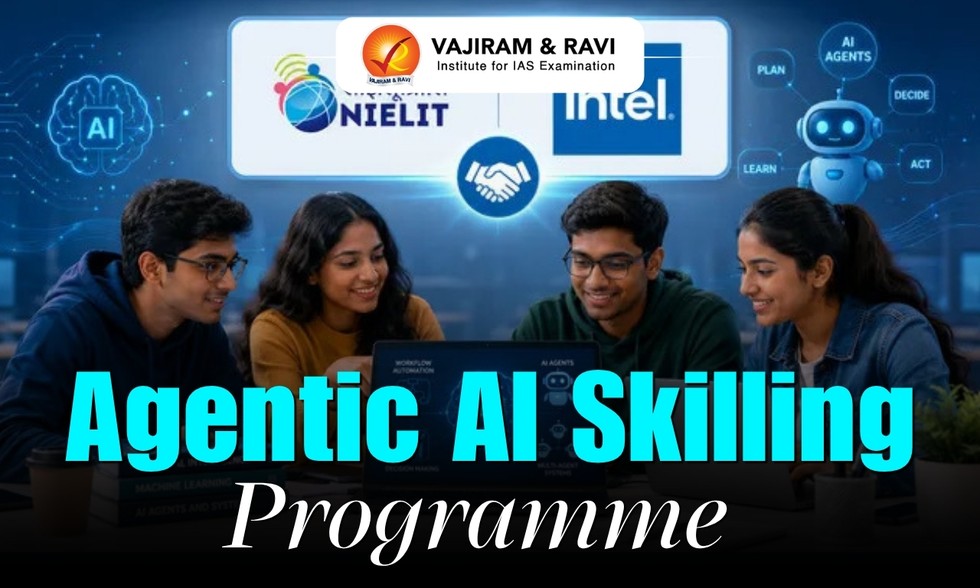
About Agentic AI Skilling Program:
- It is aimed at expanding access to industry-aligned Agentic AI learning opportunities and contributing to the development of a future-ready AI talent ecosystem in the country.
- It was launched by the National Institute of Electronics and Information Technology (NIELIT), Ministry of Electronics and Information Technology (MeitY), in collaboration with Intel India.
- Under the initiative, two programmes have been introduced:
- Agentic AI for Everyone
- It introduces learners to workflow automation, AI agents and multi-agent systems, with a focus on improving productivity, enabling business transformation and supporting intelligent decision-making.
- The programme provides hands-on exposure to designing and governing AI-powered workflows and agentic systems using no-code platforms.
- Engineering Agentic AI Systems
- It focuses on designing, building and deploying AI-powered agentic systems.
- Learners will gain practical exposure to no-code/low-code platforms and code-based frameworks, covering areas including agent architecture, tool integration, orchestration, memory and deployment to develop scalable and production-ready solutions.
What is Agentic AI?
- It is an advanced form of artificial intelligence focused on autonomous decision-making and action.
- It consists of AI agents—machine learning models that mimic human decision-making to solve problems in real time.
- Unlike traditional AI, which primarily responds to commands or analyzes data, agentic AI can set goals, plan, and execute tasks with minimal human intervention.
- “Agentic” indicates agency — the ability of these systems to act independently, but in a goal-driven manner.
- At its core, this technology is built on several key components:
- Perception: Agentic AI starts by gathering information from its surroundings and different sources, such as sensors, databases, and user interfaces.
- Reasoning: Using a large language model (LLM), agentic AI analyzes the gathered data to understand the context, identify relevant information, and formulate potential solutions.
- Planning: The AI then uses the information it gathered to develop a plan. This involves setting goals, breaking them down into smaller steps, and figuring out the best way to achieve them.
- Action: Based on its plan, the AI takes action. This could involve performing tasks, making decisions, or interacting with other systems.
- Reflection: After taking action, the AI learns from the results. It evaluates whether its actions were successful and uses this feedback to adjust its plans and actions in the future.