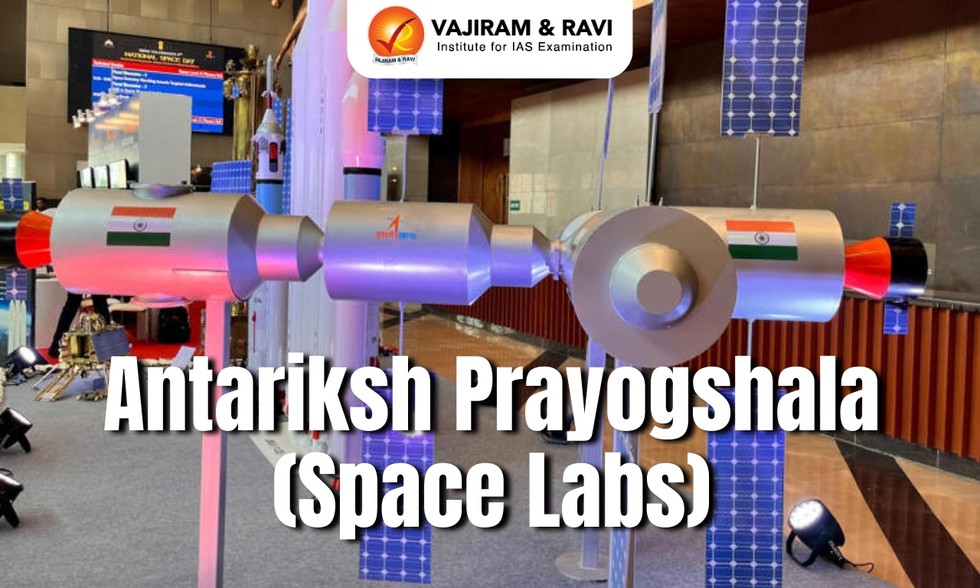
About Antariksh Prayogshala (Space Labs):
- It is an initiative of the Indian National Space Promotion and Authorisation Centre (IN-SPACe).
- It is a first-of-its-kind initiative aimed at creating state-of-the-art space laboratories within Indian academic institutions.
- These labs will provide hands-on training to students pursuing space tech courses in academic institutes spread across the country.
- This initiative is intended to enable meaningful industry–academia collaboration and support India’s long-term vision of becoming a leading global space economy.
- Under the scheme, up to seven academic institutions will be selected in a phased manner from different zones across the country.
- To ensure balanced regional representation, one lab is proposed in each zone.
- These labs will also be available to Non-Governmental Entities (NGEs) for utilization in that zone.
- IN-SPACe will provide financial support to the institutions.
- The selection process will be carried out in two stages:
- Institutions will first be screened based on eligibility criteria.
- Shortlisted applicants will then be evaluated and ranked by an Empowered Committee (EC), following which final selections will be made on a zone-wise basis.
Key Facts about IN-SPACe:
- It is a single-window, independent, nodal agency that functions as an autonomous agency in the Department of Space (DOS).
- It is formed following the Space sector reforms to enable and facilitate the participation of private players.
- IN-SPACe is responsible to promote, enable, authorize and supervise various space activities of non-governmental entities (NGEs), including:
- Building launch vehicles & satellites and providing space-based services;
- Sharing space infrastructure and premises under the control of DOS/ISRO.
- Establishing new space infrastructure and facilities.
- The agency acts as an interface between ISRO and NGEs and assesses how to utilize India's space resources better and increase space-based activities.
- It also assesses the needs and demands of private players, including educational and research institutions, and explores ways to accommodate these requirements in consultation with ISRO.