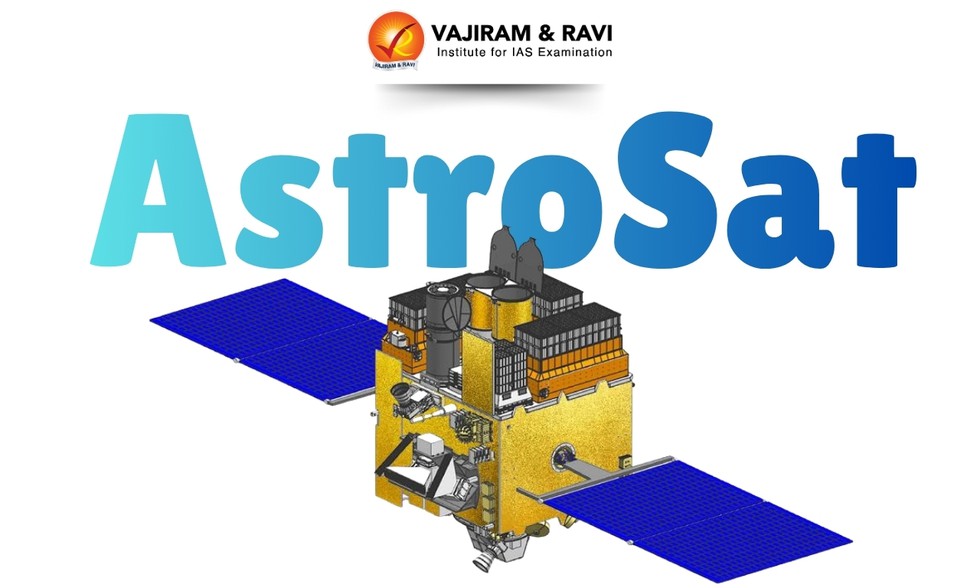
Recently, the Indian Institute of Astrophysics (IIA) celebrated a decade of successful operation of the UltraViolet Imaging Telescope (UVIT) on AstroSat.
About AstroSat:
It is the first dedicated Indian astronomy mission aimed at studying celestial sources in X-ray, optical and UV spectral bands simultaneously.
The payloads cover the energy bands of Ultraviolet (Near and Far), limited optical and X-ray regime.
It enables the simultaneous multi-wavelength observations of various astronomical objects with a single satellite.
Payloads of Astrosat:Ultra Violet Imaging Telescope (UVIT), Large Area X-ray Proportional Counter (LAXPC), Cadmium–Zinc–Telluride Imager (CZTI), Soft X-ray Telescope (SXT) and Scanning Sky Monitor (SSM).
UVIT consists of two telescopes: one dedicated to near-ultraviolet and visible wavelengths, and the other to far-ultraviolet observations.
Objectives of AstroSat:
To understand high energy processes in binary star systems containing neutron stars and black holes.
Estimate magnetic fields of neutron stars.
Study star birth regions and high energy processes in star systems lying beyond our galaxy.
Detect new briefly bright X-ray sources in the sky.
Perform a limited deep field surveyof the Universe in the Ultraviolet region.
The spacecraft control centre at Mission Operations Complex (MOX) of ISRO Telemetry, Tracking and Command Network (ISTRAC), Bengaluru manages the satellite during its entire mission life.
Dear Student,
You have still not entered your mailing address. Please enter the address where all the study materials will be sent to you. (If applicable).