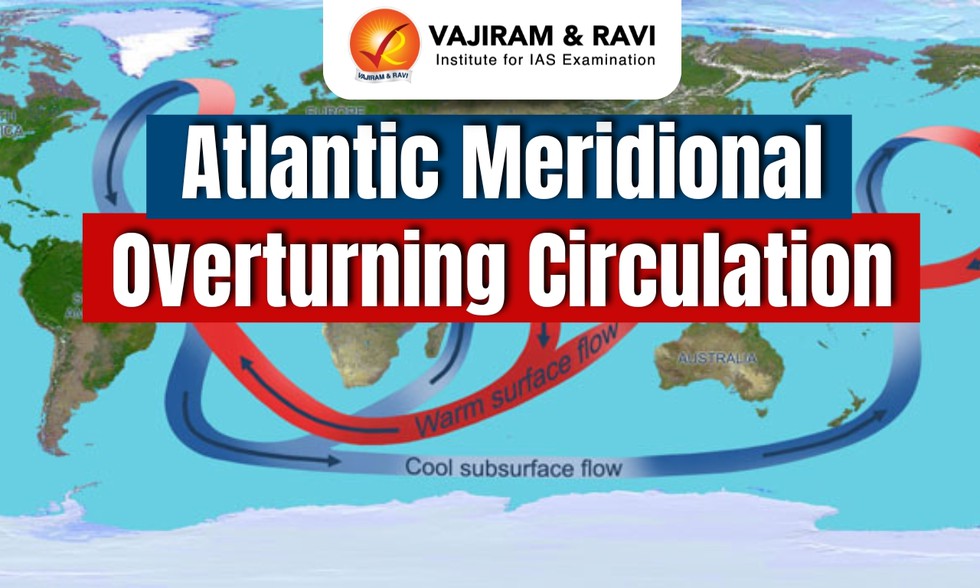
About Atlantic Meridional Overturning Circulation:
- It is a complex system of ocean currents and eddies (circular currents of water) that form a huge vertical loop spanning the whole length of the Atlantic Ocean.
- AMOC is also one of the 16 Earth system climate tipping elements being studied by scientists
- Mechanism:
- AMOC acts as an ocean conveyor belt, transporting warm water northward from the tropics across the Atlantic at the surface, and cold water southward at the bottom.
- This circulation is driven by differences in temperature and salinity, which create differences in water density – a process known as thermohaline circulation.
- In the North Atlantic Ocean, the warm water cools and becomes denser, sinking and down into the deep ocean.
- This dense water then travels southward along the ocean floor, eventually warming and resurfacing to complete the cycle.
- Reason for weakening of AMOC:
- It will weaken as greenhouse gas concentrations rise and global temperatures increase.
- One of the main drivers is believed to be the influx of freshwater from the melting Greenland Ice Sheet, which reduces ocean salinity and disrupts the circulation.
- Impacts of Weak AMOC:
- Gulf Stream, a part of the AMOC, is a warm current responsible for mild climate at the Eastern coast of North America as well as Europe.
- Without a proper AMOC and Gulf Stream, Europe will be very cold.
- Modelling studies have shown that an AMOC shutdown would cool the northern hemisphere and decrease rainfall over Europe.
- It can also have an effect on the El Nino.