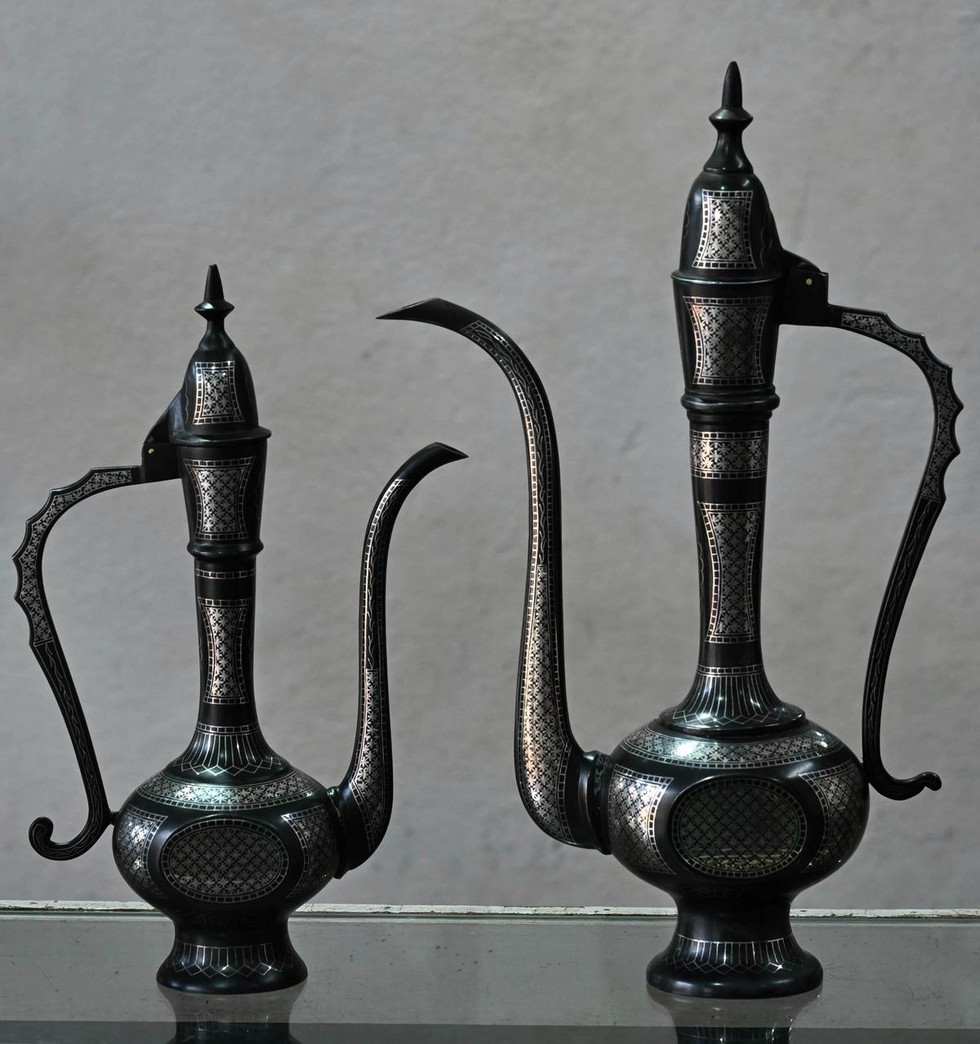
Recently, it was observed that Bidriware, the centuries-old metal craft is facing fresh pressure from the rising prices of silver, copper, and zinc.
About Bidriware:
It is a form of metal handicraft which has been made for centuries by artisans from Karnataka’s Bidar district.
It is renowned for its intricate, handcrafted designs.
Origin:
The origin of Bidriware as a craft is attributed mostly to the Bahamani Sultans who ruled the region during the 14th and 15th centuries.
It was first brought to India by the noted Sufi Khwaja Moinuddin Hasan Chisti in the form of utensils.
The art form developed in the kingdom was a mix of Turkish, Persian and Arabic influences, which were intermingled with the local styles, and thus a unique style of its own was born.
It has obtained a Geographical Indications (GI) tag.
How is Bidriware made?
It is made primarily from a zinc-copper alloy, while silver is used for intricate inlay work.
The craftsman uses small chisels to engrave the design over the freehand etching. Craftsmen engrave delicate floral and geometric patterns on the surface and inlay silver into them.
Fine wire or flattened strips of pure silver are then carefully hammered into these grooves.
The characteristic deep-black lustre is produced using soil sourced from the historic Bidar Fort.
The soil is added to a chemical solution during the final stage of the process, giving the metal its distinctive black finish.
The product then undergoes a process called buffing to smoothen the surface.
Dear Student,
You have still not entered your mailing address. Please enter the address where all the study materials will be sent to you. (If applicable).