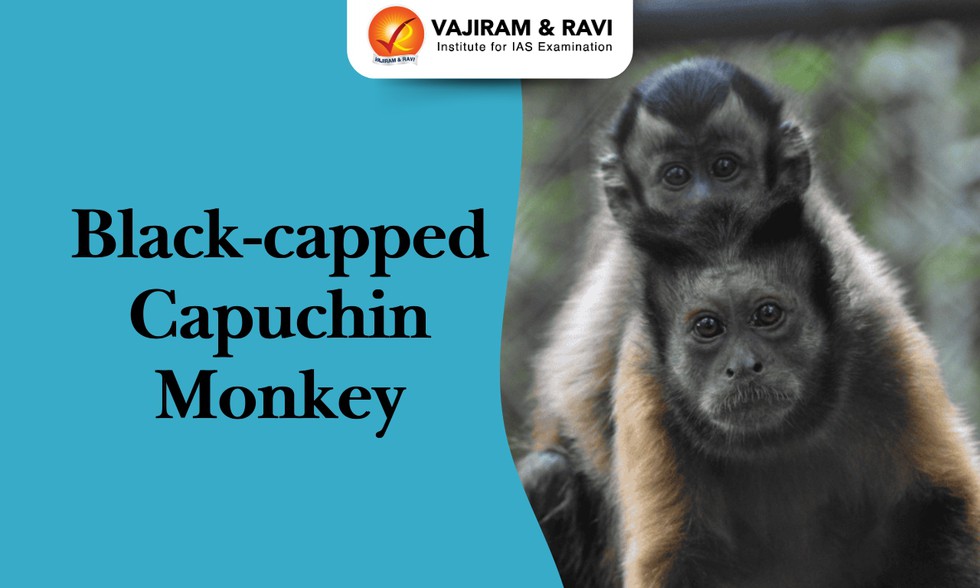
About Black-capped Capuchin Monkey:
- Black-capped capuchin (Sapajus apella) is also known as tufted capuchins.
- Distribution: It is native to South America, where they are ubiquitous throughout the Amazon River Basin.
- Habitat: It is mainly found in tropical, subtropical, dry, submontane, savannah, mangrove forests.
- Behavior and Lifestyle of Black-capped Capuchin Monkey:
- Black-capped capuchins are predominantly arboreal and diurnal species.
- Communication: Black-capped capuchin monkeys communicate with one another through vocalizations, body language, tactile methods, and olfactory cues.
- Diet: It is classified as omnivores, their diet consists of fruit, seeds, nuts, insects, lizards, eggs and crustaceans.
- Ecological Role: Feeding upon fruit, the capuchins become seed dispersers of certain forest plants.
- Conservation Status: IUCN: Least Concern
Key Facts about the Bannerghatta Biological Park
- It has been an integral part of Bannerghatta National Park and emerged out as an independent establishment in 2002.
- It has different units such as Zoo, Safari, Butterfly Park, and Rescue Centre (Conservation of Captive animals).
- It is the first biological park in India to have a fenced, forested elephant sanctuary.