Researchers have identified a fortified hilltop complex in southeastern Spain as a rare Byzantine stronghold established by soldiers and clergy in the late sixth century.
About Byzantine Empire:
It traces its beginnings to the year 330 CE, when Emperor Constantine split the Roman Empire into a western and eastern
It was the eastern half of the Roman Empire that survived for nearly 1,000 years after the western half of the empire collapsed.
It is often called the Eastern Roman Empire or simply Byzantium.
It was based at Constantinople (modern-day Istanbul), and at its peak it controlled territory stretching from southern Spain to Syria.
Strategically located on the Bosphorus Strait, Constantinople quickly rose to become Europe’s most significant urban hub.
Throughout their history, the Byzantines rarely controlled Rome and spoke mainly Greek. Despite this,the people of Byzantium continued to refer to themselves as "Romans," .
Their broader empire was considered to be a "Roman" empire even though it rarely controlled Rome.
The Byzantine Empire flourished and experienced a "golden age" during the reign of Justinian (A.D. 527 to 565), during which the empire's territories extendedinto Western Europe, and the emperor's builders constructed the Hagia Sophia, a great cathedral that still stands and is now used as a mosque.
The governance of the Byzantine Empire was marked by the absolute authority of emperors, who were seen as divinely appointed rulers.
The Byzantines developed their own political systems, religious practices, art, and architecture.
However, the empire faced numerous challenges, including territorial losses to emerging Muslim powers and internal religious schisms that eventually led to the split between the Roman Catholic and Eastern Orthodox Churches.
Decline:
After Justinian's death, the Byzantine Empire weakened and lost territory.
In 1204, during the Crusades, the Byzantines were betrayed when crusaders from the west sacked Constantinople in an attempt to gain money.
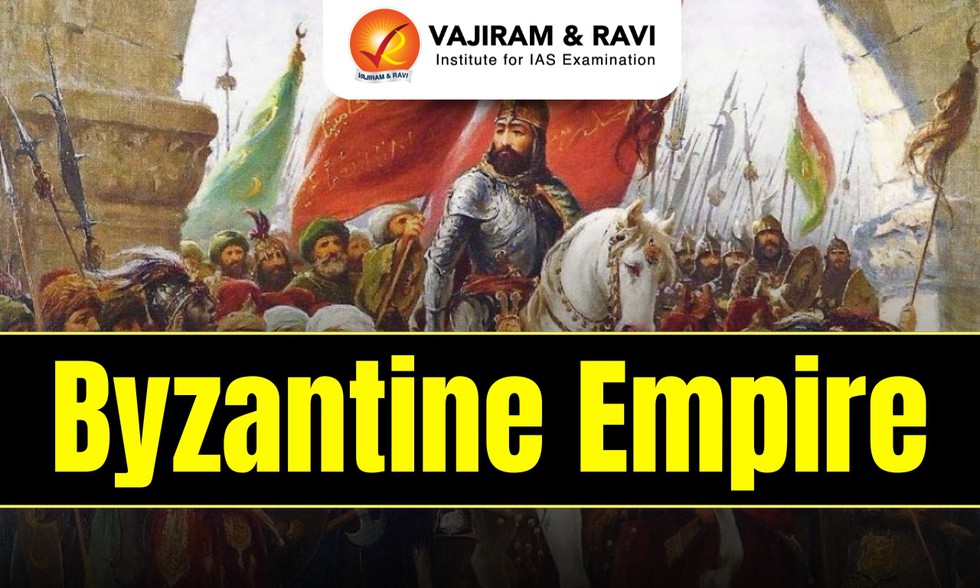
The Byzantine Empire eventually fell when Constantinople was conquered by the Ottoman Empire in 1453 CE following a siege.
The Byzantine Empire was the longest-lasting medieval power, and its influence continues today, especially in the religion, art, architecture, and laws of many Western states, Eastern and Central Europe, and Russia.
Dear Student,
You have still not entered your mailing address. Please enter the address where all the study materials will be sent to you. (If applicable).