What are Per- and Polyfluoroalkyl Substances (PFAS)?
- Per- and Polyfluoroalkyl Substances (PFAS) are a large family of synthetic chemicals, widely known as “Forever Chemicals” due to their extreme environmental persistence.
- PFAS are extensively used in non-stick cookware, water-resistant clothing, food packaging, cosmetics, firefighting foams, metal coatings, and industrial lubricants.
- The carbon–fluorine (C–F) bond, one of the strongest covalent bonds in chemistry, makes PFAS highly resistant to degradation, leading to widespread groundwater contamination, especially near military, industrial, and municipal sites.
What is Carbon-Based PFAS Remediation?
- Carbon-based PFAS remediation is a novel in-situ groundwater treatment approach, the field study published in the Journal of Hazardous Materials.
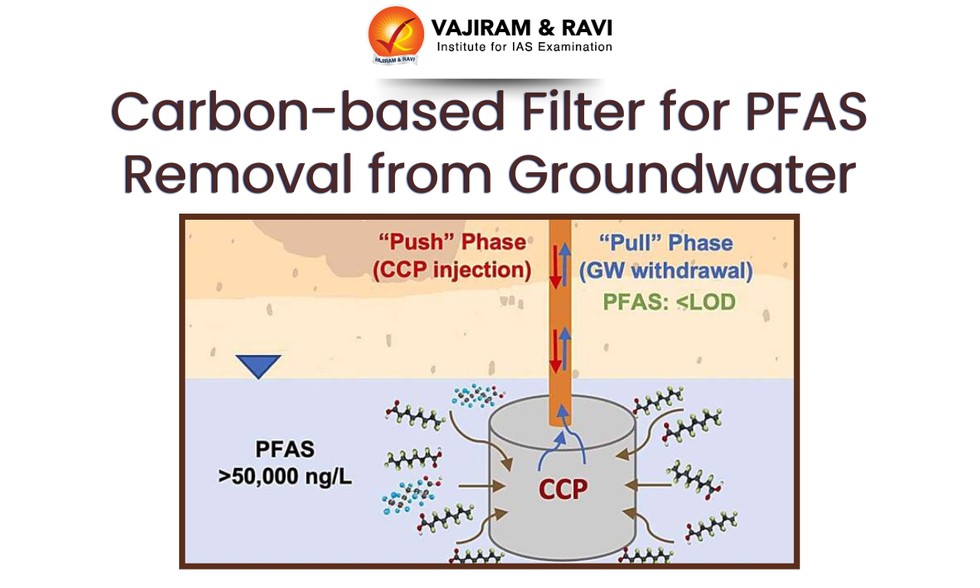
- The study evaluated a specially engineered ultra-fine carbon material, known as Colloidal Carbon Product (CCP), designed to adsorb and immobilise PFAS in groundwater.
- The technology uses a “push–pull” testing method, where CCP is injected underground to form an in-situ permeable treatment zone, and groundwater is later extracted to measure PFAS reduction.
- Unlike surface treatment methods, this approach is non-invasive, subsurface-based, and suitable for long-term remediation.