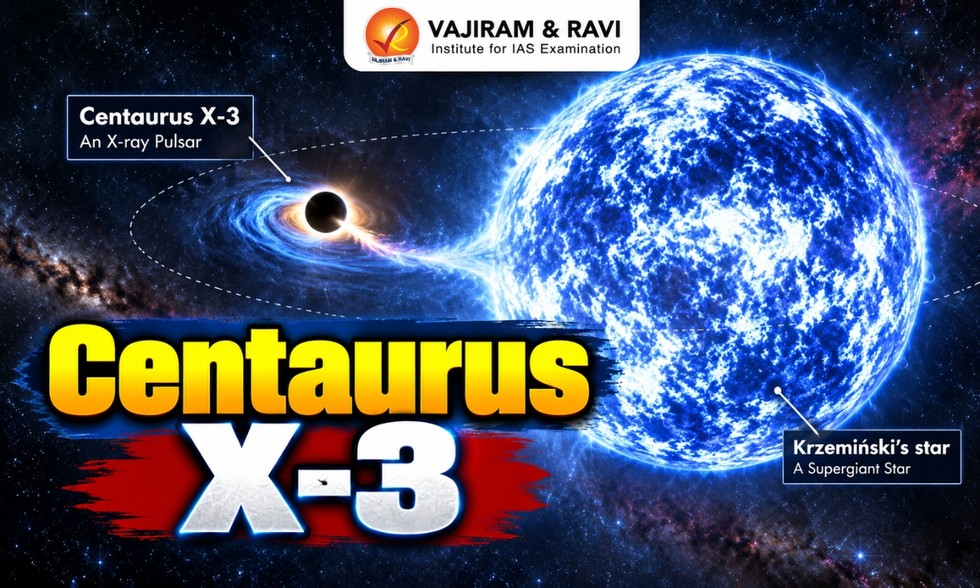
Scientists have discovered that one of the brightest X-ray pulsars, Centaurus X-3 is gobbling up material through an accretion disk.
About Centaurus X-3:
It is one of the brightest X-ray pulsars discovered in the constellation Centaurus.
It is a high-mass X-ray binary (HMXB) where the companion is more than 10 times the Sun’s mass,
Location: It is located approximately 24,000 light-years from Earth.
It contains a disk-fed pulsar with a period of 4.84 seconds that is in a 2.087 day orbit around an O-star companion.
An X-ray binary pulsar consists of a pulsar— a highly magnetised neutron star, and a Sun-like star bound in a gravitational dance.
A neutron star is a celestial body with the mass of our sun crunched into a ball the size of Bangalore.
In an X-ray binary, the pulsar’s extreme gravity pulls in material ejected by its companion star, and the pulsar starts accreting material from it, shooting out X-rays in the process.
What are Pulsars?
These are rapidly rotating neutron stars that blast out pulses of radiation at regular intervals ranging from seconds to milliseconds.
Pulsars emit radiation from their magnetic poles, known as the primary emission.
Pulsars have very strong magnetic fields, which funnel jets of particles out along the two magnetic poles. These accelerated particles produce very powerful beams of light.
Pulsars have been primarily observed at radio wavelengths.
Dear Student,
You have still not entered your mailing address. Please enter the address where all the study materials will be sent to you. (If applicable).