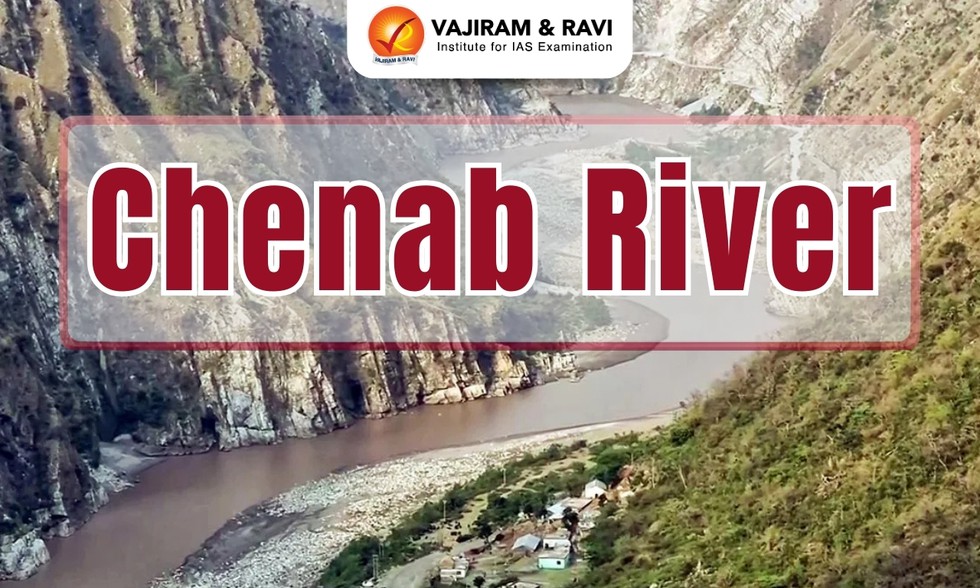
About Chenab River:
- It is a tributary of the Indus River.
- Origin: It is formed by the confluence of two streams, Chandra and Bhaga, in the Lahaul and Spiti Districts of Himachal Pradesh.
- In its upper reaches, it is also known as the
- It flows through Jammu and Kashmir union territory, Himachal Pradesh and after receiving the Jhelum River near Trimmu, the Chenab empties into the Sutlej River.
- Major Tributaries:
- Left Bank: Niru, Tawi, Neeru, and Liddrari
- Right Bank: Ans, Bhut Nalla, Bichleri, Kalnai Marusudar and Miyar Nalla.
- Major Dams on Chenab River: Salal (rockfill dam), Aalal (concrete dam), Baglihar, and Dul.
- The waters of the Chenab are shared by India and Pakistan as per the terms of the Indus Water Treaty.
What is the Indus Waters Treaty (IWT)?
- It was signed in 1960 between India and Pakistan, with the World Bank acting as a mediator.
- The treaty outlines water usage rights over six rivers of the Indus River System, categorizing them into Eastern and Western rivers.
- The Eastern rivers—Ravi, Beas, and Sutlej—are allocated for India’s exclusive and unrestricted use.
- The Western rivers—Indus, Jhelum, and Chenab—are allocated primarily to Pakistan.