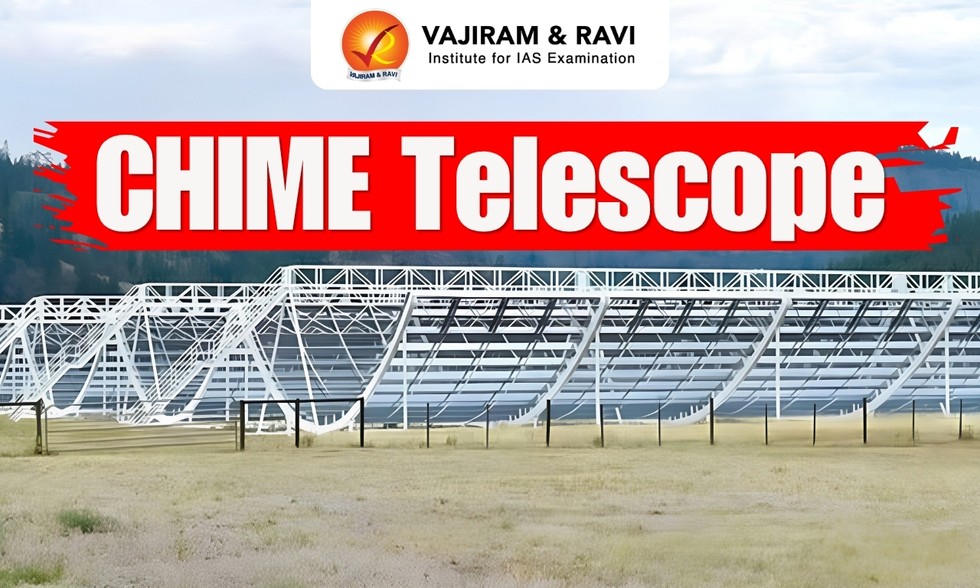
An international team, including researchers from the Raman Research Institute (RRI) in Bengaluru, has detected the faint radio glow of hydrogen from 9 billion years ago by using CHIME radio telescope.
About CHIME Telescope:
The CHIME (Canadian Hydrogen Intensity Mapping Experiment) is a radio telescope located in British Columbia, Canada which was built in 2017.
Focus: It was built to map the distribution of hydrogen gas in the early universe.
It is capable of mapping the sky with unprecedented sensitivity and speed.
It delivers a snapshot of what our sky looks like at radio wavelengths every day.
Components:
CHIME comprises four massive parabolic radio antennas that collect radio waves in the 400 to 800 MHz range.
It has no moving parts and instead uses signal processing techniques to combine the information from over a thousand antennas to focus and point the telescope digitally.
The telescope receives radio signals each day from half of the sky as the Earth rotates.
CHIME focuses incoming signals using a correlator—a powerful digital signaling processor that can work through huge amounts of data, at a rate of about 7 terabits per second.
It has capability to detect and study Fast Radio Bursts (FRBs), transient flashes of radio waves originating from distant galaxies.
Dear Student,
You have still not entered your mailing address. Please enter the address where all the study materials will be sent to you. (If applicable).