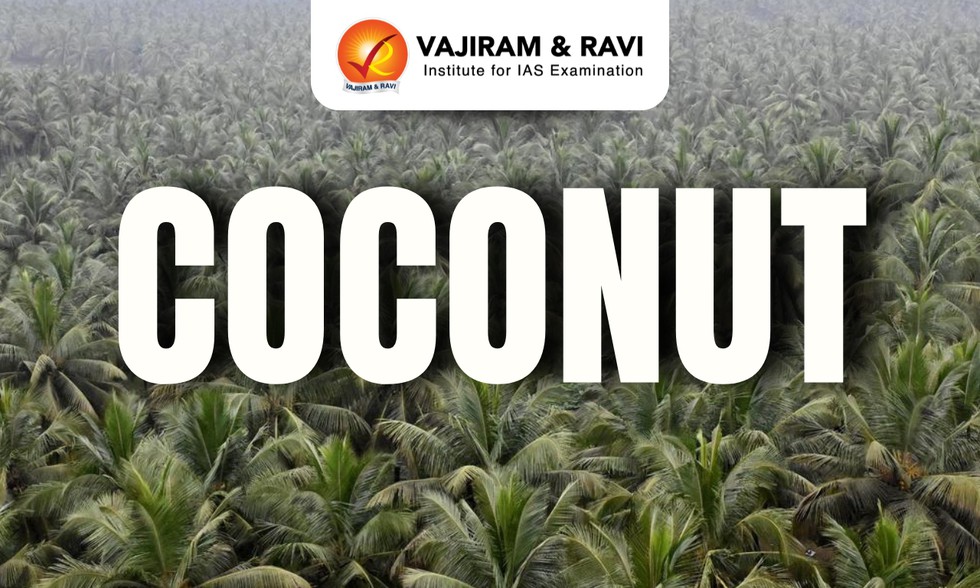
Recently the Minister of State for Agriculture and Farmers Welfare informed the Lok Sabha that India is the world’s largest producer of coconuts contributing to 30.37% of the Global coconut production.
About Coconut:
Coconut (Cocos nucifera) is a large palm of the family Arecaceae.
It grows in the subtropical coastal regions of Asia (India, Philippines, Sri Lanka, Thailand, Indonesia) and Oceania.
It was originated in Southeast Asia, and was transported throughout the Pacific either by migrating Indonesians and Polynesians.
Required Climatic Conditions for Coconut
Rainfall:1000-3000 mm per year. Prefers evenly distributed rainfall
Temperature: Optimum 27°C with a diurnal variation of 6-7 0C Cold spells are more limiting than high temperatures. Light- Coconut palm requires maximum sunlight.
Altitude: Up to 600 m above mean sea level.
If temperature remains favourable, the palm grows well up to an altitude of 800 m.
Humidity: Needs warm and humid conditions
Soils: It is particularly adapted to the coastal light sandy and sandy loam type soils. Coconuts also thrive well in laterite soils.
Distribution in India: It is majorly grown in Kerala, Tamil Nadu, Karnataka, Andhra Pradesh, Odisha, Goa, and West Bengal.
Uses: Coconuts are used as whole fruits or, conversely, by their parts: mesocarp fibers, milk, kernel (or flesh), husk.
Dear Student,
You have still not entered your mailing address. Please enter the address where all the study materials will be sent to you. (If applicable).