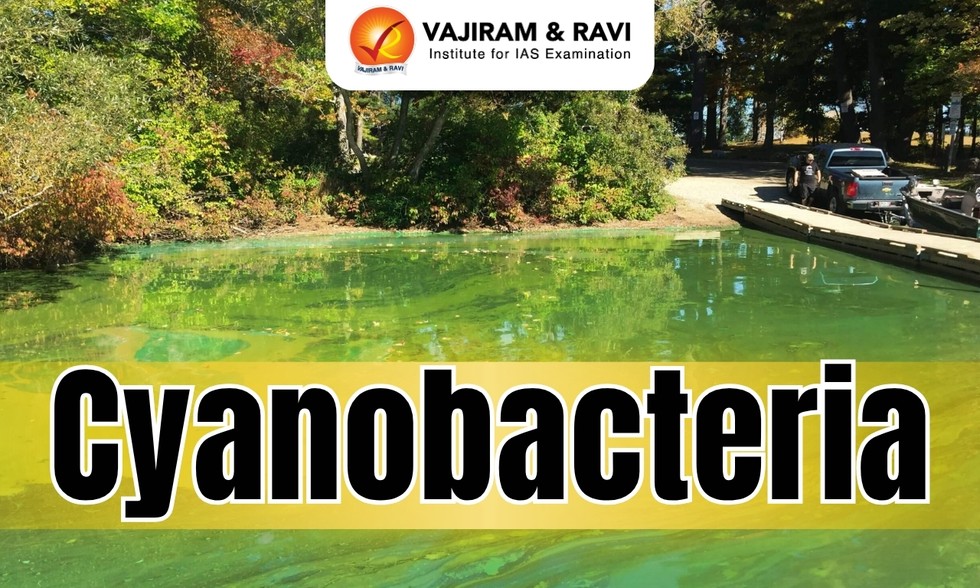
Recently, researchers found that cyanobacteria can be used to absorb lead from contaminated water.
About Cyanobacteria:
These are also called blue-green algae, microscopic organisms found naturally in all types of water.
They have the distinction of being the oldest known fossils, more than 3.5 billion years old.
Habitat: These single-celled organisms live in fresh, brackish (combined salt and fresh water), and marine water.
Characteristics of cyanobacteria:
Autotrophs: All cyanobacteria are autotrophs, meaning they produce their own energy by photosynthesizing sunlight. Cyanobacteria are a very old group of organisms.
Reproduction in Cyanobacteria: Cyanobacteria also reproduce asexually and the commonest mode of reproduction in them is transverse binary fission.
Some are solitary others are colonial and few cyanobacteria produce toxins.
Cyanobacteria blooms can form in warm, slow-moving waters that are rich in nutrients from sources such as fertilizer runoff or septic tank overflows.
In warm, nutrient-rich environments, microscopic cyanobacteria can grow quickly, creating blooms that spread across the water’s surface and may become visible.
Dear Student,
You have still not entered your mailing address. Please enter the address where all the study materials will be sent to you. (If applicable).