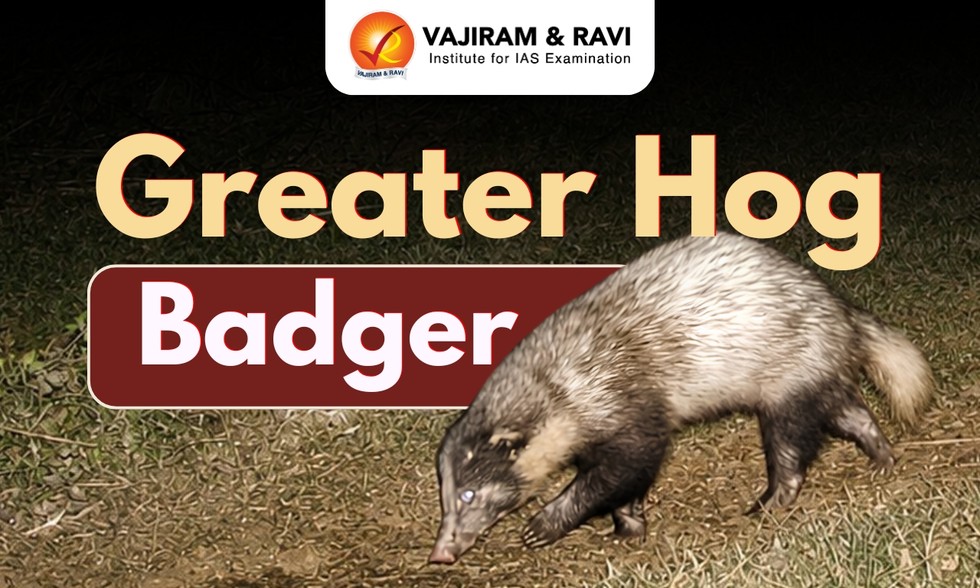
About Greater Hog Badger:
- It is a nocturnal small burrowing omnivore mammal.
- It is called ‘mati gahori’ in Assamese.
- Globally, there are three extant species of this mammal—the greater hog badger, the northern hog badger (Arctonyx albogularis), and the Sumatran hog badger (Arctonyx hoevenii). The first two are found in India.
- Appearance:
- It possesses an elongated pig-like snout and modified teeth which point forward and are used for turning over the soil.
- Its body fur is dark grey to brownish.
- Distribution: It is distributed across parts of South, Central, and Southeast Asia.
- Its range extends from Bangladesh and northeastern India eastwards through Myanmar, Thailand, Lao PDR and Vietnam.
- Habitat: They live in tropical evergreen forests, savanna, grasslands and shrubland, hills, and mountains.
- Characteristics:
- It is a ground-dwelling very shy and leads a secretive solitary life.
- These are territorial creatures that mark their territories with their scents on the grass, rocks, and tree trunks.
- They are excellent burrowers and dig into the ground to create burrows for shelter and to find their food.
- Diet: Its diet includes worms, insects, small mammals but also fruits, tubers, and roots.
- Ecological Role: It contributes to ecosystem function as a highly fossorial mammal (a term for animals adapted for digging, burrowing, or living primarily underground) through soil disturbance, nutrient redistribution, and leaf litter turnover during foraging.
- Such digging behaviour enhances soil aeration and may facilitate seed germination and micro-habitat formation for invertebrates and small vertebrates.
- Conservation Status
- IUCN: Vulnerable
- Wildlife Protection Act of 1972: Schedule I