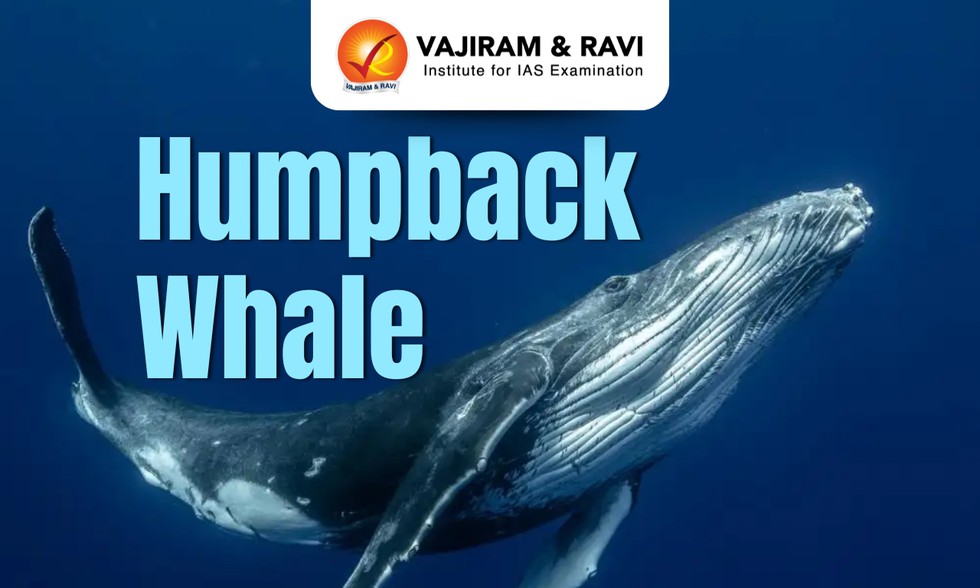
Recently, a stranded humpback whale was managed to swim free in Baltic Sea.
About Humpback Whale:
The Humpback whale (Megaptera novaeangliae) is a species of baleen whale.
It is a rorqual; a member of the family Balaenopteridae.
Migration: They undertake long migrations between polar feeding grounds in summer and tropical or subtropical breeding grounds in winter.
Appearance:
It has the distinctive hump on its back.
Its long pectoral fins inspired its scientific name, Megaptera, which means “big-winged”
Humpback females are larger than males.
Distribution: They inhabit all major oceans from sub-polar latitudes to the equator
Behavior: Humpbacks use a unique method of feeding called bubble netting, in which bubbles are exhaled as the whale swims in a spiral below a patch of water dense with food.
Diet: They filter their food through baleen plates. They strain krill, anchovies, cod, sardines, mackerel, capelin, and other schooling fish from the waters.
Lifespan & Reproduction: Humpback whales reach sexual maturity between the ages of 4 and 10 years. Females produce a single calf every 2 to 3 years on average.
Dear Student,
You have still not entered your mailing address. Please enter the address where all the study materials will be sent to you. (If applicable).