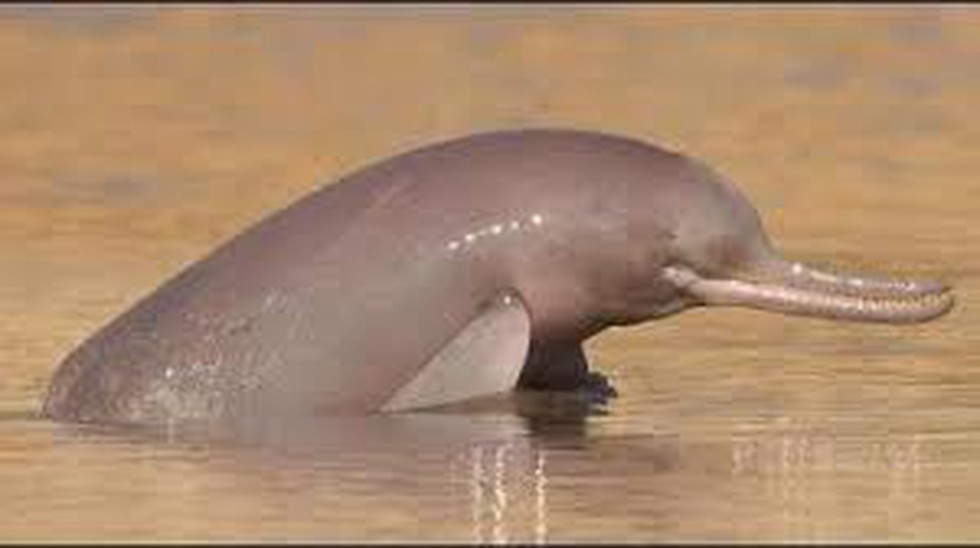
About Indus River Dolphin:
- The Indus River dolphin (Platanista minor) is one of the rarest mammals.
- Appearance:
- It has the long, pointed nose characteristic of all river dolphins.
- The teeth are visible in both the upper and lower jaws even when the mouth is closed.
- Distribution: It presently only occurs in the Indus River system, along with a remnant population in the Beas River.
- Features of Indus River Dolphin:
- It is functionally blind. It has extremely reduced eyes without lenses.
- Instead of vision, it relies entirely on echolocation to navigate, hunt and avoid obstacles in the highly turbid waters.
- It has a remarkable trait of swimming predominantly on its side.
- This allows it to use its long, sensitive snout to probe the riverbed for prey. Side-swimming is extremely rare among cetaceans and is a signature feature of this species.
- It lives largely solitary or in very small groups (typically mother-calf pairs).
- Diet: These are carnivores (piscivores). They feed on a variety of fish and crustaceans, including prawns, carp, catfish, and gobies.
- Threats: Water pollution, poaching, fragmentation of habitat due to barrages
- Conservation Status:
- IUCN Red List: Endangered
- Wildlife Protection Act 1972: Schedule I