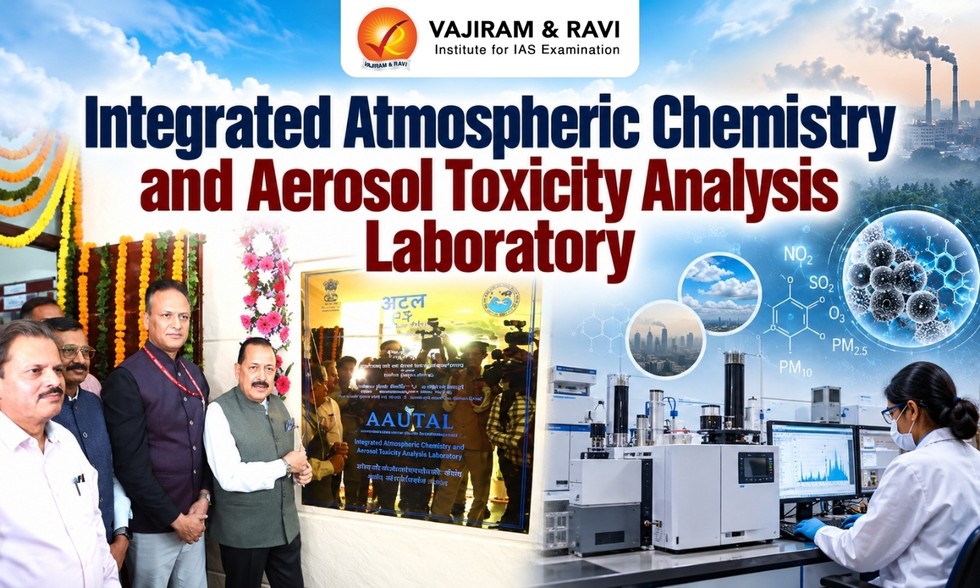
About Integrated Atmospheric Chemistry and Aerosol Toxicity Analysis Laboratory:
- It is a specialised facility aimed at identifying the sources, composition and potential health impacts of air pollution in Delhi-NCR.
- It is established under Mission Mausam.
- It is designed to provide real-time information on pollution sources and their relative contributions, helping authorities move beyond Air Quality Index (AQI) readings to develop targeted pollution-control measures.
- Features of AATAL:
- It is equipped to analyse atmospheric gases, aerosols, fine particulate matter (PM2.5), metals, toxic elements and other pollutants.
- Its capabilities will help distinguish between pollution sources, including vehicular emissions, industrial activity, biomass and crop-residue burning, construction and road dust, and pollution transported from neighbouring regions.
- It will also examine the chemical characteristics of pollutants to improve scientific understanding of their potential toxicity and implications for public health.
- AATAL has been integrated with IITM’s AIRWISE, or Air Quality Warning and Integrated Decision Support System for Emissions, which combines air-quality observations, forecasts and source-apportionment information.
- AIRWISE provides forecasts at a spatial resolution of 400 metres for the next 72 hours, enabling authorities to assess how pollution levels and their likely sources may vary across different parts of Delhi.
- The system is intended to help identify locations likely to experience deteriorating air quality and provide advance information for preventive action.
- It would help the Commission for Air Quality Management (CAQM) and other agencies plan targeted interventions and assess their effectiveness.