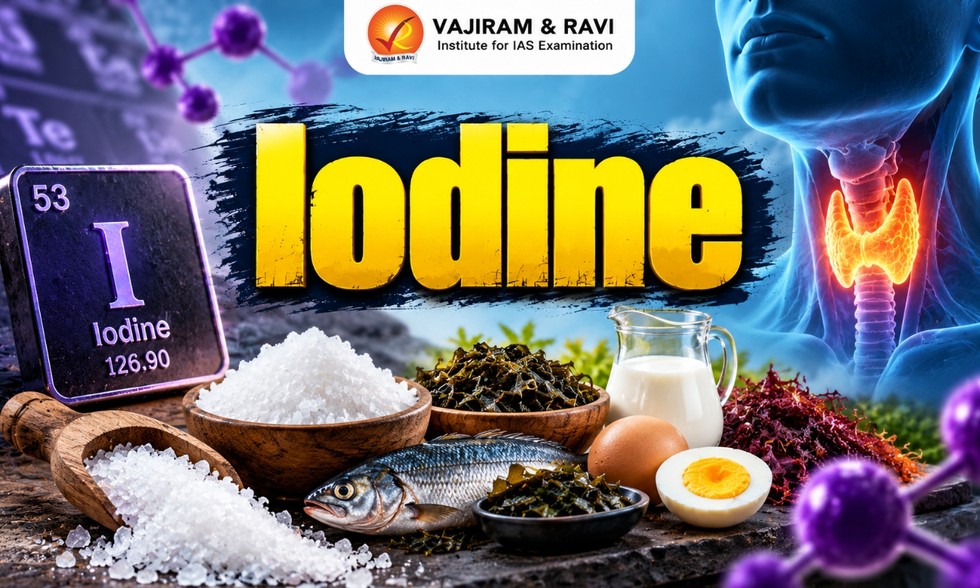
Recently, on the occasion of World Iodine Deficiency Day the Ministry of Health and Family Welfare, has advised citizens to choose iodised salt and use it in moderation for better health.
About Iodine:
It is a chemical element and a member of the halogen elements, belonging to Group 17 (Group VIIa) of the periodic table.
Properties:
It is a nonmetallic, nearly black solid at room temperature with a glittering, crystalline appearance.
The molecular lattice of iodine contains discrete diatomic molecules, which are also present when iodine is molten or in a gaseous state.
Iodine is a bluish-black, lustrous solid. It volatilises at ambient temperatures into a blue-violet gas.
It has ability to form stable compounds with both metals and nonmetals.
Example: For instance, iodine reacts with alkali metals to produce iodides.
Occurrence:
Iodine is a naturally occurring element that is essential for the good health of people and animals.
It is found in small amounts in sea water and in certain rocks and sediments.
Uses:
Iodine is an essential component of the thyroid hormones thyroxine (T4) and triiodothyronine (T3).
Thyroid hormones regulate many important biochemical reactions, including protein synthesis and enzymatic activity, and are critical determinants of metabolic activity.
It is widely used in medical antiseptics, iodized salt for nutritional supplementation, photographic chemicals, and as a catalyst in various industrial processes.
It is used in nuclear medicine for diagnostic imaging and treatment procedures, particularly due to its natural affinity for the thyroid gland.
Dear Student,
You have still not entered your mailing address. Please enter the address where all the study materials will be sent to you. (If applicable).