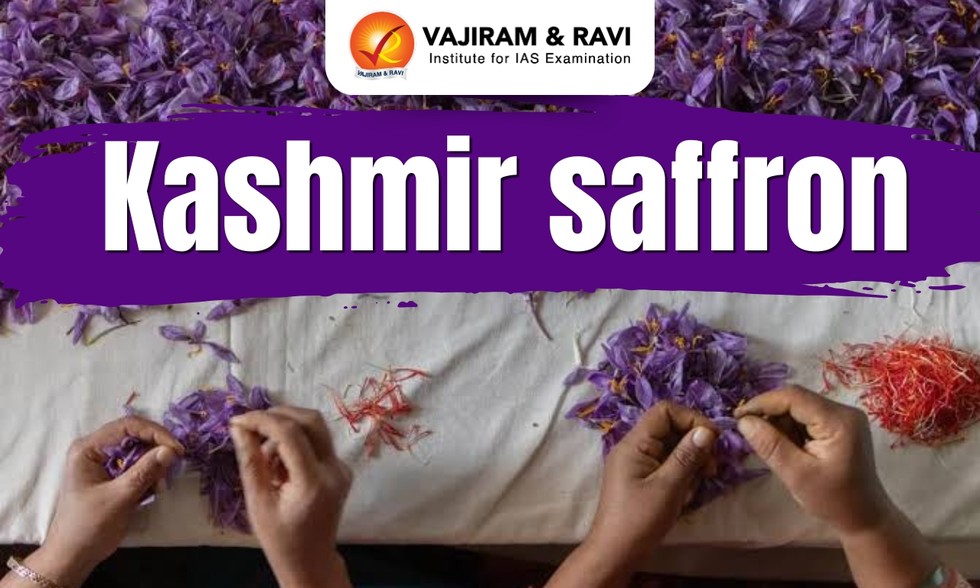
The ongoing crisis in West Asia, coupled with a sharp decline in saffron output from Iran has resulted in the demand for Kashmiri saffron.
About Kashmir Saffron:
It is often called “red gold” for its distinctive aroma, flavour, and natural colouring properties.
It is primarily cultivated in Pampore and nearby regions of South Kashmir.
It has secured Geographical Indication (GI) tagin 2020.
Characteristics: The saffron plant produces purple flowers with bright orange to red stigmas, which are carefully dried to obtain the highly valued spice.
The saffron available in Kashmir is of three types: Lachha Saffron, Mongra Saffron and Guchhi Saffron
Required Climatic conditions:
It grows at an elevation of 1,500-2,000 m above mean sea level.
Climate: Saffron cultivation requires explicit climatic conditions with temperatures ranging from not more than 35 degree Celsius or 40 degree Celsius in the summer to about -15 degree Celsius or -20 degree Celsius in the winter.
It can be grown in dry, moderate and continental climate types.
Soil: It thrives on loamy, sandy, and calcareous soils.
Saffron grows best on acidic soil. It thrives well when the soil pH is 5.5 to 8.5.
In India around 90% of saffron production comes from Kashmir, where it has been grown for centuries.
Dear Student,
You have still not entered your mailing address. Please enter the address where all the study materials will be sent to you. (If applicable).