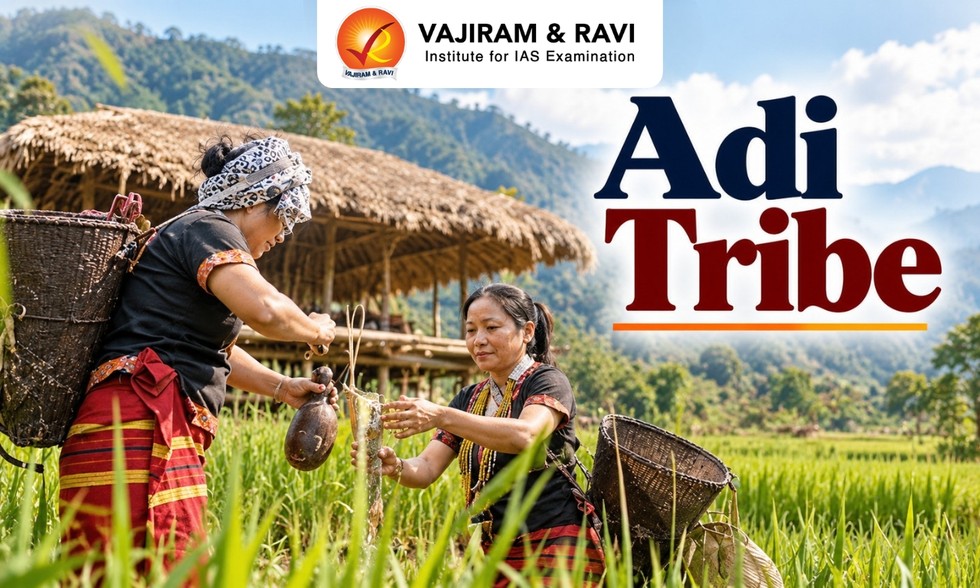
About Key Facts about Adi Tribe:
- The Adi are one of the major indigenous tribal communities of Arunachal Pradesh.
- The name Adi means 'hill man'.
- They primarily reside in the lower part of the Lower Dibang Valley district, particularly in Roing and Dambuk areas.
- They are believed to have come from southern China in the 16th century.
- The Adis have two main divisions (the Bogums and Bomis), and under each there are a number of sub-tribes.
- The Minyonfs, Karkos, Shimongs, Bomdo, Janbos, Panggis, Palibos, Bogums, Padams, Milangs, and so on form one group, while the Gallong and seven other groups constitute another group of Adis.
- Racially the Adi tribes belong to the Mongoloid stock with well-built features.
- Language:
- The language spoken by Adis is called Adi, which is distantly related to the Chinese and Tibetan languages.
- It is spoken with minor variations among all the Adi tribes.
- Society:
- The father is considered the head of the family.
- The Adis by nature are democratic and have a nicely organised village council, better known as "Kebang".
- The Adi tribe is organized into several clans.
- This tribe is determinant of the social relationship and kinship.
- Family is the lowest unit of social organization and nuclear in character.
- Monogamy is the common form of marriage, though polygamy is socially restricted.
- Adi houses are constructed using wood and bamboo, featuring raised floors called "chang," made from split bamboo over beams supported by wooden or bamboo stilts.
- Occupation:
- Agriculture forms the backbone of Adi livelihoods, with both wet rice cultivation and shifting cultivation being practiced.
- In addition to agriculture, fishing and hunting play significant roles in supplementing food sources.
- Handicrafts of the Adi tribes are best seen in their cane and bamboo works like baskets, trays, haversacks, mats, and hats and headgears with artistic designs that are produced for domestic use.
- Women belonging to the Adi tribal group are expert weavers.
- Religion:
- The majority of Adi traditionally followed the animist Donyi-Polo religion, which involves the worship of the sun, the moon, and the ancestral god, the shaman, called Miri, can be a female.
- But, in modern times, many of the Adis have moved away from Donyi-Polo, especially the Adi youths, and have converted to Christianity.
- Festivals:
- Their main festivals are Solung, Etor, and Aaran.
- Popular dances are the Ponung, Delong, Yakjong, and Tapu, which is in-fact, a war dance.
- Dances performed are in-group lead by a main singer (Miri).