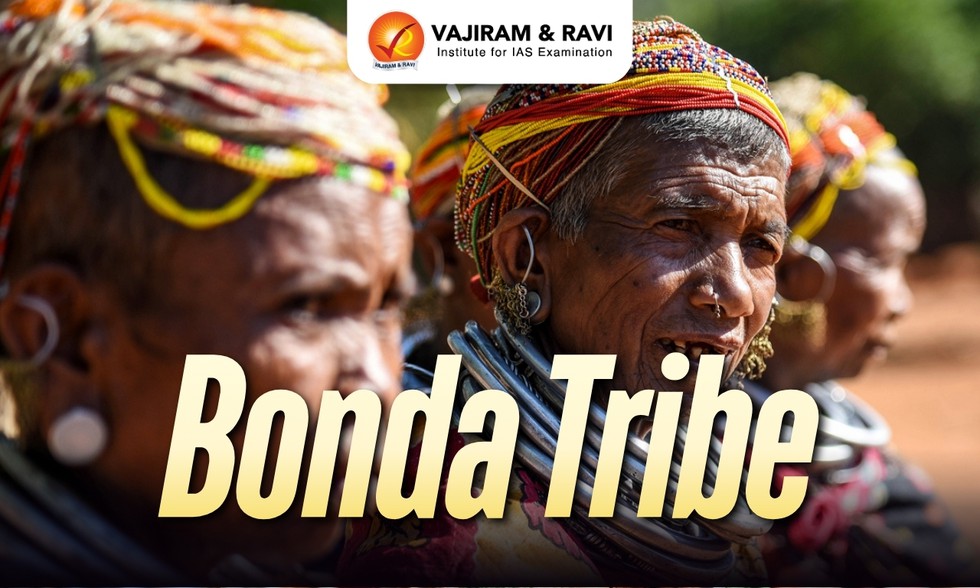
Members of the Bonda community in Odisha’s Malkangiri district are set to transition from fragile thatched huts to permanent pucca houses under the Union government’s PM-Janman scheme.
About Bonda Tribe
The Bondas are exclusively found in the Malkangiri district of Odisha and are mostly concentrated in the Khairaput block of the district.
It is a particularly vulnerable tribal group (PVTG) and one of the oldest tribes of India.
They are also known as Bondo, Bondas, Bonda Paraja, and Bhonda.
They are considered one of the first settlers in India, with their lineage tracing back to the Austroasiatic race.
Language:
The Bonda people speak Remo, a language belonging to the Austroasiatic linguistic family.
This is distinct from mainstream Indian languages, making it difficult for outsiders to communicate with them.
The Bondas are divided into two groups because of their distinct cultural practices:
The Lower Bondas, who live in the Malkangiri district in south Odisha and border Andhra Pradesh and Chhattisgarh, and
The Upper Bondas, who live in the remote villages of the district’s hilly terrain.
The social organization is hierarchical, with a council of elders that makes important decisions for the community.
The Bonda people live in small villages organized around communal spaces where ceremonies and meetings take place.
Bonda architecture is characterized by mud and thatched-roof houses, designed to adapt to the mountainous environment and climatic conditions.
The art of the Bonda is expressed mainly through the creation of decorative tools and utensils, in addition to their colorful fabrics and jewelry.
They have an interesting dressing style – ladies are semiclad and wear different sorts of rings and pieces of jewelry around their bodies, while the men wear deadly attires.
Religion: The religion of the Bonda people is animistic, focused on the worship of nature and ancestral spirits.
Occupation:
Their economy is based mainly on subsistence agriculture, hunting, and gathering.
They are known for their unique practice of shifting cultivation called dangar chas.
They grow crops like paddy, millet, pulses, and vegetables.
Only 6% of Bondas are literate. The life expectancy of the tribe is so low they are nearly extinct.
Dear Student,
You have still not entered your mailing address. Please enter the address where all the study materials will be sent to you. (If applicable).