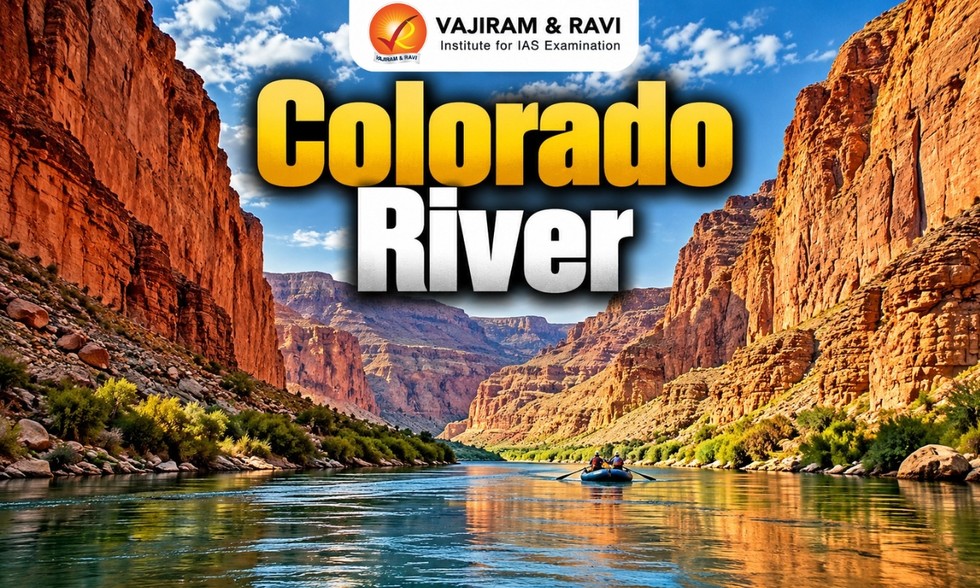
During an intense drought from 2020 to 2022, the Upper Colorado River Basin lost far more groundwater than the Lower Basin did, despite having much higher natural recharge, a recent study has found.
About Colorado River:
It is a major river of North America.
The name "Colorado" comes from Spanish and means "colored reddish." This is because the river used to carry a lot of silt, which made its water look red.
Origin:
It rises in the Rocky Mountains of Colorado, United States.
Colorado forms an international boundary between Arizona (US) and Mexico and drains North America’s vast semi-arid and arid area.
The intensive development along the river has earned it the name “Lifeline of the Southwest.”
Lakes: It forms several major reservoirs, including Lake Mead and Lake Powell.
Tributaries:
It has several tributaries, including Green, Gunnison, San Juan, Dolores, Little Colorado, Gila, and Virgin Rivers.
The Green River is the longest river feeding into the Colorado River.
One of the Colorado River’s most famous features is the Grand Canyon, which it carved over millions of years.
Grand Canyon landscape is a UNESCO World Heritage Site and a major tourist attraction.
The river also flows through Canyonlands National Park and Horseshoe Bend in Arizona.
Major Dams:
Hoover Dam is an arched dam.
It is one of the world’s highest dams and one of the largest concrete dams in volume.
It holds back Lake Mead, one of the world’s greatest reservoirs.
Parker Dam: It is the deepest dam on earth.
Glen Canyon Dam: It created one of the biggest reservoirs in the United States, known as Lake Powell.
Dear Student,
You have still not entered your mailing address. Please enter the address where all the study materials will be sent to you. (If applicable).